


EN
“Ready in 30 minutes” to “6,500 kilometer rush”, watch full freight traffic, reveal the secret of three wheels of electricity spanning Fengxian County
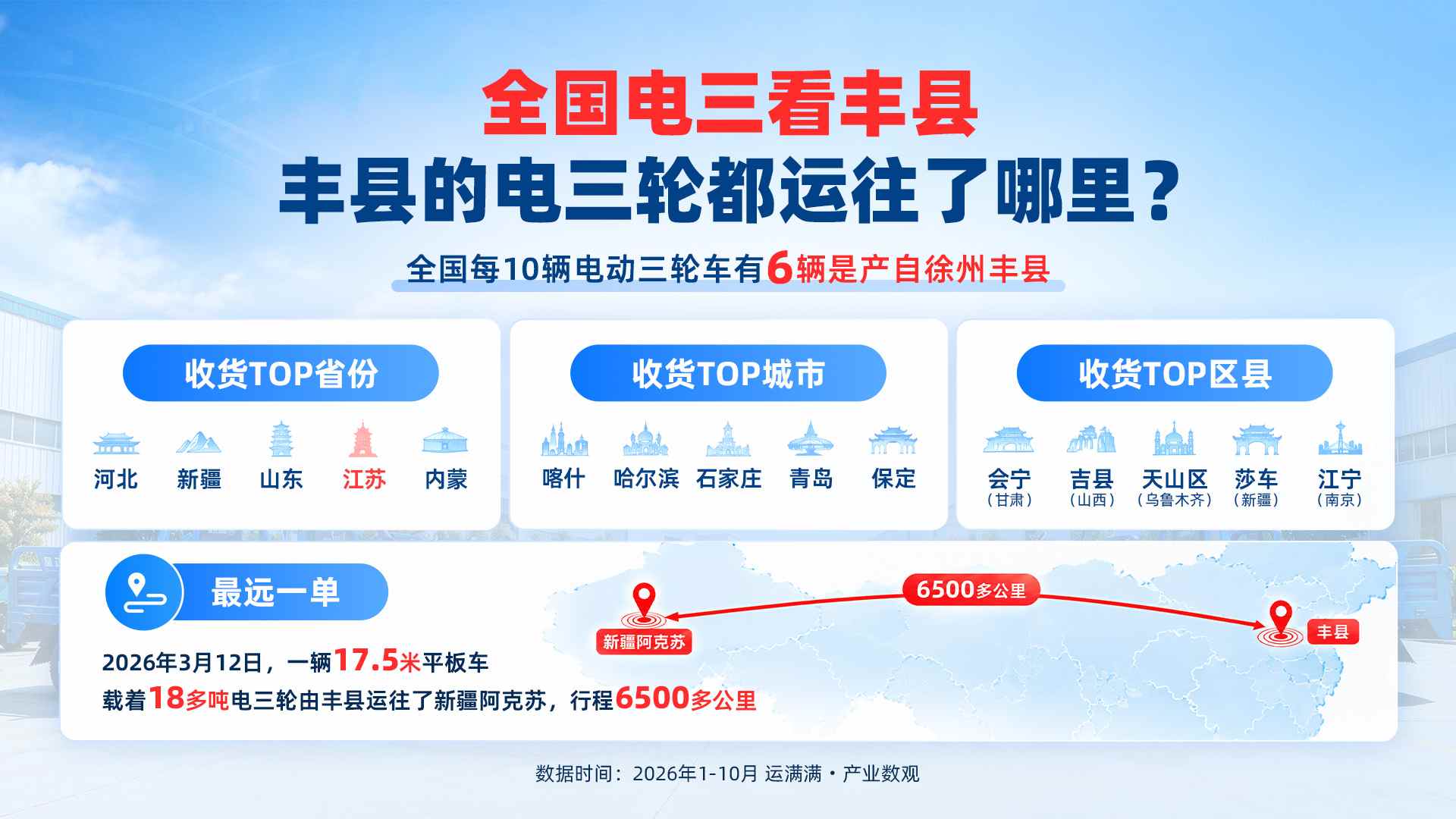
On March 12, 2026, a 17.5-meter flatbed truck departed from Fengxian County, Jiangsu, carrying an 18-ton electric tricycle. The destination was Aksu, Xinjiang. Climbing through the Qinling Mountains, crossing the Hexi Corridor, and crossing Tianshan Mountain, it sped over 6,500 kilometers. This was the furthest trip the Fengxian Electric Tricycle took in 2026 on a platform full of traffic.
In Fengxian, this kind of departure scene happens every day. According to public data, for every 10 electric tricycles in the country, 6 are made in Fengxian County; for every 10 electric three-wheeled motors in the country, at least 9 are from Fengxian County. In November 2026, Yunmanman's “Upstream · Seeing the Source” series of industrial traceability activities entered Fengxian County and released a distribution map of the electric three-wheel industry based on the platform's freight data from January to October 2026 — not starting from production and output value, but following the “trampoline” of a car to see where it came from, where it went, and whose days it saved.
“Fault No. 1” on the delivery list and delivery locations scattered all over the country
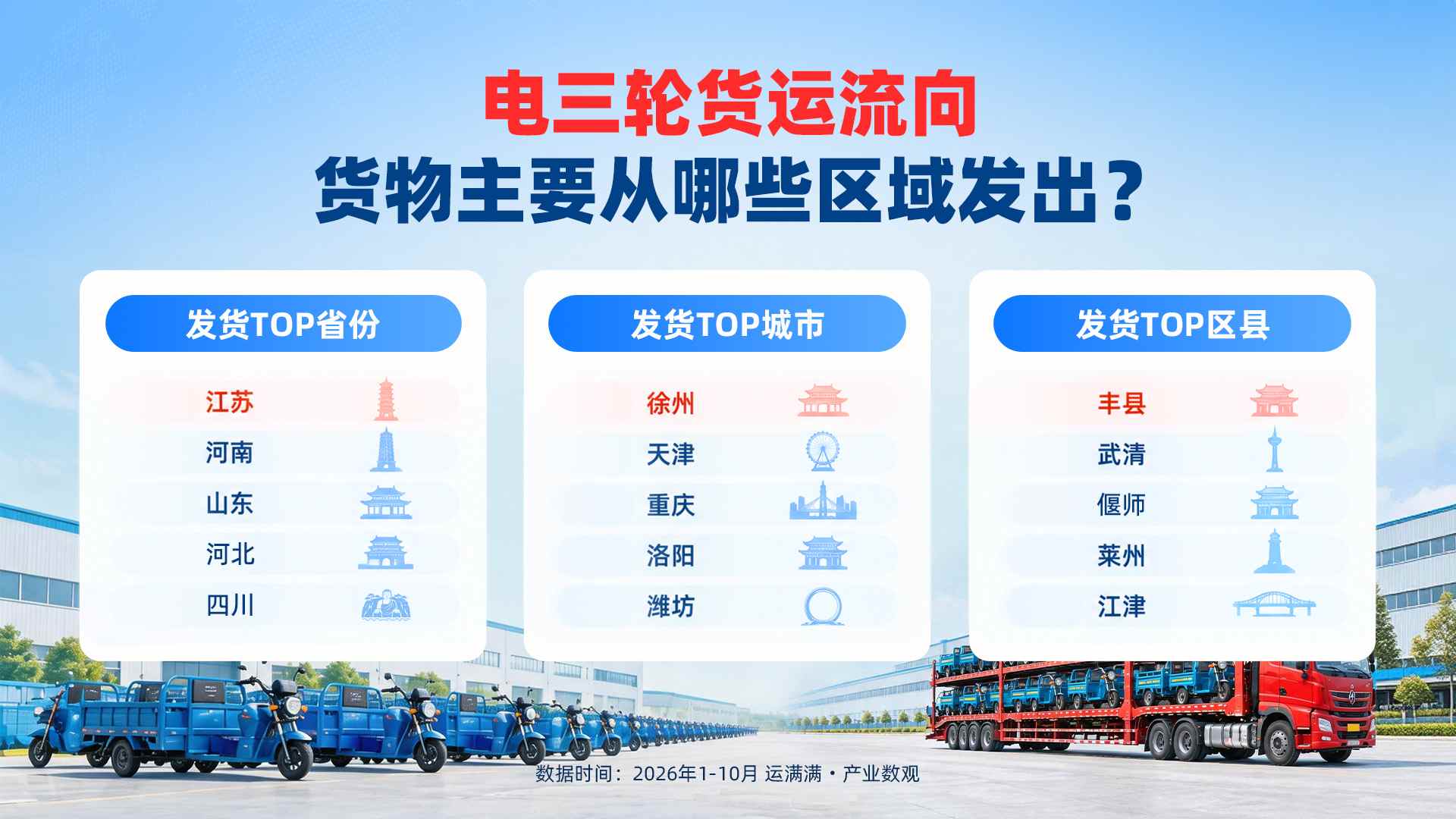
From January to October 2026, the top five provinces with three rounds of electricity shipments on the Yundan platform were Jiangsu, Henan, Shandong, Hebei, and Sichuan; the top five cities were Xuzhou, Tianjin, Chongqing, Luoyang, and Weifang; the top five districts and counties were Fengxian, Wuqing, Yanshi, Laizhou, and Jiangjin. Fengxian County in Jiangsu is at the top of the list of districts and counties. Together with Wuqing in Tianjin, Yanshi in Luoyang, Laizhou in Yantai, and Jiangjin in Chongqing, it forms the core supplier of electric three-wheeled vehicles in the country.
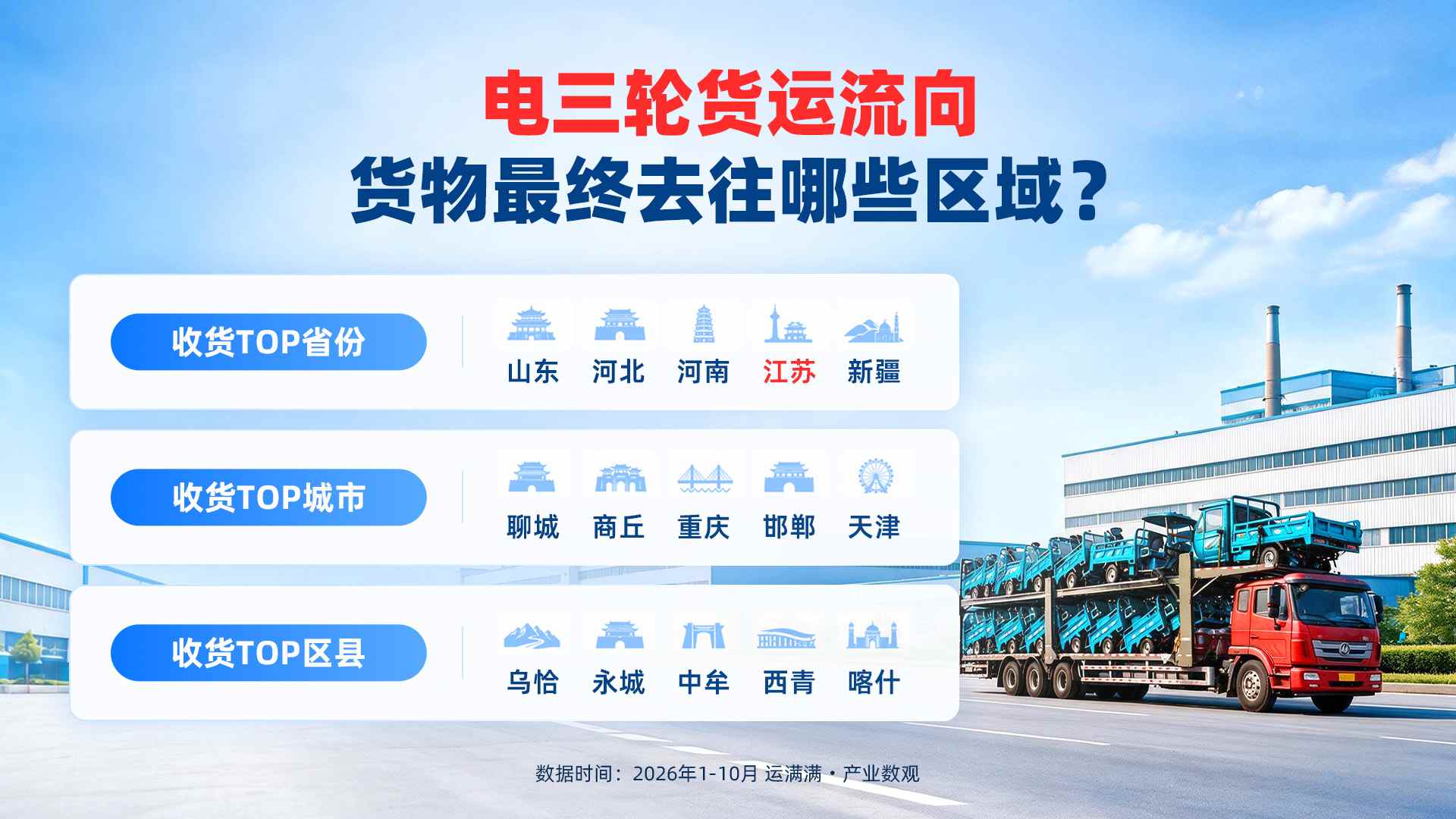
The receiving end, showed a clear depth of decline. The top 5 provinces to receive electric three-wheeled vehicles are Shandong, Hebei, Henan, Jiangsu, and Xinjiang; the top five cities are Liaocheng, Shangqiu, Chongqing, Handan, and Tianjin; the top five districts and counties are Wuqia, Yongcheng, Zhongmou, Xiqing, and Kashi. Wucha is at the westernmost tip of Xinjiang, Kashi is on the edge of the Tarim Basin, Yongcheng is in the East Yudong Plain, and Zhongmou is between Zhengzhou and Kaifeng. These place names appeared on a freight list, pointing to the fact that electric tricycles are not fashionable consumer goods in cities, but rather the most practical means of production in counties, towns, and villages. Transporting goods, delivering express deliveries, picking up children, and working on the ground, a car is a family's livelihood.
Focusing on Fengxian County itself, the top 5 provinces that receive three-wheeled electricity are Hebei, Xinjiang, Shandong, Jiangsu, and Inner Mongolia; the top five cities are Kashi, Harbin, Shijiazhuang, Qingdao, and Baoding; the top five districts and counties are Huining (Gansu), Ji County (Shanxi), Tianshan (Xinjiang), and Jiangning (Jiangsu). From the foot of the Pamir Plateau to the edge of the Songhua River, from the Loess Plateau to the Yangtze River, the footprints of Fengxian Electric Tricycle spans east, west, north and south.
What is more noteworthy is the distance of transportation. The average distance of electric three-wheelers in Fengxian County is 1,100 kilometers, which is significantly higher than the national average of 700 kilometers. The additional 400 kilometers is the difference between the “source production area” and the “ordinary market.”
More than a complete vehicle: motors, rear axles, and sheet metal parts support the “core parts supply base”
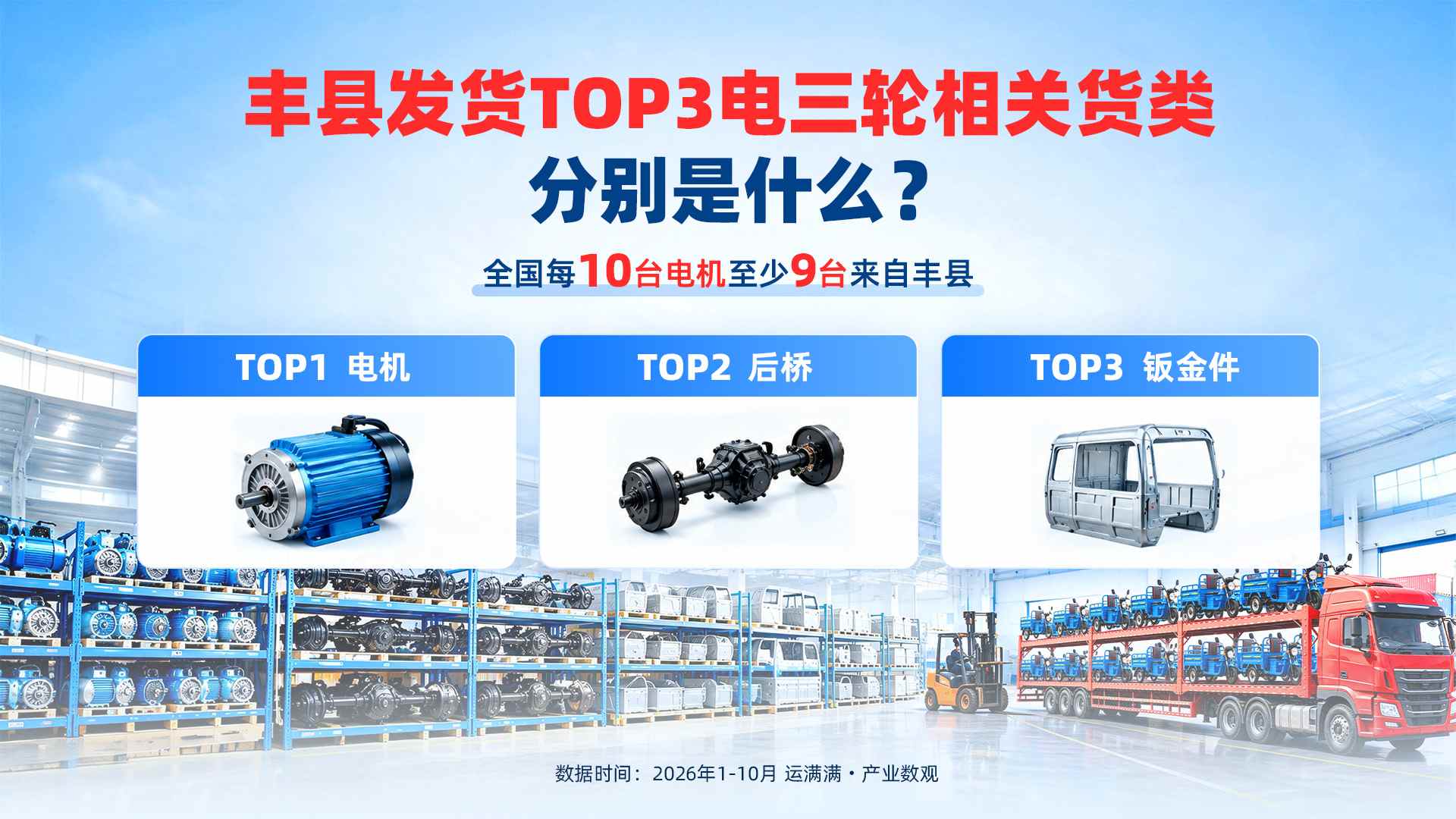
Among the electric tricycle-related goods shipped from Fengxian County, the top three are motors, rear axles, and sheet metal parts. These three types of goods correspond exactly to the power system, transmission system and body structure of electric three-wheeled vehicles. Among them, at least 9 out of every 10 electric three-wheel motors in the country come from Fengxian County — Fengxian is not only a vehicle assembly base, but also a supply source for core components.
In the workshop of a motor company in Fengxian County, a motor goes offline every 12 seconds, and the processing accuracy is controlled within 0.04 mm, which is thinner than a strand of hair. End users won't know who owns the motor; it's hidden in the car body, and no one will lift the lid to take a look at the nameplate. However, it is these “invisible” parts that support Fengxian Electric Power Company's “visible” position in the national industrial chain.
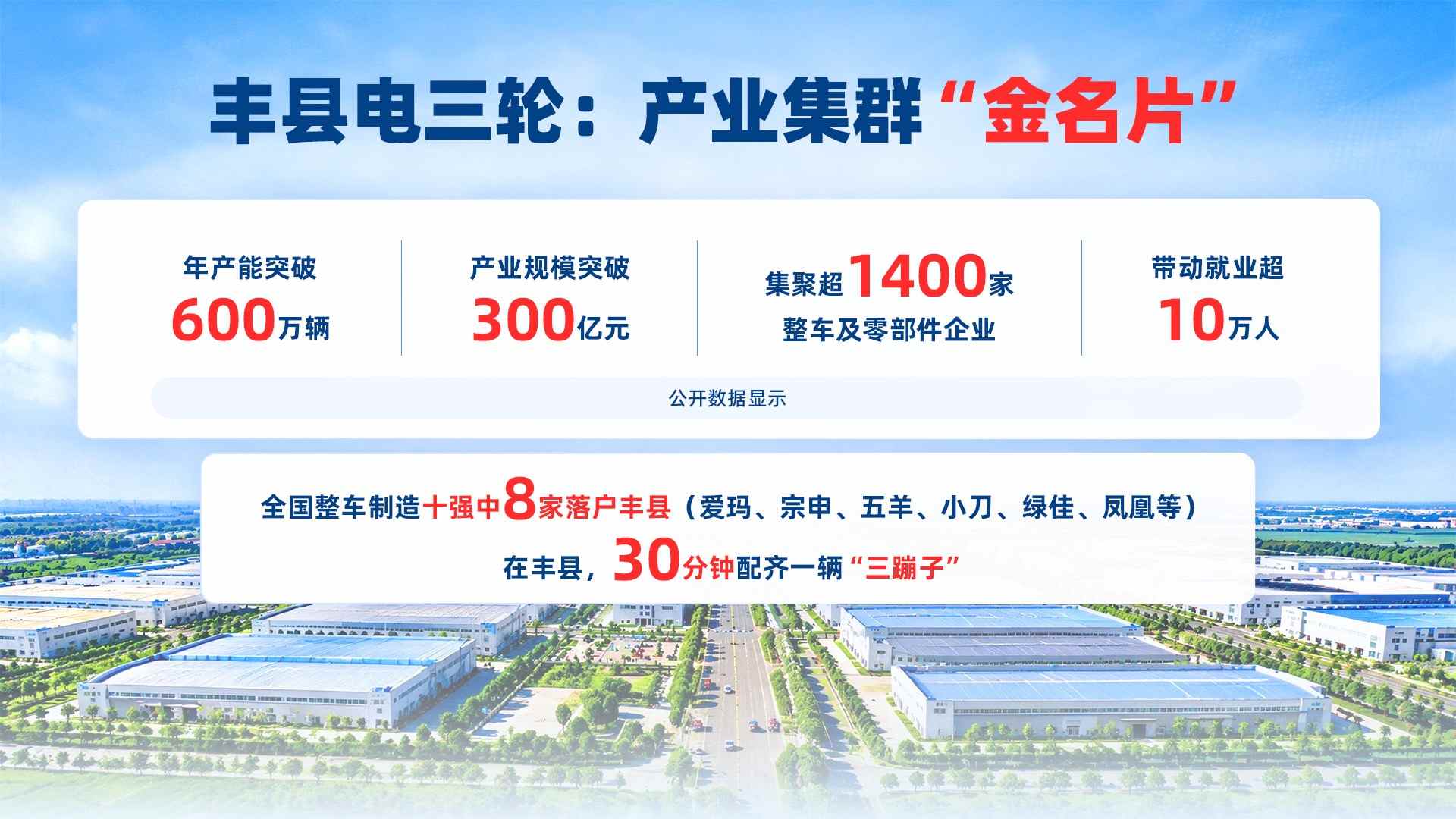
According to public data, Fengxian has an annual production capacity of electric wheels exceeding 6 million units, and the scale of the industry has exceeded 30 billion yuan; it has gathered more than 1,400 vehicle and parts companies, driving employment for more than 100,000 people; 8 of the top ten vehicle manufacturers in the country have settled in Fengxian County, including brands such as Emma, Zongshen, Wuyang, Kodao, Lujia, and Phoenix. In Fengxian County, there is a saying “30 minutes, equipped with three trampolines” — the motor, rear axle, and sheet metal parts can be completed within the county area, and the whole vehicle can be loaded and shipped directly after it goes offline. Industrial density determines logistics efficiency, which in turn supports industrial expansion.
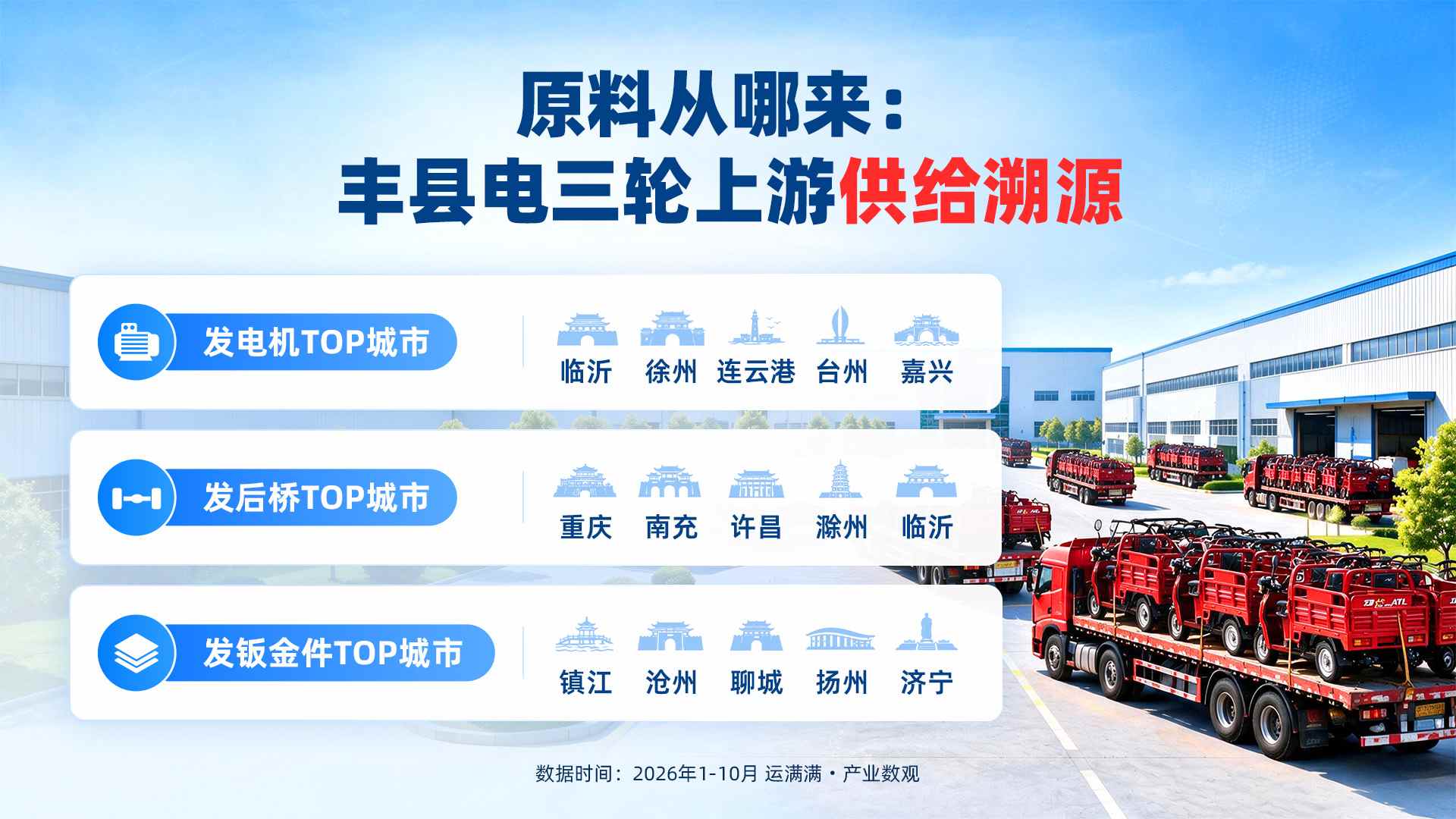
Upstream supply is also characterized by networking. The top cities that send motors to Feng County are Linyi, Xuzhou, Lianyungang, Taizhou, and Jiaxing; the top cities that send out Houqiao are Chongqing, Nanchong, Xuchang, Chuzhou, and Linyi; and the top cities that send sheet metal parts are Zhenjiang, Cangzhou, Liaocheng, Yangzhou, and Jining. The supply organization covers the Yangtze River Delta, the Central Plains, Chengdu and Chongqing, and North China, with both surrounding collaborative supply and long-distance transportation across provinces.
Logistics password: multiple models coexist and travel at home and abroad
In terms of transport models, the top 5 electric tricycles in Fengxian County are 4.2 meter high fence, 4.2 meter high rail, 6.8 meter high fence, 3.8 meter high rail, and 9.6 meter high fence, which is generally similar to the national level. From 3.8 meters to 9.6 meters, from high rails to flatbeds, the coexistence of multiple models shows that the demand for electric three-wheeled transportation is not a single model: there is not only flexible small-batch transportation for county dealers, but also capacity requirements for bulk goods and long-distance routes.
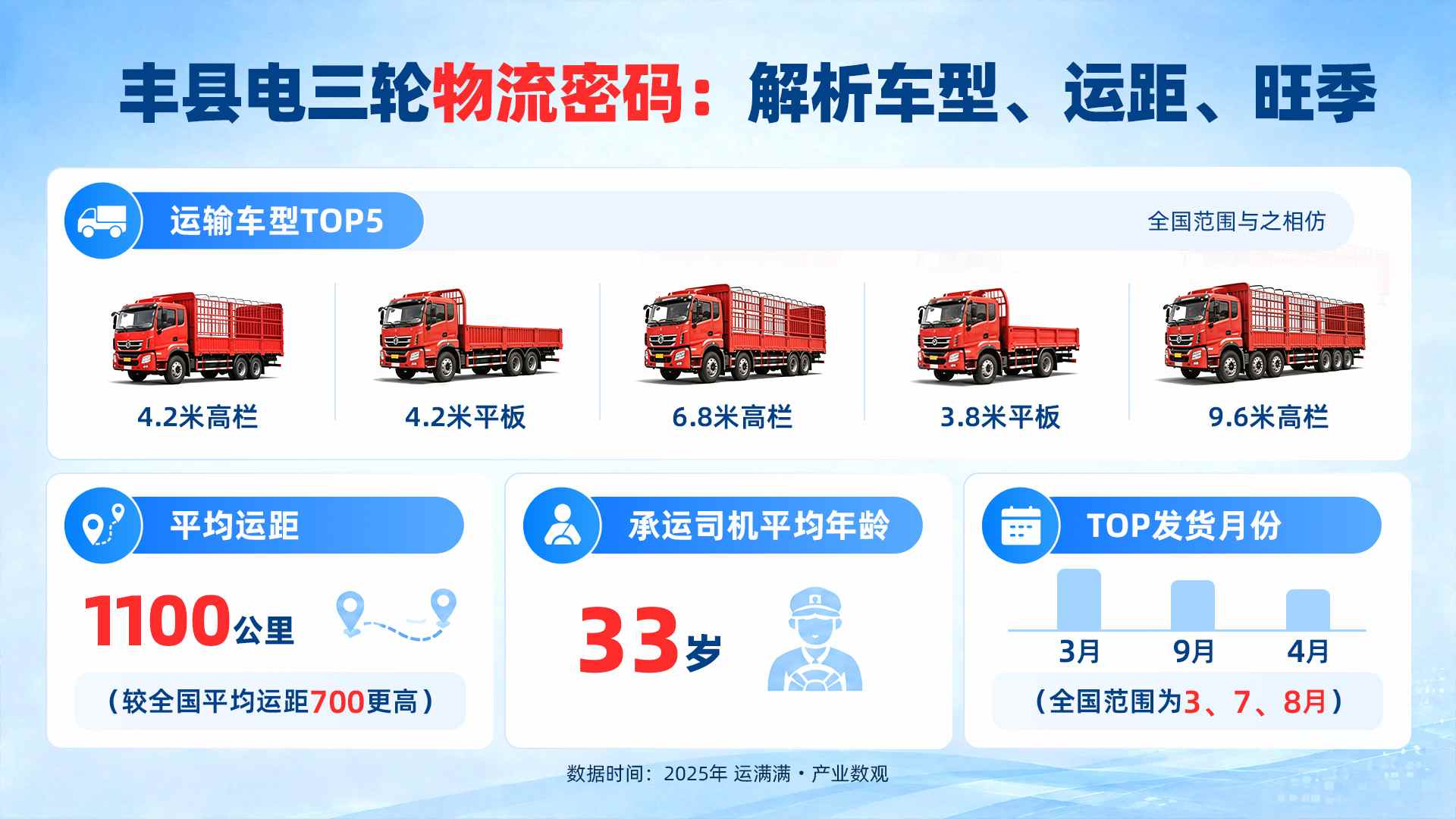
Peak shipments in Fengxian County were concentrated in March, September, and April, while nationwide peaks were in March, July, and August. This difference in pace reflects the Fengxian industrial cluster's own production and shipping rhythm from the freight side — the start of school in spring, preparation for spring farming, and the peak season in autumn all left traces on this curve.
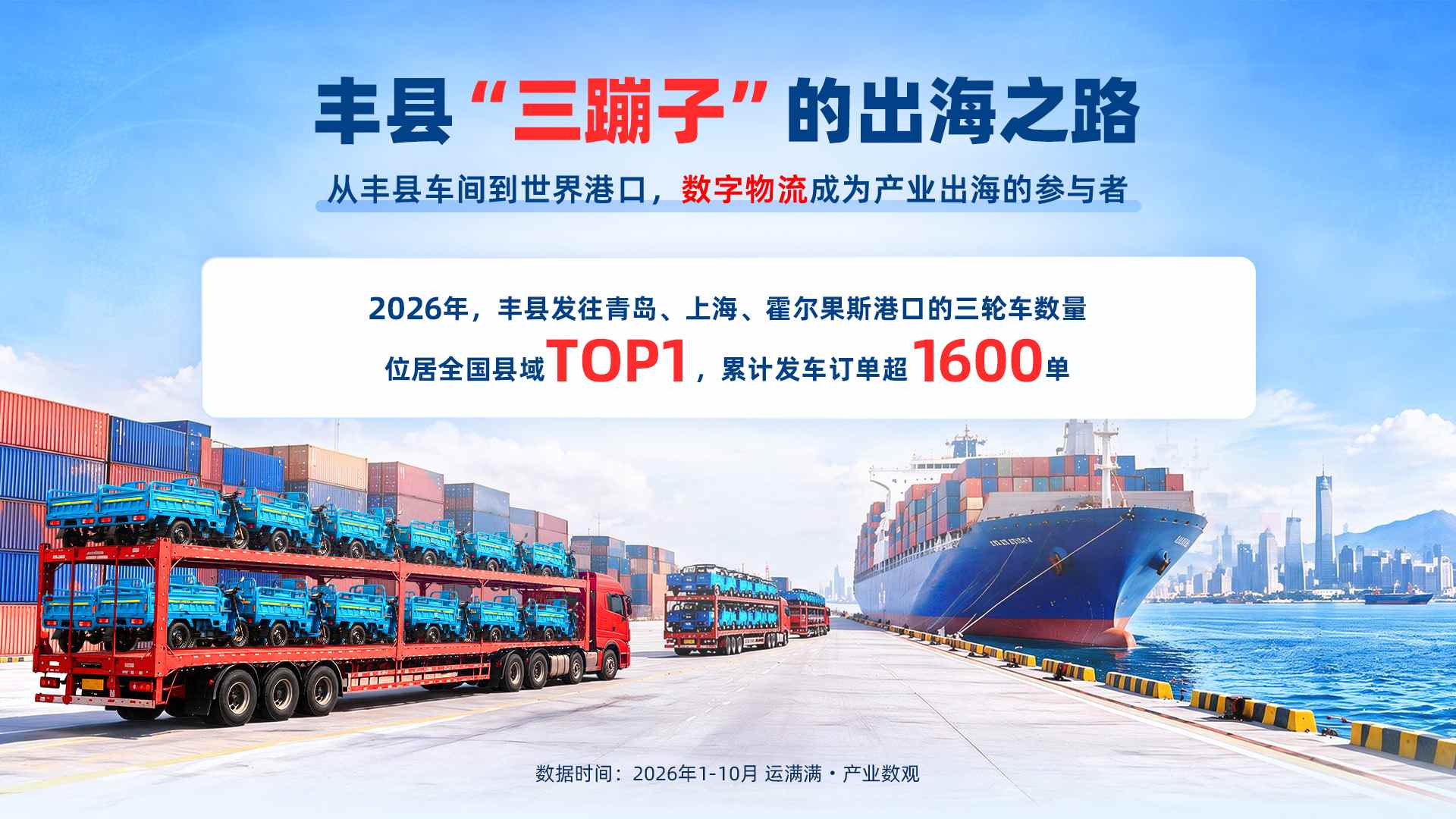
In terms of going out to sea, the number of tricycles sent from Fengxian to Qingdao, Shanghai, and Khorgos ports in 2026 ranked in the top 1 county in the country, with a total number of tickets exceeding 1,600. According to statistics from the Fengxian Bureau of Commerce, from January to May 2026, Fengxian's self-operated electric tricycles increased 99.3% year-on-year. The total cumulative export volume exceeded 3 billion yuan, and the products were sold to more than 80 countries and regions around the world. From the Fengxian workshop to the world port, digital logistics is becoming the new artery for the county's industry to go overseas.
When it comes to going out to sea, people in Fengxian County went through a process from “not expecting it” to “not being able to stop.” An ordinary electric three-wheeled vehicle sells for about 2,000 to 5,000 yuan in the domestic market, and can be sold for 3,000 to 6,000 US dollars in the European and American markets. The profit from export sales is about four times that of domestic sales.
The townspeople in Changdian Town, Fengxian County felt the changes brought about by industrial density the most. This town used to be a typical agricultural town. Today, over 80% of the town's labor force is involved in the electricity industry and supporting industries. From ordinary workers to technical backbone, from individual merchants to business owners, they have a stable income at their doorstep. One “trampoline” carried not only goods, but also the livelihoods of 100,000 people.
Upstream, see the source: Using freight data to record industry trends
Fengxian County is an important stop to trace the origin of the “upstream and see the source” industry of Yunman 2026. This year, we visited various industrial sources: in May, we visited Xuyi to observe how to “grab fresh” crayfish from Tangkou. Platform data showed that Xuyi crayfish shipments increased by more than 80% year on year; in June, it went to Yantai Fushan and released “Cherry Industry Digital View”. 88.5% of Yantai cherries were shipped outside the province, with an average transportation distance of 1004 kilometers. For every 10 boxes of cherries distributed in the country, 1 box came from Yantai; in September, it went to Gongyi and released “Aluminum in Freight Data”, which ranked Gongyi as the first shipping area in the country for aluminum foil sheets. The longest order is more than 2,700 kilometers and directly reaches Linzhi, Tibet.
From lobster ponds to cherry orchards, from aluminum workshops to three power lines, what Yunmanman has done is to walk into one industry source after another, use real freight data to see how the industry flows, and use digital capacity matching to make good products go further.
Equipped with a “trampoline” in 30 minutes, 6,500 kilometers to Aksu, Xinjiang, and more than 1,600 tickets to the port of departure — these three numbers correspond to the supporting density, market depth, and degree of openness of the three electricity industries in Fengxian County, respectively. A “three-trampoline” journey is not only a microcosm of China's county manufacturing embedded in a unified national market, but also a footnote on digital logistics serving the real economy and connecting industrial nodes.
About Yunmanman “Upstream · See the Source”
“Upstream · Seeing the Source” is an industrial traceability series of activities launched by Yunman in 2026. It aims to enter the origin of representative industrial clusters in the country, present the industrial circulation context based on the platform's real freight data, and use digital transportation power to serve manufacturing enterprises and county industrial belts. Previously, it has successively entered industrial sources such as Xuyi crayfish, Yantai Big Cherry, and the Gongyi aluminum industry.
Data description: The freight data in this article is all from the full shipping platform. The statistical period is from January to October 2026 (outbound and export data is from January to May 2026); public data such as industry size, number of enterprises, and export value refer to public reports and government releases related to the Fengxian Electric Power Industry Cluster.