


EN
Post reports sales below analyst estimates in Q3 CY2026 earnings
Packaged foods company Post (NYSE:POST) fell short of the market’s revenue expectations in calendar Q3 2026 [fiscal Q4 2026], with revenue falling 13% year on year to $1.95 billion. Its non-GAAP profit of $1.84 per share was 3.8% above analysts’ consensus estimates.
For more on Post, read the full research report for free.
Post Q3 CY2026 highlights:
- Revenue $1.95 billion vs S&P analyst consensus of $2.00 billion (13% year-on-year decline, 2.2% miss)
- Adjusted EPS $1.84 vs S&P analyst consensus of $1.77 (3.8% beat)
- Adjusted EBITDA $378.4 million vs analysts’ consensus estimates of $374.5 million (19.4% margin, 1.1% beat)
- EBITDA guidance $1.48 billion at the midpoint for fiscal 2027, in line with analysts’ consensus estimates
- Operating margin 10.5%, up from 7.5% in the same quarter last year
- Free cash flow margin 8.3%, up from 6.7% in the same quarter last year
- Market capitalization $3.55 billion
Revenue growth
Reviewing a company’s long-term revenue performance reveals insights into its quality. Any business can have short-term success, but a top-tier one grows for years.
With $8.12 billion in revenue over the past 12 months, Post is one of the larger consumer staples companies and benefits from a well-known brand that influences purchasing decisions. However, its scale is a double-edged sword because there are only a finite number of major retail partners, placing a ceiling on its growth. To accelerate revenue growth, Post likely needs to optimize its pricing or focus on new products and international expansion.
Post’s 5.1% annualized revenue growth over the last three years was tepid. This shows it failed to generate significant demand.
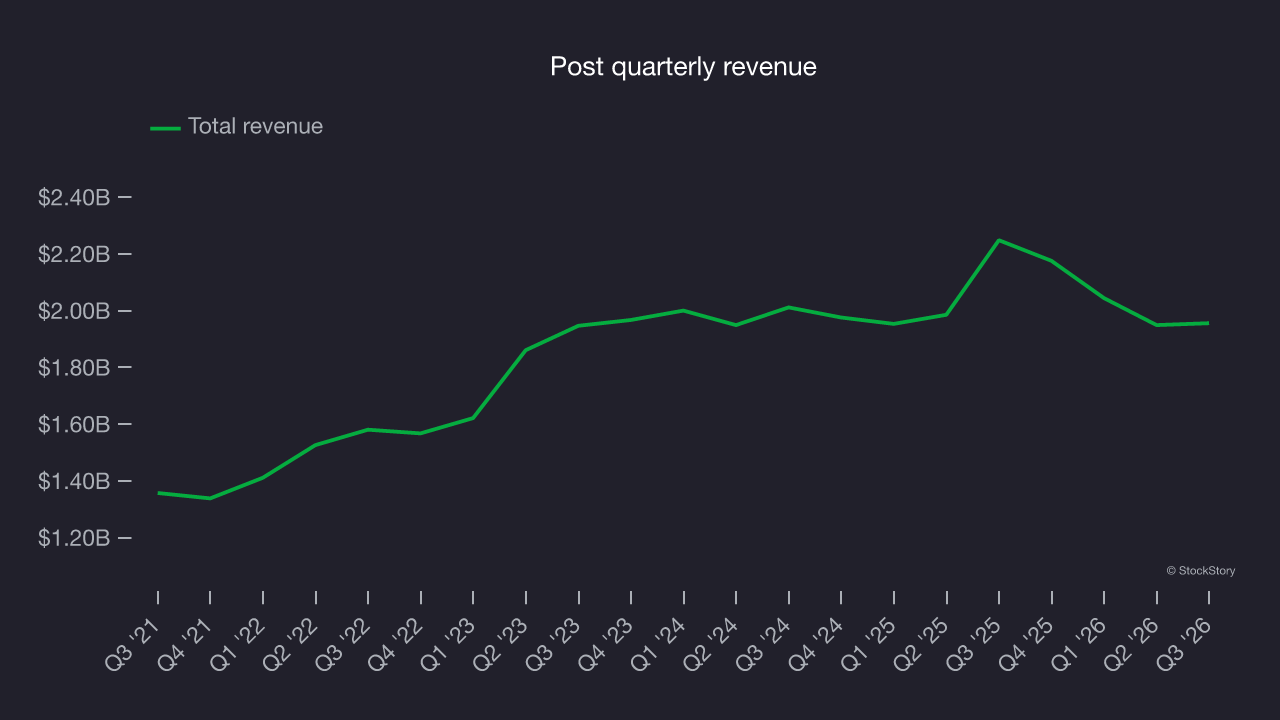
This quarter, Post missed Wall Street’s consensus estimates and reported an uninspiring 13% year-on-year revenue decline, generating $1.95 billion in revenue.
Looking ahead, sell-side analysts expect revenue to decline by 2.8% over the next 12 months, according to S&P, a deceleration versus the last three years. This projection is underwhelming and indicates its products will see some demand headwinds.
Free cash flow
Free cash flow isn’t a prominently featured metric in company financials and earnings releases, but it’s telling because it accounts for all operating and capital expenses, making it tough to manipulate.
Post has shown durable cash profitability, giving it some flexibility to reinvest or return capital to investors. The company’s free cash flow margin averaged 6.5% over the last two years, slightly better than the broader consumer staples sector.
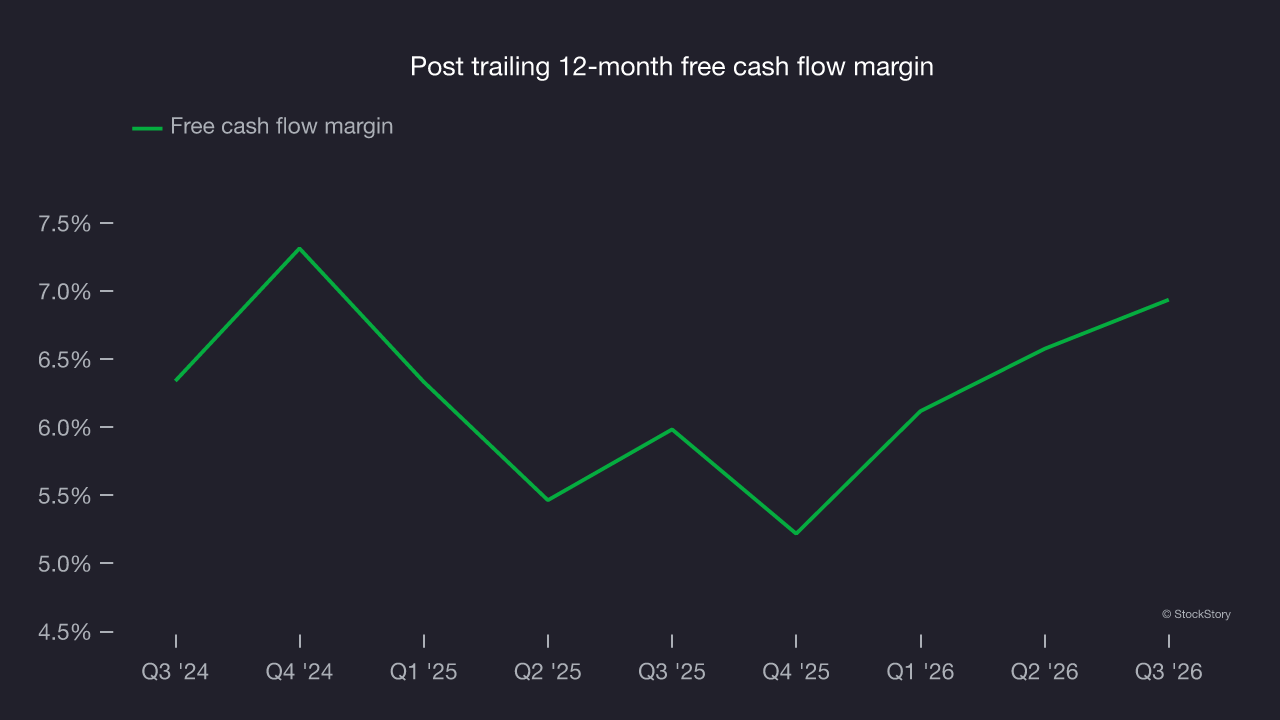
Post generated $161.7 million in free cash flow in Q3, equivalent to an 8.3% margin. This was a positive result, as its margin was 1.5 percentage points higher than in the same quarter last year, but short-term results warrant caution because investment needs can be seasonal, causing temporary swings. Long-term trends carry greater meaning.
Key takeaways from Post’s Q3 results
Post’s Q3 results left room for improvement: revenue missed expectations, despite gross margin topping analysts’ consensus estimates and EBITDA narrowly beating Wall Street’s consensus estimates. Shares rose 2.7% to $80.31 immediately after the results.
For more on Post as an investment at its current price, consider its valuation, business quality and latest earnings. Read our full research report here (it’s free).