


EN
Ross Stores posts Q3 2026 sales in line with estimates but stock drops
Off-price retail company Ross Stores (NASDAQ:ROST) met Wall Street’s revenue expectations in Q3 2026, with revenue up 11.7% year on year to $6.26 billion. Its GAAP profit of $1.91 per share was 2.2% above analysts’ consensus estimates.
For more on Ross Stores, read our full research report, available free.
Ross Stores Q3 2026 highlights:
- Revenue $6.26 billion vs analysts’ consensus estimates of $6.23 billion, according to S&P (11.7% year-on-year growth, in line)
- EPS (GAAP) $1.91 vs analysts’ consensus estimates of $1.87 (2.2% beat)
- GAAP EPS guidance $8.80 at the midpoint for the full year, roughly in line with what analysts were expecting
- Operating margin 12.3%, in line with the same quarter last year
- Free cash flow margin 5.8%, down from 11% in the same quarter last year
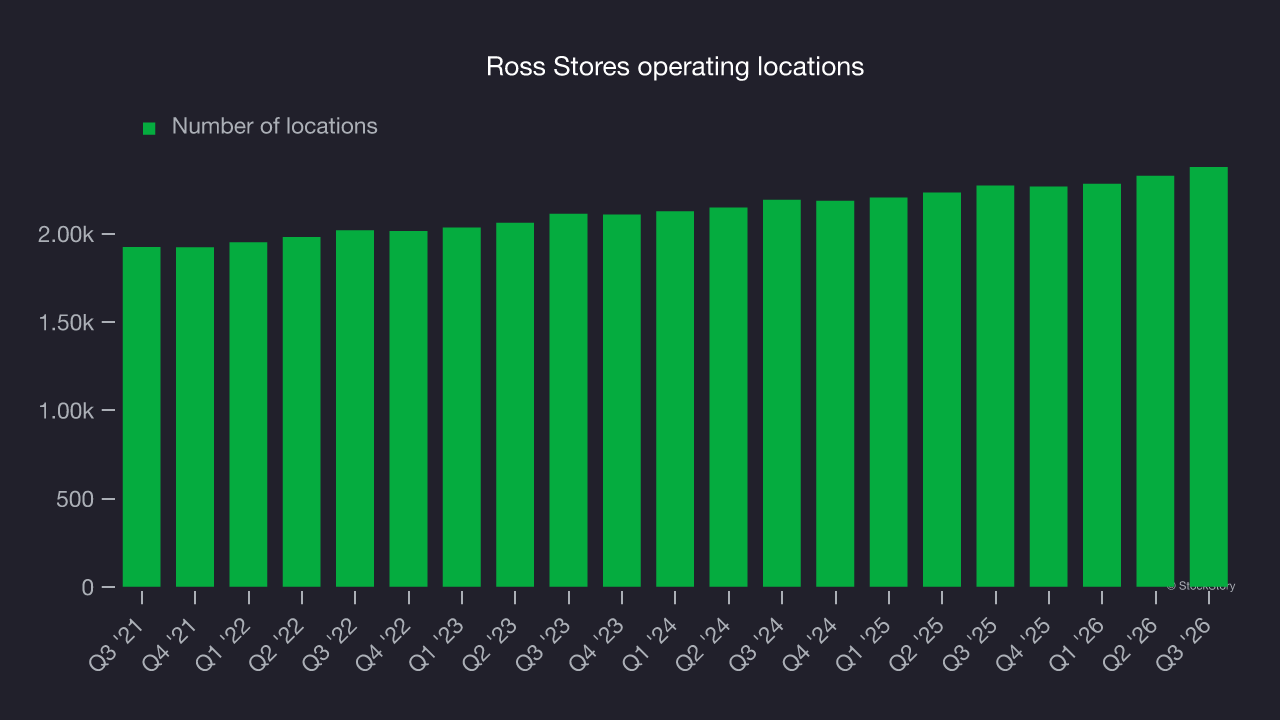
- Locations 2,377 at quarter end, up from 2,273 in the same quarter last year
- Same-store sales rose 8% year on year (7% in the same quarter last year)
- Market capitalization $72.72 billion
Jim Conroy, chief executive officer, commented, "We are extremely pleased with our third quarter sales and earnings growth, particularly given the more challenging comparisons we faced. Results exceeded our expectations as our marketing initiatives continue to attract more customers while our compelling combination of great brands at exceptional values and an enhanced store experience continued to resonate. As a result, customer traffic remained the primary driver of our comparable store sales growth. We are encouraged by the broad-based strength of our results and the continued positive response from customers to our brands, values, and shopping experience."
Revenue growth
Examining a company’s long-term performance can provide clues about its quality. Any business can have short-term success, but a top-tier one grows for years.
With $25.17 billion in revenue over the past 12 months, Ross Stores is one of the larger companies in the consumer retail industry and benefits from a well-known brand that influences purchasing decisions. However, its scale is a double-edged sword because there is only so much real estate to build new stores, placing a ceiling on its growth. To accelerate revenue growth, Ross Stores likely needs to optimize its pricing or pursue international expansion.
Ross Stores grew its revenue at a mediocre 8.7% compounded annual growth rate over the last three years, but to its credit, it opened new stores and increased revenue at existing, established locations.
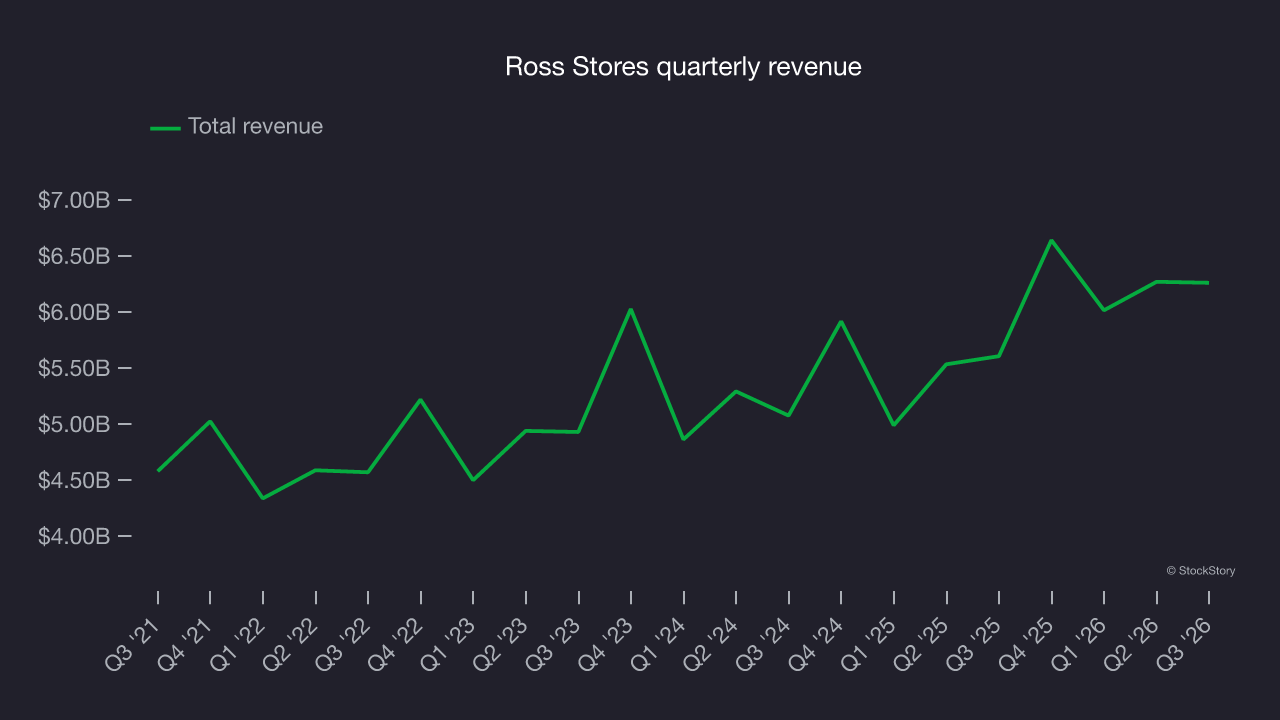
This quarter, Ross Stores’s year-on-year revenue growth was 11.7%, and its $6.26 billion of revenue was in line with Wall Street’s consensus estimates.
Looking ahead, sell-side analysts expect revenue to grow 7.1% over the next 12 months, according to S&P, a slight deceleration versus the last three years. Its growth trajectory remains attractive given its scale and indicates the market expects success for its products.
Store performance
Number of stores
Ross Stores had 2,377 locations in the latest quarter. Over the last two years, it has opened new stores quickly, averaging 3.9% annual growth. This was faster than the broader consumer retail sector.
When a retailer opens new stores, it usually means it’s investing for growth because demand is greater than supply, especially in areas where consumers may not have a store within reasonable driving distance.
Same-store sales
A company’s store base only paints one part of the picture. When demand is high, it makes sense to open more. But when demand is low, it’s prudent to close some locations and use the money in other ways. Same-store sales is an industry measure of whether revenue is growing at those existing stores and is driven by customer visits (often called traffic) and the average spending per customer (ticket).
Ross Stores has been one of the most successful retailers over the last two years thanks to strong demand within its existing locations. On average, the company has posted year-on-year same-store sales growth of 7%. This performance suggests its rollout of new stores is beneficial for shareholders. This backdrop gives Ross Stores multiple ways to grow: revenue can increase through new stores, e-commerce or increased foot traffic and higher revenue per customer at existing locations.
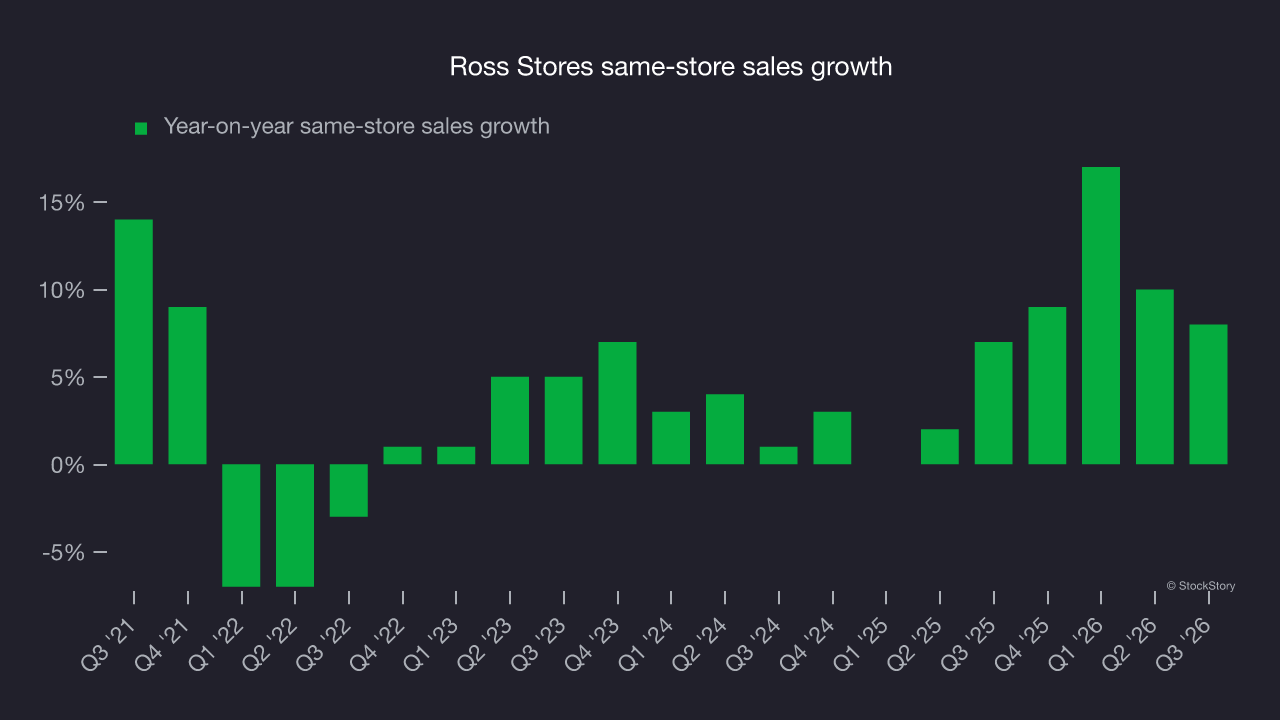
In the latest quarter, Ross Stores’s same-store sales rose 8% year on year. This performance was more or less in line with its historical levels.
Key takeaways from Ross Stores’s Q3 results
Ross Stores delivered a softer quarter, with revenue in line with analysts’ consensus estimates but next-quarter EPS guidance falling short. Shares tumbled 9.7% to $199.50 immediately after the report.
Ross Stores may have had a tough quarter, but that alone doesn’t determine whether the stock offers an investment opportunity. The latest quarter is only one part of the longer-term assessment of business quality. Quality, when combined with valuation, can help determine if the stock is a buy. For more on Ross Stores, read our full research report here (it’s free).