


EN
Apple Nears a Rare Long-Term DRAM Supply Deal With Samsung Electronics. What This Means for AAPL Stock.
The iPhone is selling faster, but the memory inside it is getting more expensive. Apple (AAPL) reported $57.6 billion in iPhone revenue in its fiscal fourth quarter, up 17% from a year earlier. Yet after stripping out the benefit of tariff refunds — about $2.2 billion — its gross margin fell from the prior quarter, largely because of higher memory costs.
Apple expects a gross margin of 45% to 46% in the December quarter, with higher memory costs among the factors weighing on that outlook. That makes the reported talks with Samsung Electronics over a rare deal to secure DRAM supply for several years especially timely.
Would securing more memory give Wall Street a reason to raise its earnings expectations for Apple, or would it simply help the company meet them? Let’s take a closer look.
What a Samsung Deal Would Secure
Apple designs and sells iPhones, iPads, Macs, and wearables, and offers services such as iCloud, Apple Music, and Apple Pay. The company's iPhones, iPads, and Macs use dynamic random access memory (DRAM) to temporarily store the data apps need while they run.
The company is reportedly close to signing a rare multiyear deal with Samsung Electronics to secure a minimum supply of those chips. This deal would run for four to five years, starting in the first half of 2027, a departure from Apple’s usual shorter contracts. Samsung would commit to supplying a minimum volume, although it is unclear how many chips that would cover. The timing helps explain why Apple is willing to commit for several years.
TrendForce, a technology market research firm, expects conventional DRAM contract prices to rise 10% to 15% from the previous quarter in the final three months of 2026. That forecast reflects industry pricing rather than Apple’s own costs. Meanwhile, SK Hynix (SKHY) says long-term agreements already cover more than half of its production capacity for 2027 and 2028.
The deal could help Apple keep iPhones and MacBooks in production as suppliers shift capacity toward artificial intelligence (AI) servers. It could also support the foldable iPhone Duo as Apple ramps production, although Apple hasn’t identified memory as the cause of that device’s supply constraints.
Apple’s clearest potential benefit is a lower risk of lost sales from memory shortages. The catch is that securing enough chips to fill orders wouldn’t protect Apple’s margins if memory prices keep rising.
Where AAPL Stands Financially
Apple reported Q4 fiscal 2026 results on Nov. 2, with revenue rising 12% year-over-year (YOY) to $114.5 billion, beating the $113.6 billion consensus estimate. Its EPS of $2.10 also beat the $1.99 estimate, while gross and operating margins held steady YOY at 47.9% and 31.1%, respectively.
Apple’s product revenue rose 12% to $82.9 billion, led by iPhone sales climbing 17% to $57.6 billion on strong iPhone Duo and iPhone 18 Pro demand. Its active iPhone base hit a record, with record upgrades in the United States, China, India, and Japan.
Mac revenue rose 24% to $10.8 billion, driven by MacBook Neo and MacBook Pro demand, with room to attract first-time buyers and upgraders in emerging markets. Services revenue grew 10% YOY to $31.6 billion, supported by strength in cloud, payments, advertising, video, and music, more than 2.5 billion active devices, and more than 1.5 billion paid subscriptions.
AAPL stock fell after earnings but closed on Nov. 18 at $352.45 per share. The stock is up 29% year-to-date (YTD) and up 30% over 52 weeks.
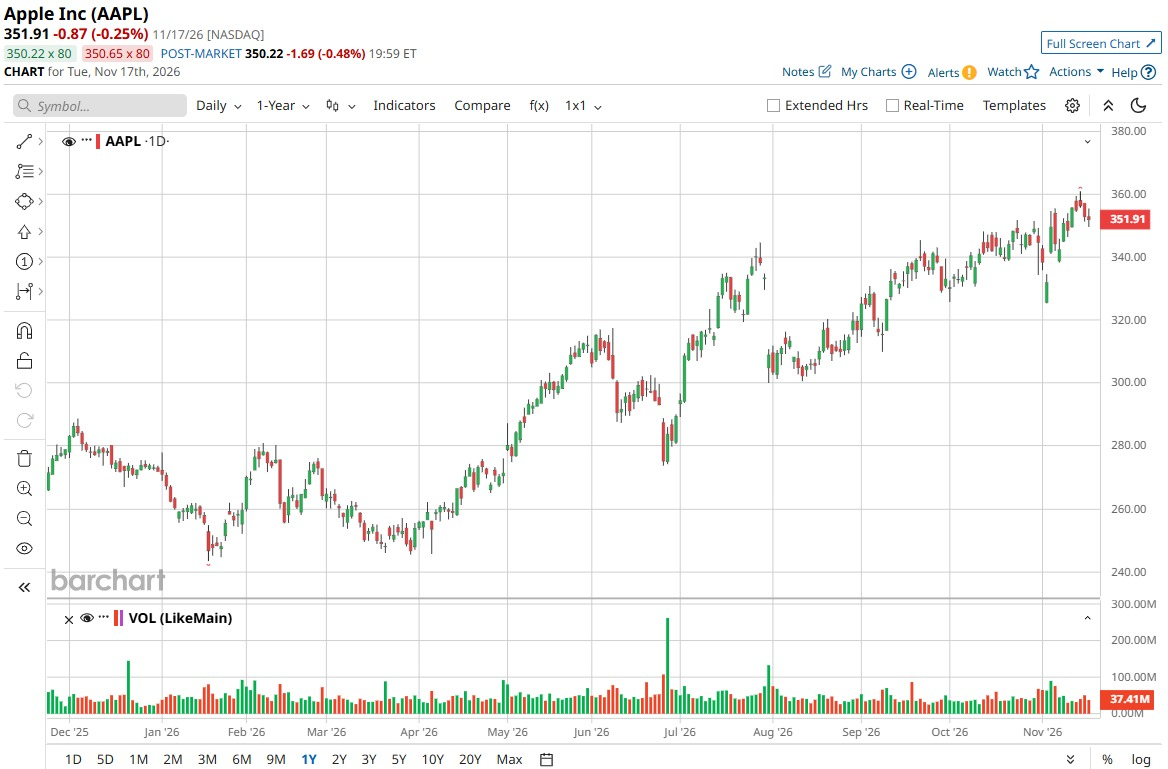
Apple’s market capitalization stands at $5.12 trillion, with a trailing price-to-earnings (P/E) multiple and a forward P/E ratio of 39.9 times and 37.2 times, respectively, versus sector medians of about 27 times and 26 times. The forward annual dividend of $1.08 per share yields 0.31%.
CEO John Ternus flagged supply constraints and rising memory costs. The December quarter gross margin outlook of 45% to 46% reflects those higher costs and the initial Siri AI rollout expenses, per CFO Kevan Parekh. Apple sees room to expand iCloud+ and paid subscriptions, with new AI features offering another potential source of revenue.
What Analysts Expect From Apple
Wall Street expects Apple to earn $2.94 per share in the December quarter, up 3.5% from $2.84 a year earlier. Apple is expected to report those results on Feb. 4, 2027.
Analyst Dan Ives thinks investors should buy the dip. Ives argues Apple doesn’t need to build data centers on the same scale as its rivals to bring AI features to the iPhone. It can lean on suppliers and cloud partners instead. He also thinks investors are underestimating how many customers will upgrade to the iPhone Duo.
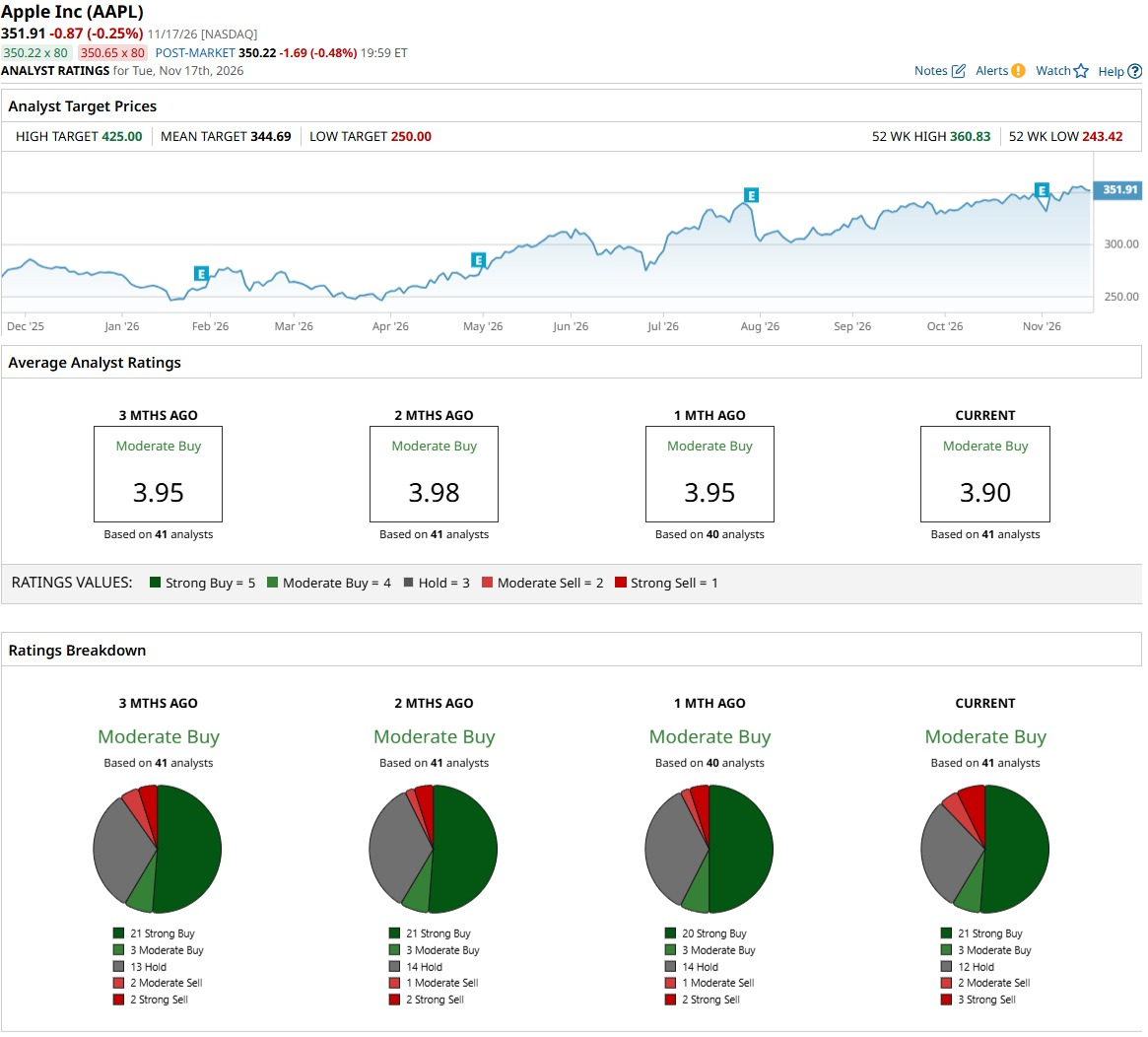
Not everyone is willing to pay up for that story. Morgan Stanley rates AAPL stock as “Overweight,” but its $350 price target is already below current levels. KeyBanc analyst Brandon Nispel is more skeptical. Nispel rates Apple as “Underweight” with a $250 target, citing the risk of slowing hardware sales.
That gap between ratings and price targets extends beyond those two firms. Apple has a consensus “Moderate Buy” rating from 41 analysts, yet the average target of $344.69 is about 2% below the current price of AAPL stock.
Conclusion
Apple’s reported deal with Samsung would help keep iPhones shipping even if memory gets harder to buy. But with prices still tied to the market, securing chips won’t shield Apple from higher costs. The most likely outcome is fewer supply headaches rather than a meaningful bump in earnings. That makes the deal good news for Apple’s business, but probably not enough to lift AAPL on its own, especially with shares already trading above Wall Street’s average price target.
On the date of publication, Ebube Jones did not directly have a position in any of the securities mentioned in this article. All information and data in this article is solely for informational purposes. For more information please view the Barchart Disclosure Policy here.