


EN
Selling the 0DTE Fly: Two Targets Instead of One
A short SPX put butterfly sold for a $23.10 credit at 9:44 ET was bought back for $17.00 fifty minutes later, a $6.10 gain per spread (about $601 after costs on one contract). The usual play off the gamma map is the opposite: buy a 1-2-1 fly for a debit and hope price settles at the body. This morning I didn't trust any single settle point, so I sold the fly and let a move toward either wing do the work.
The map's own butterfly guide called for a long fly centered at 7,440, above the market. SPX went the other way. Here is how the morning played out and why selling the fly was the better fit.
What the 8:40 gamma map said
The premarket map read positive gamma, the regime where dealer hedging tends to dampen moves. But the setup was stretched: /ES futures implied SPX near 7,394, about 70 points above the prior close of 7,323.63.
- Call wall: 7,400
- Gamma flip: 7,366
- Put wall: 7,350
- Largest gamma strike (pin): 7,455
- Expected close (model): 7,442
- ATM straddle: about 65 points
- Trend-day odds (heuristic): 40%
The map's fly guide was a long 7,405 / 7,440 / 7,475 fly covering the central band. That trade needs price to drift up into the pin and sit there. With a 65-point straddle, 40% trend-day odds and an overnight gap still to hold, I wasn't confident of any one settle point.
What SPX actually did
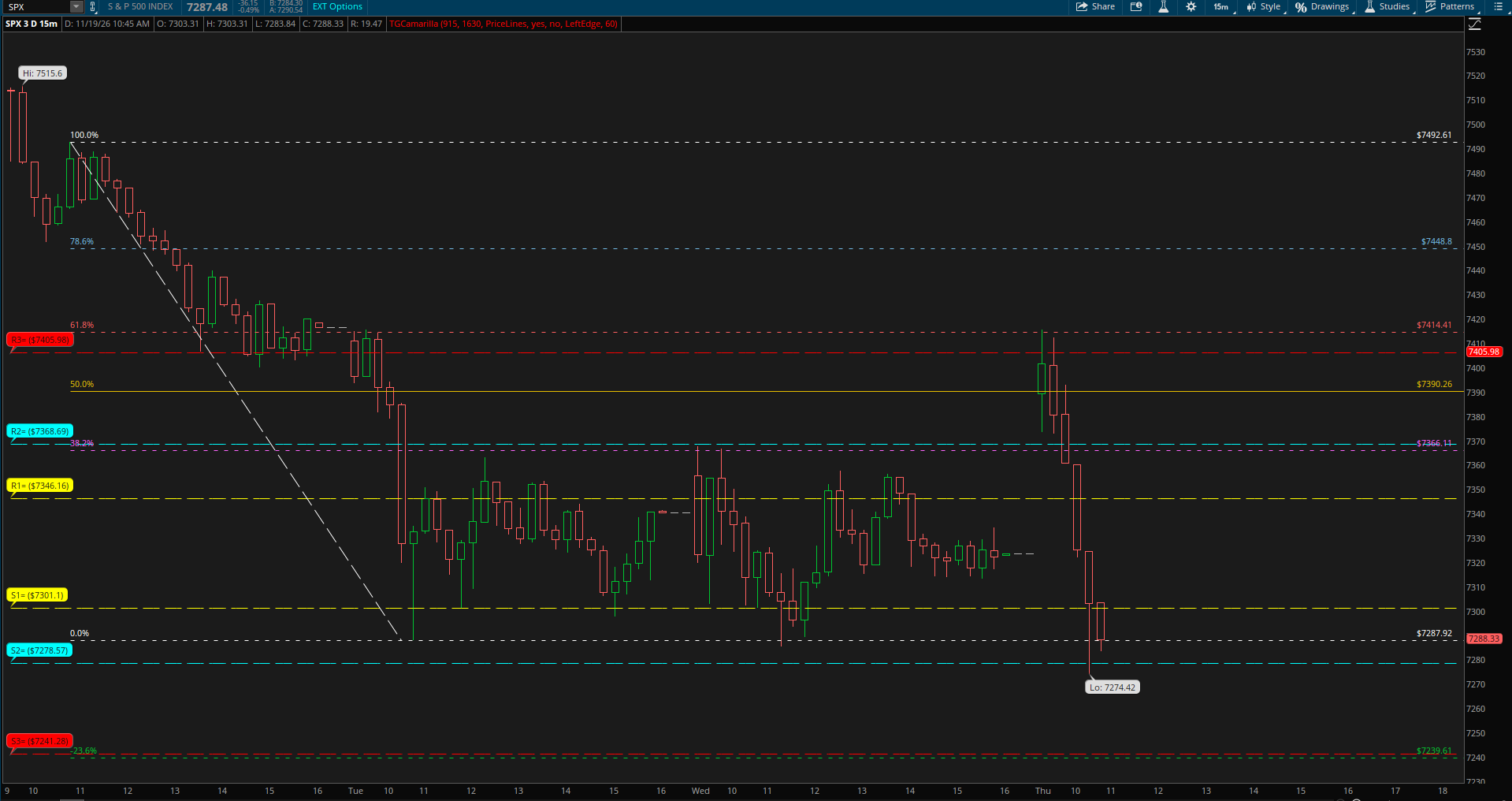
SPX opened near 7,400 and the first push stalled around 7,415, right at the Camarilla R3 (7,405.98) and the 61.8% retracement of the week's selloff. From there it unwound the whole overnight gap: a drop of more than 130 points through the flip (7,366), the put wall (7,350) and the S1 Camarilla (7,301.10), to a low of 7,274.42 just under S2 (7,278.57). SPX was at 7,287.48 at 10:45 ET, down 36 points on the day.
The trade
I sold one 7,310 / 7,380 / 7,450 put butterfly at 9:44 ET, about 15 minutes after the cash open. The body sat at 7,380, close to the flip and just under the call wall, so a 45-point-plus move either way would start paying. I closed it at 10:34 ET with SPX around 7,300, at the S1 Camarilla level and right on the lower wing.
- Sold 1 x 7,450 put at 62.75; bought back at 148.89
- Bought 2 x 7,380 puts at 22.90; sold at 84.80
- Sold 1 x 7,310 put at 6.15; bought back at 37.71
- Net: opened for a 23.10 credit, closed for a 17.00 debit
- Result: 6.10 points, $610 per spread before costs; about $601 after $9.30 in commissions and fees.
- Time in the trade: 50 minutes.
- Defined risk: wing width 70 less the 23.10 credit = 46.90 points ($4,690) maximum loss, only if SPX expires right at 7,380.
- Breakevens at expiry: 7,333.10 and 7,426.90. Maximum gain is the full 23.10 credit below 7,310 or above 7,450.
Why sell the fly instead of buying it
A long 1-2-1 fly is a bet on where price will settle. A short fly is a bet that price will leave the body, in either direction. This morning the second bet was easier to make than the first.
- Two targets, not one. The 7,450 and 7,310 wings were both live targets. A rally toward the map's pin paid; so did a fade of the overnight gap. It was the fade that came.
- The long fly would have been on the wrong side. The map's 7,405 / 7,440 / 7,475 fly needed SPX to climb into the pin. With SPX near 7,300 at my exit, that fly was well out of range.
- Time works against you early. A short fly loses most if price sits at the body into the close, so I took the gain once SPX moved toward a wing rather than wait for the full credit.
What could have gone wrong: SPX opening and pinning near 7,380 all day. That is the 46.90-point loss case, which is why the position stays small and why the plan was to exit on the first good move rather than hold to expiry.
Takeaways for 0DTE traders
- Read the map for its levels, not just its fly guide. The walls, flip and straddle tell you how far price can travel; the guide is one way to trade them.
- Match the structure to your conviction. Sure of a settle point, buy the fly. Sure only that price will move, sell it.
- Put the body where price is likely to leave, with wings at levels a normal move can reach.
- Wait for the open to settle (here, about 15 minutes) and have an exit plan before entering.
Daily 0DTE gamma maps for SPX, NDX and RUT: tradeguidance.com
Educational only, not investment advice. Gamma levels are model output from public option data, not a measurement of actual dealer positioning. Options involve risk and are not suitable for all investors. Results shown are from one trade and do not indicate future results.