


EN
Borr Drilling’s Q3 2026: Beats on revenue

Offshore drilling contractor Borr Drilling (NYSE:BORR) reported Q3 2026 results topping the market’s revenue expectations, but revenue fell by 5.1% year on year to $263.1 million. Its non-GAAP loss of $0.13 per share was 36.8% below analysts’ consensus estimates.
For more on Borr Drilling, read our full research report, available free.
Borr Drilling Q3 2026 highlights:
- Revenue $263.1 million vs S&P analyst consensus of $259.9 million (5.1% year-on-year decline, 1.2% beat)
- Adjusted EPS -$0.13 vs S&P analyst consensus of -$0.09 (36.8% miss)
- Operating margin 13.3%, down from 35.4% in the same quarter last year
- Free cash flow margin 7.5%, down from 13.8% in the same quarter last year
- Market capitalization $999.6 million
Revenue growth
Cyclical sectors like energy often flatter weaker operators during favorable price environments, but a longer-term lens separates those from businesses that can consistently perform across market cycles. Over the last five years, Borr Drilling grew its revenue at a strong 33.5% compounded annual growth rate. Its growth beat the average energy upstream and integrated energy company and shows its offerings resonate with customers.
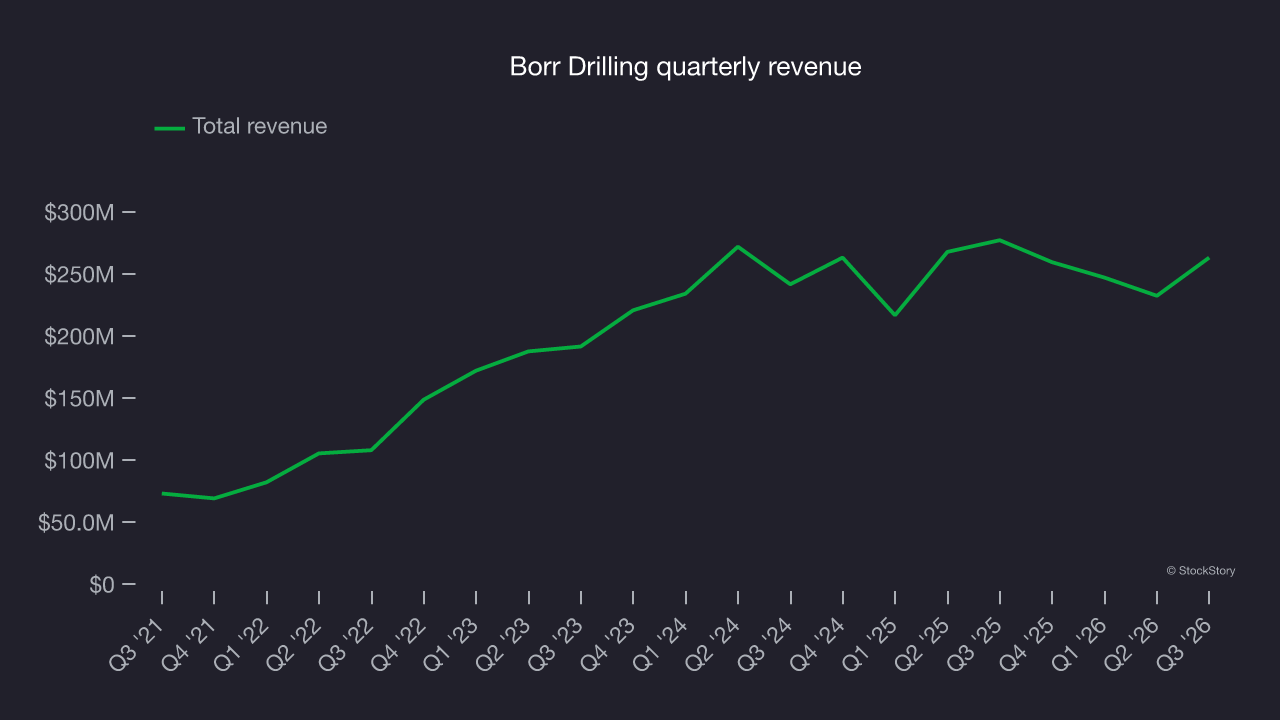
Energy cycles can be long enough that a single five-year period can still reflect one price environment, which is why an additional, decade-long view can help capture through-cycle performance. Borr Drilling’s annualized revenue growth of 31.6% over the last eight years is below its five-year trend, but the results still suggest decent demand.
This quarter, Borr Drilling’s revenue fell by 5.1% year on year to $263.1 million but beat Wall Street’s consensus estimates by 1.2%.
Free cash flow
Adjusted EBITDA shows how profitable a company’s existing “rock” is before financing and reinvestment, while free cash flow, or FCF, shows how much value remains after paying to replace those wells. Because production declines over time, strong EBITDA can coexist with weak FCF if drilling is expensive or declines are steep. FCF therefore captures both operating efficiency and the cost of sustaining production.
While Borr Drilling posted positive free cash flow this quarter, the broader picture has been less favorable. Borr Drilling’s heavy reinvestment needs have drained its resources over the last five years, creating financial pressure and limiting its ability to return capital to investors. Its free cash flow margin averaged negative 13.9%, meaning it burned $13.92 of cash for every $100 in revenue.
While the level of free cash flow margins is important, their consistency matters just as much.
Borr Drilling’s ratio of quarterly free cash flow volatility to price volatility in West Texas Intermediate, or WTI, crude over the past five years was 17.1 (lower is better), indicating that its cash generation is far more sensitive to commodity-price swings than most peers. This elevated volatility limits its access to capital in downturns and makes it unlikely to act as a consolidator when weaker competitors come under pressure.
Why assess Borr Drilling’s stability against commodity prices using free cash flow rather than revenue or EBITDA? What ultimately matters is not how much revenue or profit it earns when prices are high but how much cash it can generate when prices are low. Free cash flow is the superior metric because it captures hedging effectiveness, growth and maintenance capex and management behavior during good times and bad.
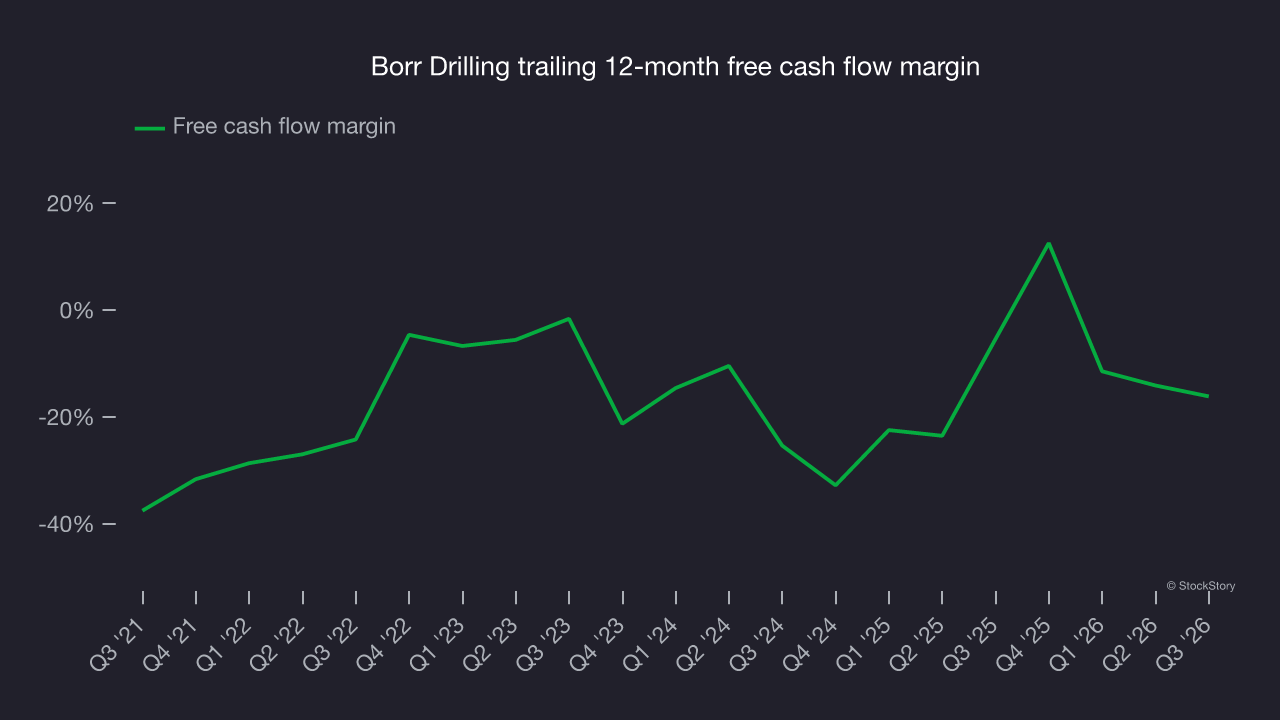
Borr Drilling’s free cash flow came in at $19.8 million in Q3, equivalent to a 7.5% margin. The company’s cash profitability declined, with its margin 6.3 percentage points lower than in the same quarter last year, but still above its five-year average. This quarter’s decline should not be overinterpreted because investment needs can be seasonal, causing short-term swings. Long-term trends matter more than temporary fluctuations.
Key takeaways from Borr Drilling’s Q3 results
Borr Drilling’s quarter left room for improvement: revenue narrowly topped analysts’ consensus estimates, but EPS fell short. Shares rose 2.9% to $3.26 immediately after the release.
An investment decision on Borr Drilling should take into account the bigger picture, including valuation, business quality and the latest earnings. For more on those factors, read our full research report here (it’s free).