


EN
Why It’s Time to Buy the Pullback in Intel Stock
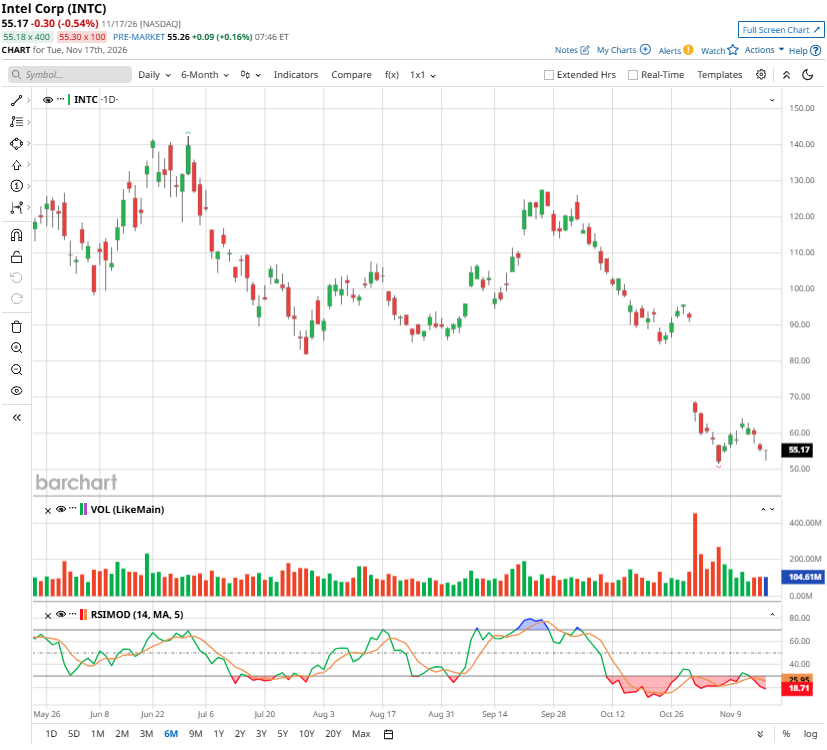
Intel (INTC) stock has witnessed a steep correction, eroding a substantial portion of its year-to-date (YTD) gains. INTC stock has fallen more than 61% from its 52-week high and about 39% over the past month.
Multiple factors have dragged Intel stock down, including disappointing fourth-quarter revenue guidance, manufacturing capacity constraints, rising memory prices, tighter corporate IT budgets, and broader weakness across artificial intelligence (AI)-related stocks. These challenges are significant for Intel's Client Computing business, where demand conditions have weakened considerably.
However, the recent decline has created a more attractive risk-reward profile. Although the PC market remains under pressure, Intel's Data Center and AI (DCAI) business is witnessing strong growth, supported by increasing demand for server processors and purpose-built silicon. This segment remains a key growth driver as the company navigates near-term challenges.
Weak PC Demand and Cautious Revenue Guidance Weigh on Sentiment
A disappointing outlook for Q4 followed Intel's latest quarterly results. Management projected revenue between $15 billion and $16 billion, below analysts’ expectations of more than $17 billion. The weaker guidance raised concerns about the company's near-term revenue trajectory, especially as capital expenditures and component procurement commitments are expected to increase over the coming quarters.
The pressure is most evident in the PC market. Rising memory prices and limited component availability have increased system costs, further constraining demand in an environment where corporate IT budgets remain tight. Intel also indicated that its original equipment manufacturer (OEM) partners have accelerated inventory adjustments in response to weaker end-market sales.
Management expects these conditions to persist until memory supply improves and pricing stabilizes. Its current projections suggest that the PC market could face a prolonged downturn rather than a temporary slowdown.
Intel anticipates that the total addressable market (TAM) for PC units will contract, while the second half of 2027 could show some improvement. These projections highlight the risks facing Intel's client computing business. Consequently, expectations for a meaningful near-term recovery in PC-related revenue should remain cautious.
The DCAI Business Provides a Strong Growth Counterbalance
While the PC business faces cyclical and supply-related headwinds, Intel's DCAI segment is delivering considerably stronger results. DCAI revenue reached $7.3 billion in Q3, increasing 17% sequentially and 78% year-over-year (YOY). Growth was broad-based, driven by hyperscale cloud providers, enterprise customers, and emerging neocloud operators.
Purpose-built silicon is emerging as another important growth driver for Intel. Revenue from this business increased more than 50% sequentially and more than doubled YOY. Management noted that the segment has tripled in size over the past three years and expects it to triple again over the coming years.
The opportunity is supported by growing demand for customized computing solutions, particularly among AI infrastructure providers and hyperscale customers. Intel is expanding its intellectual property (IP) portfolio to address a broader range of customer requirements, including opportunities with existing clients, new customers, and AI-focused companies.
The company has also introduced Crescent Island, an inference-optimized GPU designed to address the growing demand for AI inference workloads. Initial customer feedback has been encouraging, and management indicated that product performance is progressing as expected.
Another catalyst is the significant demand for CPUs as AI infrastructure evolves. The emergence of agentic AI applications increases server CPU requirements. As AI systems move beyond conventional model training toward more complex inference and autonomous workloads, demand for general-purpose computing capacity could expand. This creates an opportunity for Intel to benefit from broader data-center spending.
Intel Stock’s Pullback Is an Opportunity
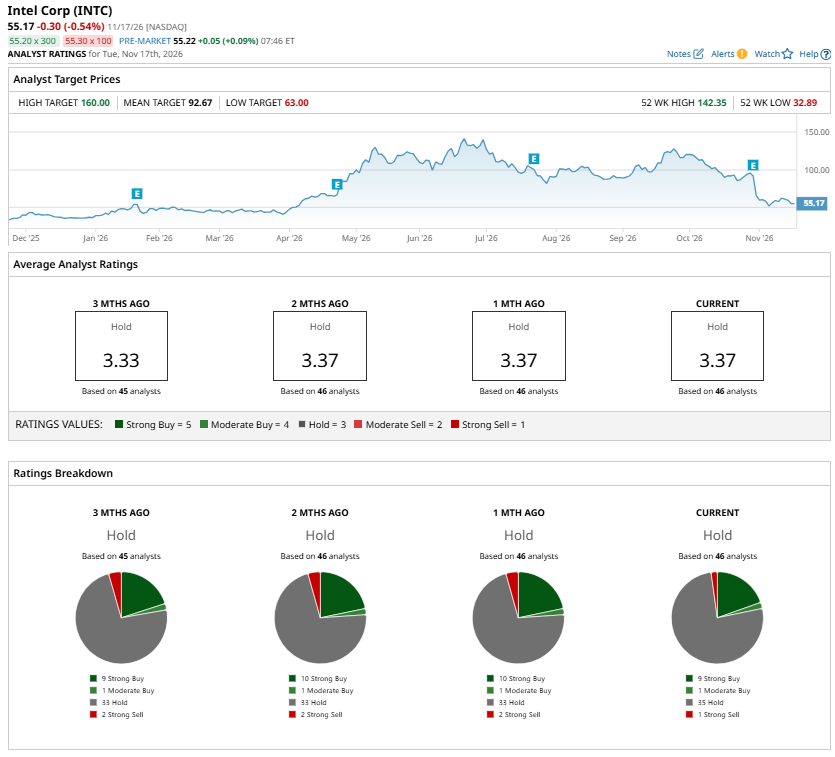
Wall Street maintains a consensus “Hold” rating on INTC stock as Intel navigates near-term PC market weakness. While cautious revenue guidance, manufacturing constraints, and rising component costs could continue to pressure results, the strong momentum in DCAI and purpose-built silicon provides a meaningful growth counterbalance. Increasing CPU demand from AI infrastructure and the company's expanding presence in customized silicon strengthen its longer-term prospects.
Therefore, the recent pullback presents an attractive entry point for investors considering Intel stock.
On the date of publication, Sneha Nahata did not directly have a position in any of the securities mentioned in this article. All information and data in this article is solely for informational purposes. For more information please view the Barchart Disclosure Policy here.