


EN
Warner Music Group’s Q3 CY2026: Beats on revenue

Global music entertainment company Warner Music Group (NASDAQ:WMG) reported calendar Q3 2026 [fiscal Q4 2026] results beating Wall Street’s revenue expectations, with revenue up 7.1% year on year to $2.00 billion. Its GAAP profit of $0.34 per share was 4.7% below analysts’ consensus estimates.
For more on Warner Music Group, read our free full research report.
Warner Music Group Q3 CY2026 highlights:
- Revenue $2.00 billion vs S&P analysts' consensus estimates of $1.91 billion (7.1% year-on-year growth, 4.8% beat)
- EPS (GAAP) $0.34 vs analysts' consensus estimates of $0.36 (4.7% miss)
- Adjusted EBITDA $477 million vs analysts' consensus estimates of $437.2 million (23.8% margin, 9.1% beat)
- Operating margin 16%, up from 7.7% in the same quarter last year
- Free cash flow margin 6.6%, down from 10.9% in the same quarter last year
- Market capitalization $17.24 billion
“Our Q4 and full-year results demonstrate the success of a multi-year, transformational strategy that sets a new bar for WMG,” said Robert Kyncl, CEO, Warner Music Group. “Our creative prowess paired with a disciplined, return-focused capital allocation approach, and tech-enabled capabilities, positions us to drive sustainable, long-term value for our artists, songwriters, and shareholders in fiscal 2027 and beyond.”
Revenue growth
A company’s long-term revenue performance is one signal of its overall quality. Even a poor business can perform well for one or two quarters, but a high-quality one grows for years. Over the last five years, Warner Music Group grew its revenue at a weak 7% compounded annual growth rate, falling short of the consumer discretionary sector benchmark.
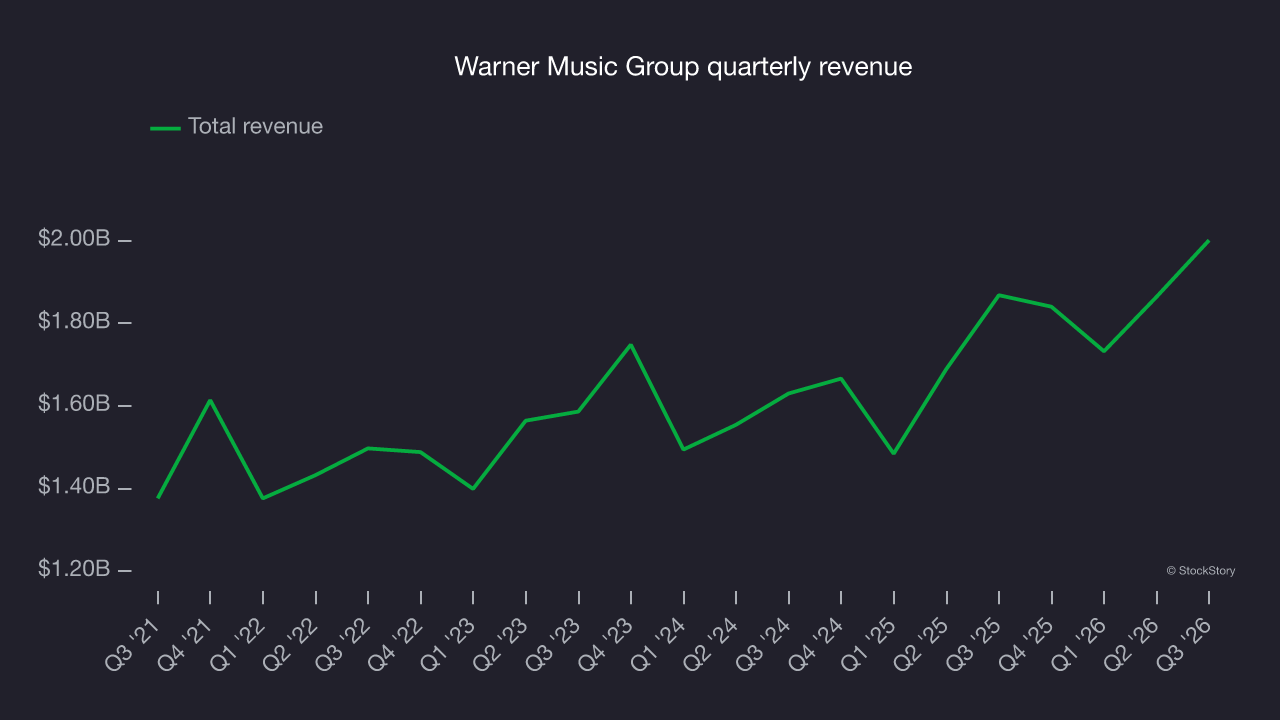
Long-term growth matters most, but within consumer discretionary, a longer historical view may miss a company riding a successful new product or trend. Warner Music Group’s annualized revenue growth of 7.6% over the last two years aligns with its five-year trend, suggesting its demand was consistently weak. 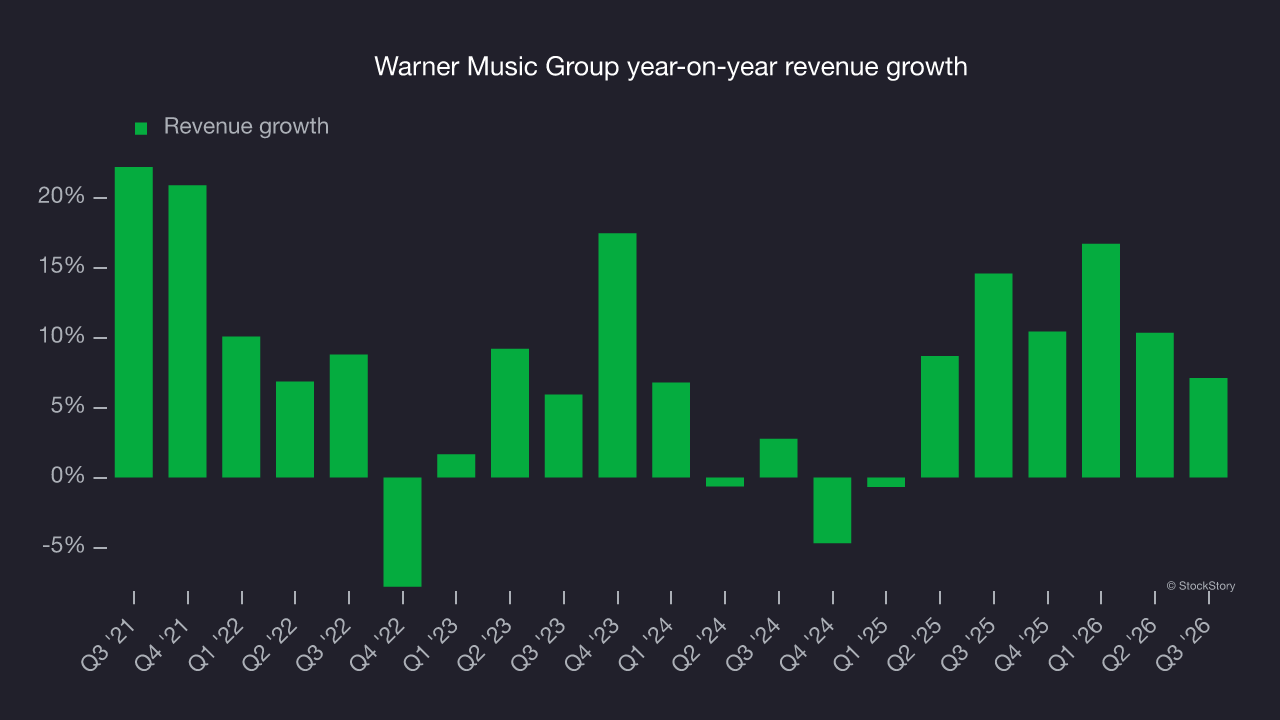
We can better understand the company’s revenue dynamics by analyzing its most important segments, Recorded Music and Music Publishing, which are 81.9% and 18.1% of revenue. Over the last two years, Warner Music Group’s Recorded Music revenue (new music production) averaged 2.7% year-on-year growth while its Music Publishing revenue (royalties from catalog music) averaged 4% growth. 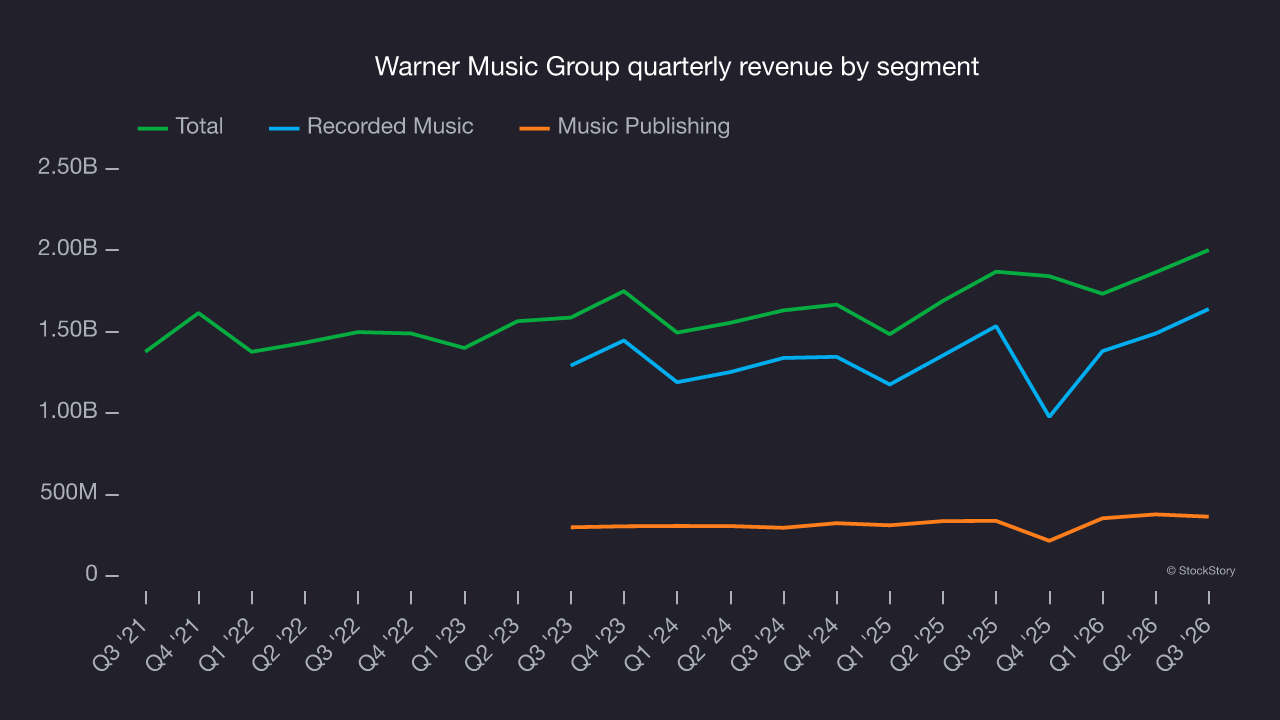
This quarter, Warner Music Group reported year-on-year revenue growth of 7.1%, and its $2.00 billion of revenue exceeded Wall Street’s consensus estimates by 4.8%.
Looking ahead, sell-side analysts expect revenue to grow 4.7% over the next 12 months, according to S&P, a slight deceleration versus the last two years. This projection is underwhelming and suggests its products and services will see some demand headwinds.
Operating margin
Warner Music Group’s operating margin has been trending up over the last 12 months and averaged 13.2% over the last two years. A rise over a short window does not establish durability. Consumer discretionary revenue and profit margins can turn quickly.
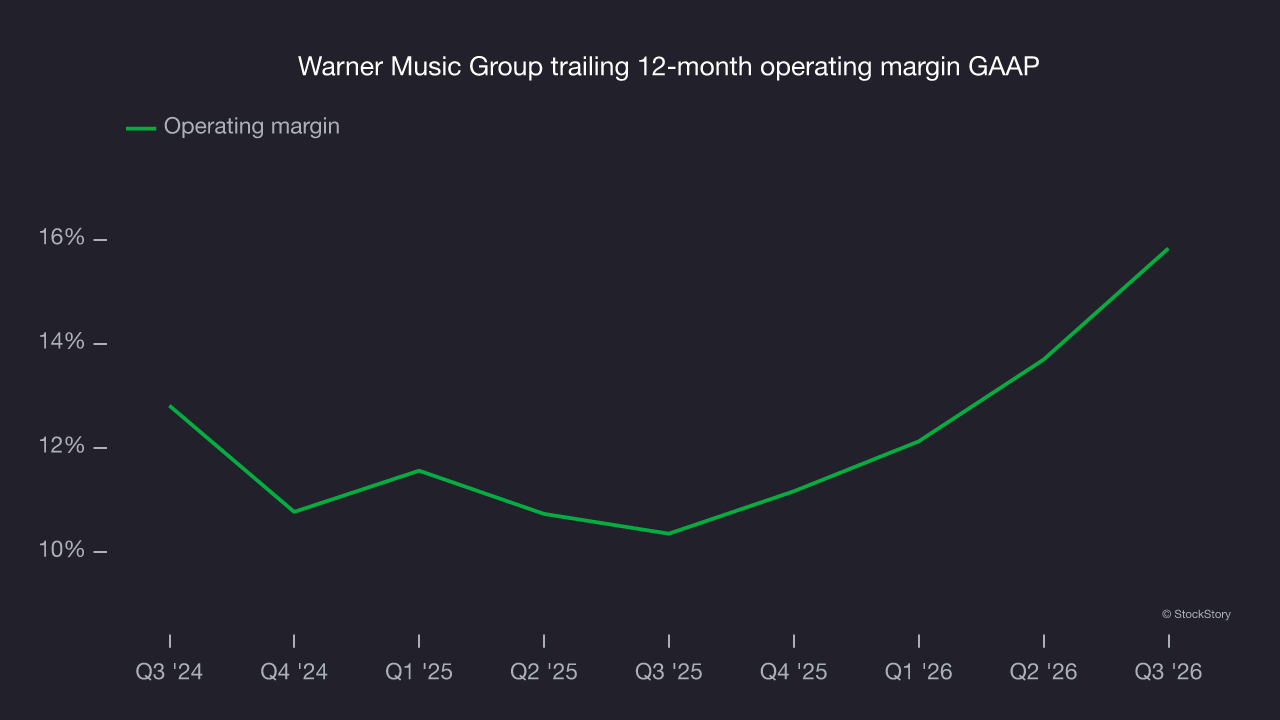
In Q3, Warner Music Group generated an operating profit margin of 16%, up 8.3 percentage points year on year.
Earnings per share
Long-term changes in earnings per share, or EPS, matter for the same reason as long-term revenue growth. Compared to revenue, however, EPS highlights whether a company’s growth is profitable.
Warner Music Group’s EPS grew at a 19% compounded annual growth rate over the last five years. This 19% growth rate was mediocre for a consumer discretionary company, though it outpaced revenue growth. That pace is uninspiring in a sector where demand shifts with consumer health.
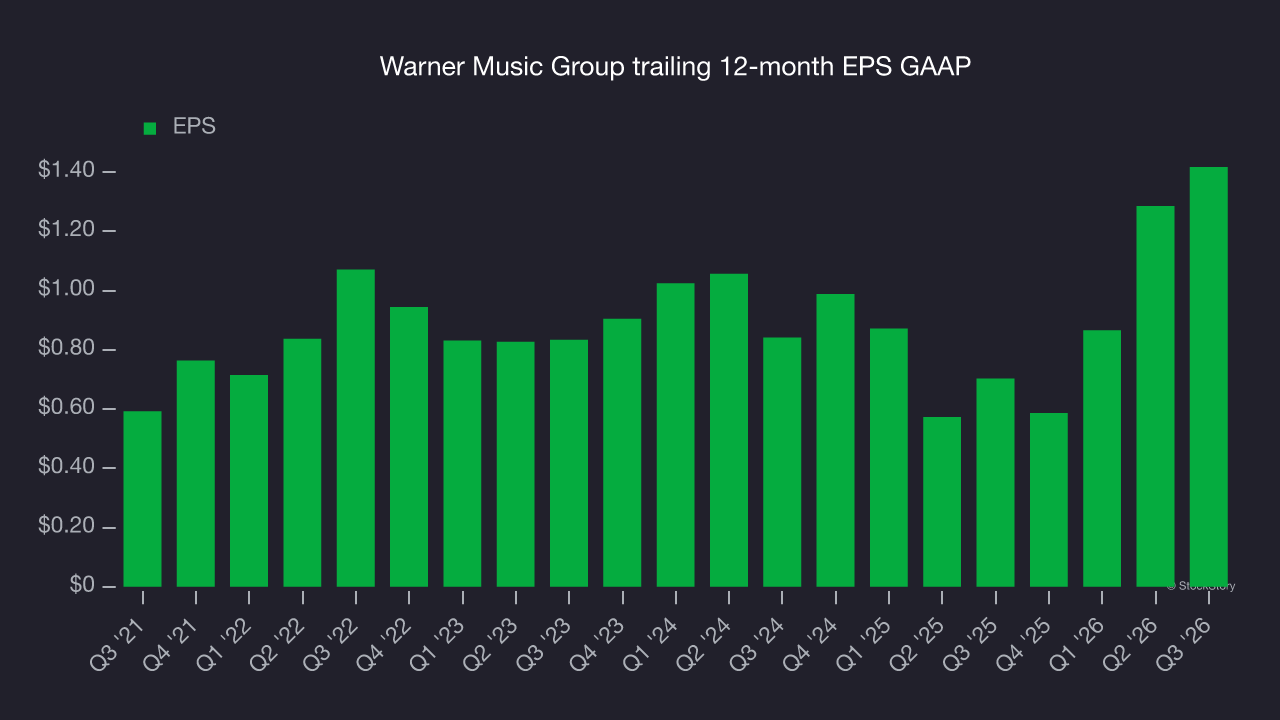
In Q3, Warner Music Group reported EPS of $0.34, up from $0.21 in the same quarter last year. Despite growing year on year, this result missed analysts’ consensus estimates. Over the next 12 months, Wall Street expects Warner Music Group’s full-year EPS to grow 21.7% from $1.42 to $1.72, according to S&P.
Key takeaways from Warner Music Group’s Q3 results
Revenue and EBITDA beats gave Warner Music Group’s quarter some key positives, but EPS missed expectations. Revenue topped analysts’ consensus estimates, and EBITDA exceeded Wall Street’s estimates. The market seemed to be hoping for more: Shares fell 2.6% to $32.10 immediately after the results.
Before deciding whether to buy the stock, consider its valuation, business quality and latest earnings. For more on these factors, read the full research report here (it’s free).