


EN
Bath and Body Works posts better-than-expected sales in Q3 2026

Personal care and home fragrance retailer Bath & Body Works (NYSE:BBWI) reported Q3 2026 results topping the market’s revenue expectations, but revenue fell by 1.1% year on year to $1.58 billion. On the other hand, next quarter’s revenue guidance of $2.62 billion was less impressive, coming in 1.8% below analysts’ consensus estimates. Its GAAP profit of $0.19 per share was 66.8% above analysts’ consensus estimates.
For more on Bath and Body Works, read the full research report, available free.
Bath and Body Works Q3 2026 highlights:
- Revenue $1.58 billion vs S&P consensus estimates of $1.55 billion (1.1% year-on-year decline, 1.7% beat)
- EPS (GAAP) $0.19 vs analysts’ consensus estimates of $0.11 (66.8% beat)
- Revenue guidance $2.62 billion at the midpoint for Q4 2026, below analysts’ consensus estimates of $2.67 billion
- GAAP EPS guidance $1.51 at the midpoint for Q4 2026, missing analysts’ consensus estimates by 11.1%
- Operating margin 6.8%, down from 10.1% in the same quarter last year
- Free cash flow -$122 million compared to -$1 million in the same quarter last year
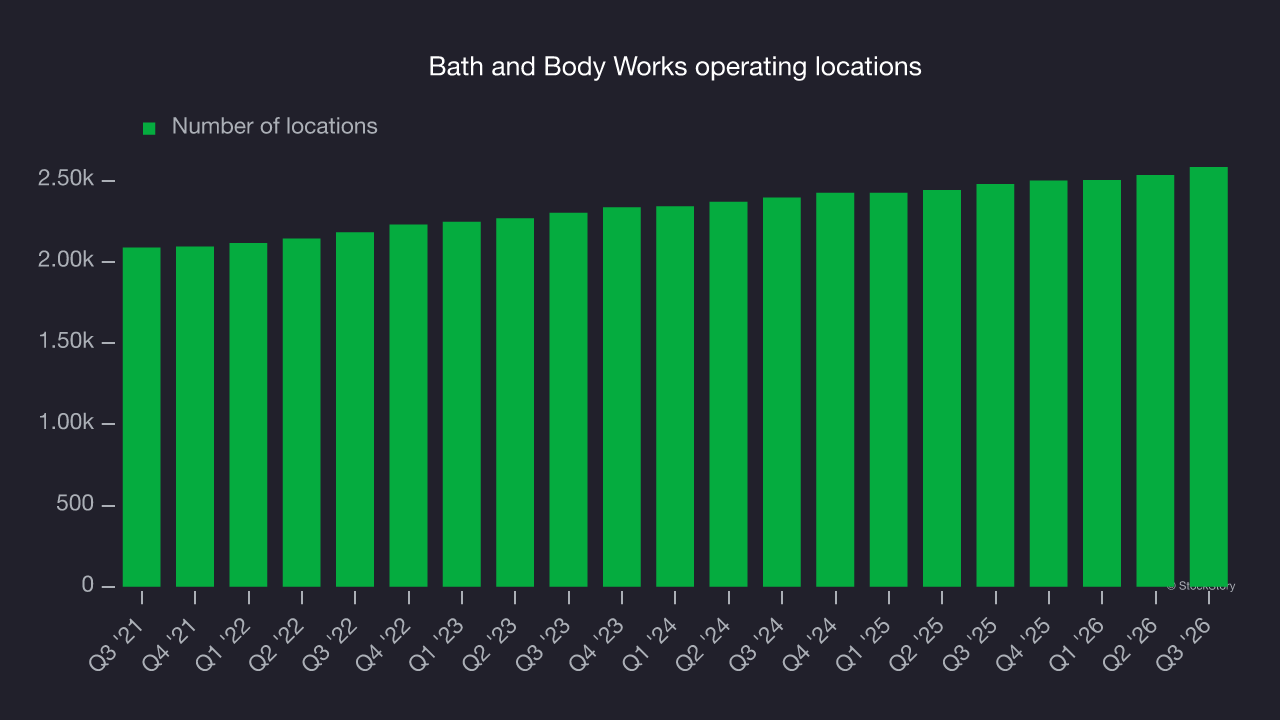
- Locations 2,582 at quarter end, up from 2,478 in the same quarter last year
- Market capitalization $3.76 billion
Daniel Heaf, chief executive officer of Bath & Body Works, commented, “Our third quarter results exceeded our sales and adjusted earnings per share guidance, and marks encouraging progress in our Consumer First Formula. One year after introducing this strategy, we are seeing our actions translate into results across product, brand, and marketplace.”
Revenue growth
A company’s long-term revenue performance is one signal of its overall quality. Any business can report a good quarter or two, but many enduring ones grow for years.
With $7.19 billion in revenue over the past 12 months, Bath and Body Works is a mid-sized retailer, which sometimes brings disadvantages compared to larger competitors benefiting from better economies of scale.
Bath and Body Works struggled to increase demand as its $7.19 billion in revenue for the trailing 12 months was close to its revenue three years ago. This was surprising given it opened new stores, implying its underperformance was driven by lower revenue at existing, established locations.
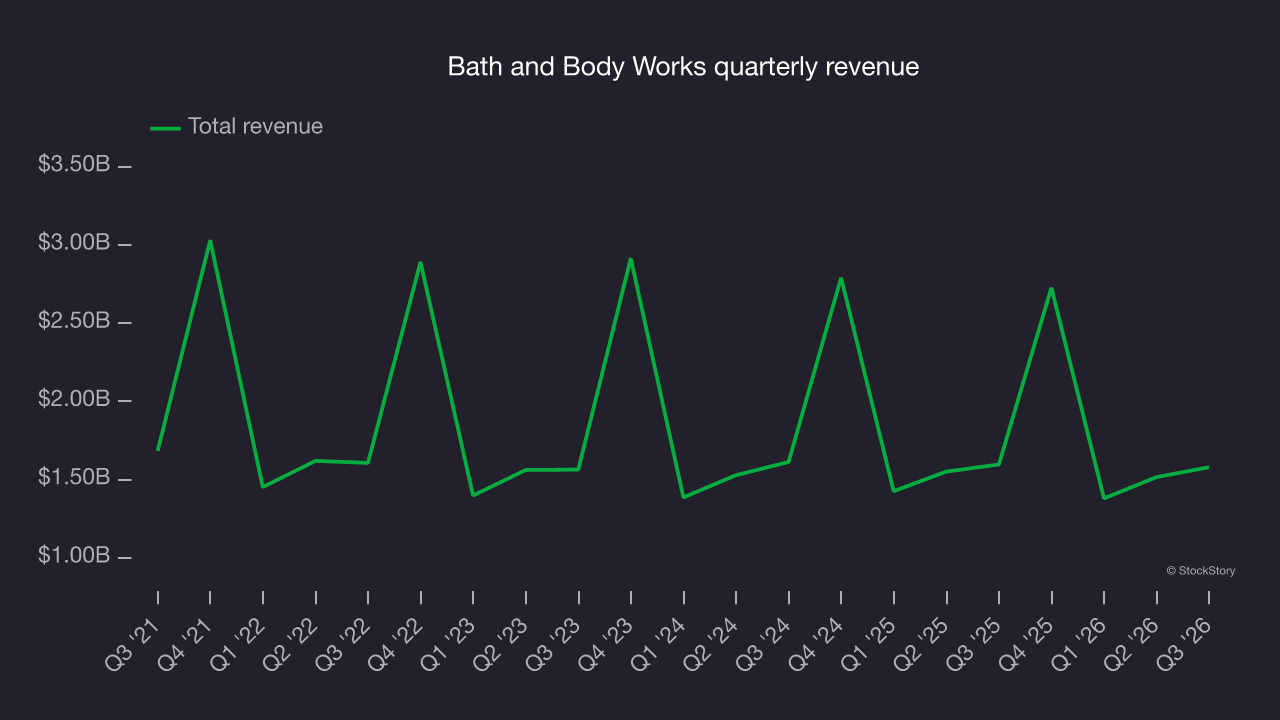
This quarter, Bath and Body Works’s revenue fell by 1.1% year on year to $1.58 billion but beat Wall Street’s consensus estimates by 1.7%. Management is guiding for a 3.8% year-on-year decline in revenue next quarter.
Looking further ahead, sell-side analysts expect revenue to remain flat over the next 12 months, according to S&P. This projection is underwhelming and implies its newer products will not lead to better top-line performance yet.
Store performance
Number of stores
Bath and Body Works operated 2,582 locations in the latest quarter. Over the last two years, it has opened new stores quickly, averaging 3.5% annual growth. This was faster than the broader consumer retail sector.
When a retailer opens new stores, it usually means it’s investing for growth because demand is greater than supply, especially in areas where consumers may not have a store within reasonable driving distance.
Same-store sales
A company’s store base only paints one part of the picture. When demand is high, it makes sense to open more. But when demand is low, it’s prudent to close some locations and use the money in other ways. Same-store sales is an industry measure of whether revenue is growing at those existing stores and is driven by customer visits (often called traffic) and the average spending per customer (ticket).
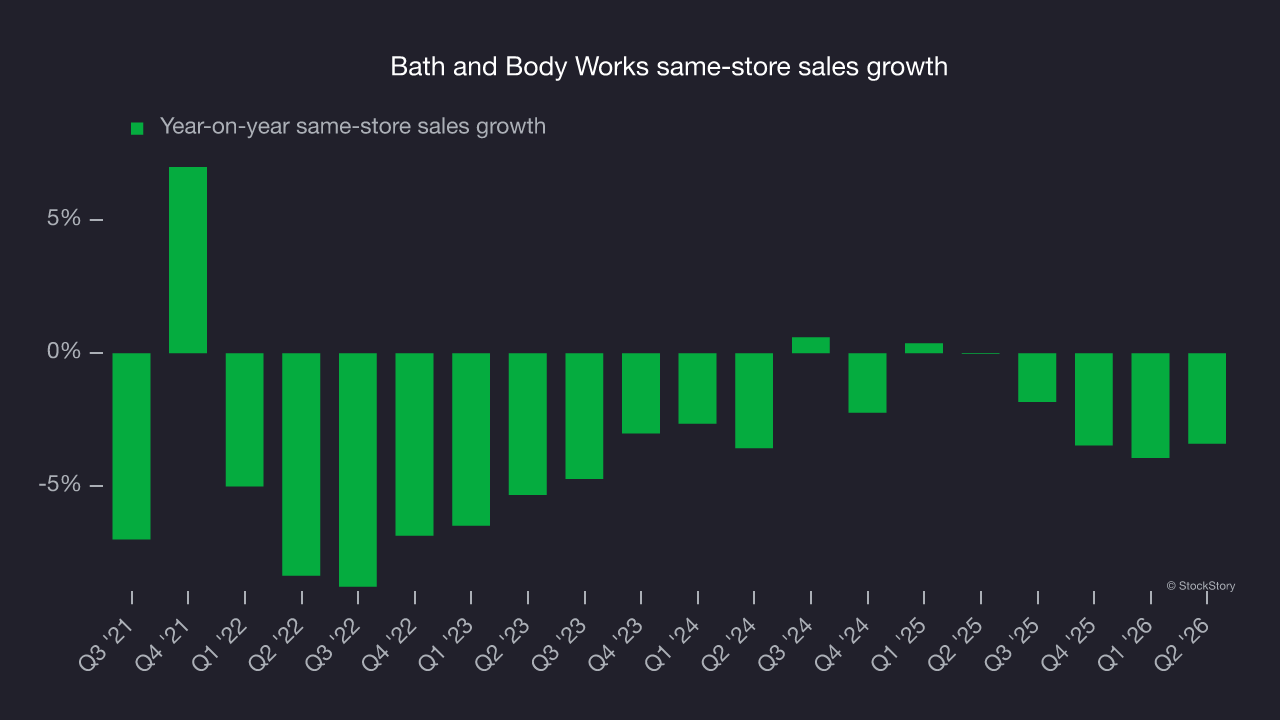
Bath and Body Works’s demand has been shrinking over the last two years as its same-store sales have averaged 2.1% annual declines. This performance is concerning – it shows Bath and Body Works boosts its revenue by building new stores despite declining demand at existing locations. Same-store sales growth would be preferable before the company takes on the costly, capital-intensive task of expanding its store base.
Note that Bath and Body Works reports its same-store sales intermittently, so some data points are missing in the chart below.
Key takeaways from Bath and Body Works’s Q3 results
Bath and Body Works delivered a mixed quarter: Revenue and EPS beat analysts’ consensus estimates, but guidance for both measures next quarter fell short of Wall Street’s consensus. The results left the market hoping for more, with shares falling 2.3% to $18.04 immediately after the report.
Bath and Body Works’ latest quarter matters, but longer-term fundamentals and valuation matter more when deciding whether the stock is a buy. Read the full research report here (it’s free).