EN
Damo dismantled its 13F holdings in the third quarter: institutional position adjustments converged, positions closely followed the market, and the popularity of technology cooled down significantly
The Zhitong Finance App learned that Morgan Stanley released a special report on the 13F positions of US stock institutions and counted institutional holdings data as of September 30 (the report covered the top 100 long-term funds and the top 100 hedge funds. The data only counted long stock positions, excluding derivatives and short exposure). The report points out that the overall margin of institutional position adjustments in the third quarter narrowed significantly compared to the second quarter, and changes in institutional positions were highly in line with the rise and fall performance of the current quarter; there was a clear divergence in the large and small market allocation logic, small cap technology was reduced, the energy sector completed a long and short reversal in the small cap market, and hedge funds continued to overfit the small-cap biomedical circuit.
In the third quarter, the overall resilience of the US stock market was limited. The S&P 500 index returned 2% in a single quarter, and the industry market was highly differentiated: the energy sector surged 17.2%, information technology rose 7.2%, and healthcare rose 6.5%; the utilities and industrial sectors failed sharply, recording gains of ‑12.4% and ‑9.7% respectively, driven by rising US bond yields and the Federal Reserve's interest rate hike in September. The Russell 2000 small cap index fell 7.5% this quarter, taking back some of the gains in the second quarter.
Large-cap stocks: Institutions have slightly increased their positions in technology, healthcare, and energy, and the intensity of technology increases has cooled down significantly
At the level of large-cap stocks, changes in the active weight of institutions across the market showed that institutions followed the trend and increased their holdings in technology (+1.3%), healthcare (+0.5%), and energy (+0.4%). These three sectors happened to be the leading market growth track this quarter; at the same time, they cut positions in industry (‑0.8%), non-essential consumer goods (‑0.6%), and utilities (‑0.3%). It is worth noting that the increase in positions in the technology sector fell sharply from +5.8% in the second quarter; the energy and healthcare sector reversed the downward trend in the second quarter, and the active weight of the two sectors declined by ‑1.3% and ‑0.7% respectively in the second quarter.
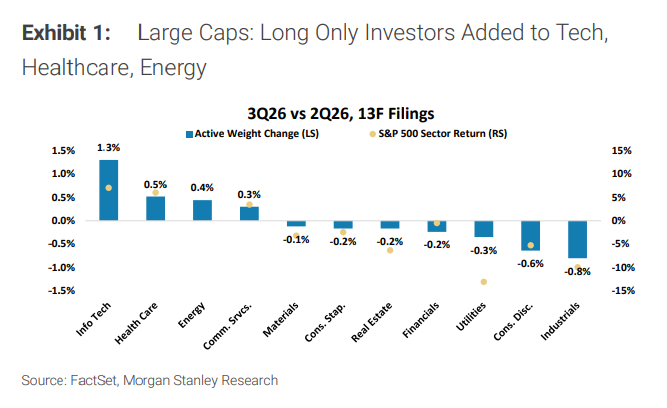
The Morgan Stanley team believes that changes in institutional positions this quarter were more driven by price quotes than by institutions taking the initiative to rearrange portfolios on a large scale.
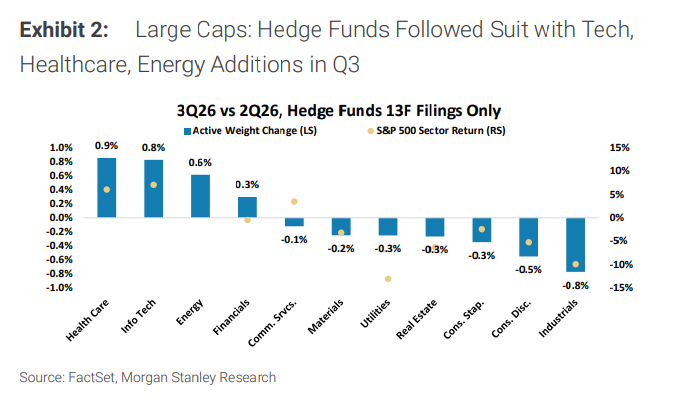
The operations of hedge funds on large-cap stocks are generally in line with market-wide institutions, giving priority to increasing positions in healthcare (+0.9%) and information technology (+0.8%), followed by energy (+0.6%) and finance (+0.3%); reducing holdings in industry (+ 0.8%) and non-essential consumer goods (‑0.5%). The financial sector is an obvious difference: hedge funds slightly increased their financial holdings, but all 13F reporting institutions as a whole reduced their holdings in the financial sector slightly (‑0.2%).
Looking at the long-term allocation structure, hedge funds have continued to maintain a low value for the large-market information technology sector since 2017. As of the third quarter, the low allocation ratio of all institutions to large market technology was -- 1.0%, the same as the month-on-month ratio; the low allocation ratio of hedge funds increased to ‑7.2%, compared to ‑6.3% in the second quarter. The weight of the S&P 500 technology industry index rose to 40% during the same period.
Small-cap stocks: Technology and industry are being sold off, and energy is shifting from a major reduction to a focus on increasing positions
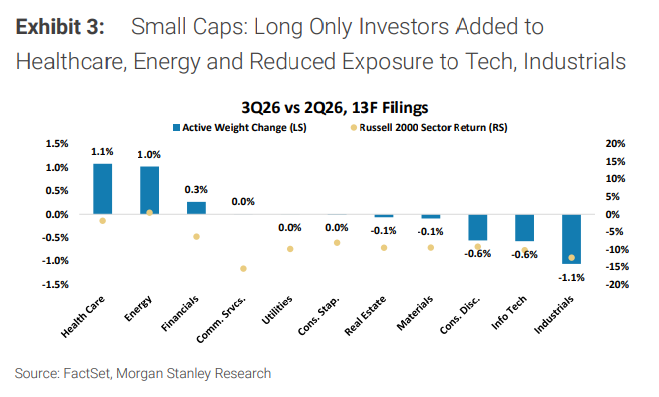
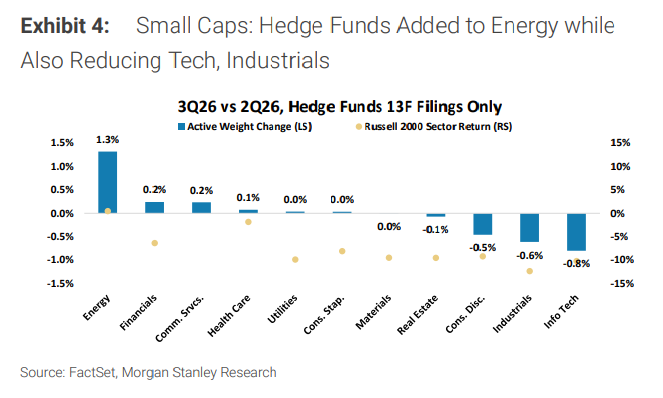
Institutional position adjustments in the small cap market showed similar characteristics to large markets, but the most prominent difference was in information technology: large cap technology obtained an active increase of +1.3%, while small cap information technology instead recorded an active position reduction of ‑0.6%.
At a time when the Russell 2000 index fell 7.5%, recovering some of the gains in the second quarter, institutions mainly increased their holdings in healthcare (+1.1%), energy (+1.0%); reduced holdings in industry (‑1.1%), information technology (‑0.6%), and non-essential consumer goods (‑0.6%). Among them, the energy sector showed a dramatic reversal in the small-cap dimension: in the second quarter, pure long term funds and hedge funds all listed small-cap energy as the main target for reducing holdings, with position reductions of -1.0% and -1.3%; by the third quarter of 2026, energy had quickly become the largest direction to increase positions in the small-cap hedge fund portfolio, increasing its active weight by +1.3%.
Hedge funds simultaneously reduced their holdings in information technology (‑0.8%), industry (‑0.6%), and non-essential consumer goods (‑0.5%) in the small-cap market. Looking back at the second quarter, hedge funds increased their holdings significantly in small-cap healthcare (+4.3%), and the trend of adding positions in the current quarter cooled down markedly to only +0.1%; small-cap information technology also changed from +1.8% increase in the second quarter to the biggest holdings reduction industry in the quarter; the industrial sector continued to reduce net holdings, but the reduction in hedge fund holdings narrowed sharply compared to the second quarter.
Small-cap healthcare is an iconic overfit racetrack for hedge funds. According to the data, healthcare assets accounted for 39% of AUM in the hedge fund portfolio, with no change from month to month, while the weight of the industry in the Russell 2000 Index was only 21%, and the overallocation was mainly concentrated on small-cap biopharmaceutical targets. This part of the health care overallocation position was achieved by the low-allocation cycle sector: compared to Russell 2000, hedge funds were low in finance - 7.9%, industry - 6.5%, and non-essential consumer goods - 3.3%.
Regional holdings: US funds hold more than 80% of S&P 500 ownership, Latin America's low-grade technology and excessive raw material energy
In terms of geographical distribution of funding sources, funds registered in the US held 81% of the total market value of the S&P 500, which was the same ratio from month to month; funds from Europe, the Middle East, and Africa accounted for 16%, and funds from the Asia-Pacific region accounted for 3%, and the shareholding share of the world's major regions remained almost unchanged this quarter. By industry, the energy sector accounts for the highest share of capital in North America, reaching 86%; the real estate sector accounts for the highest share of overseas capital, with 21% of capital coming from overseas.
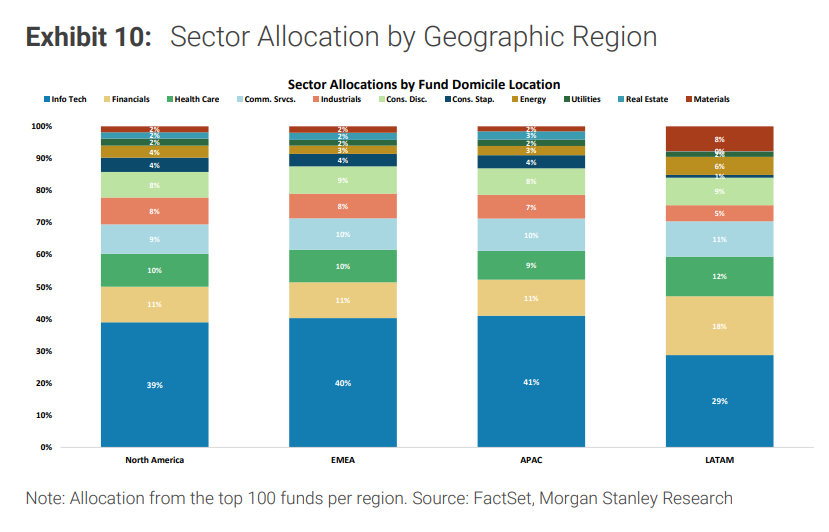
There are differences in fund industry preferences in different regions: the allocation of the fund industry in Europe and Africa is roughly close to that of the mainland of the United States, with the IT sector being relatively overallocated by 1 percentage point, unchanged from month to month; Latin American funds only allocated 29% of information technology to US stocks, which is the lowest in major regions in the world, but it has increased by 3 percentage points over the past two quarters, and Latin American capital is more favored by the raw materials, finance, energy, and communication services sectors.
At the individual stock level: The list of increases and decreases in hedge fund positions is divided, and utilities Pacific Coal and Electricity have the highest increase in holdings
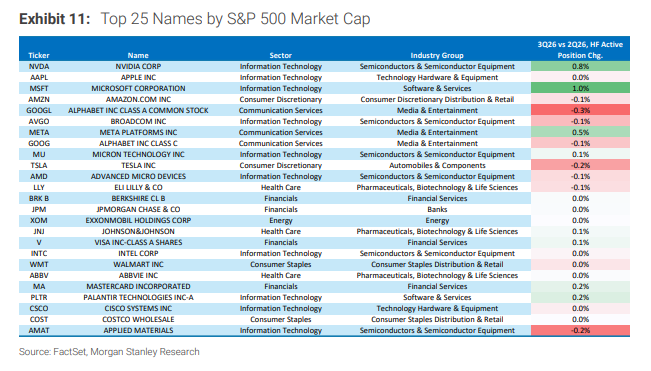
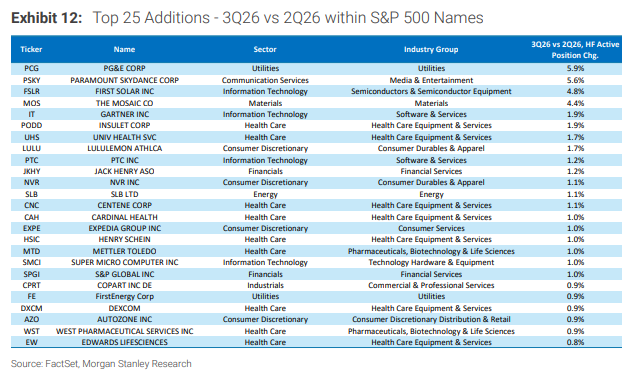
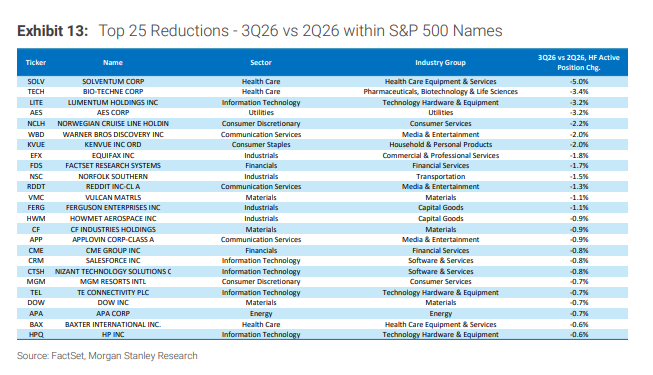
The report selected the targets with the most significant changes in active weight of hedge funds. The statistics here are quarterly changes in active weight, not absolute share of positions.
Among the S&P 500 constituent stocks, the hedge fund's active increase in holdings was the utility company PCG.US (PCG.US), with an active weight change of +5.9%; followed by media company Skydance (PSKY.US) (+5.6%), photovoltaic company First Solar (FSLR.US) (+4.8%), and fertilizer company MOS.US (+4.4%). Medical equipment stock banks Hught (PODD.US), Lululemon (LULU.US), and Gartner (IT.US) also received significant active increases in positions.
On the holdings reduction side, medical equipment company Solventum (SOLV.US) took the lead with an active weight drop of -5.0%; biotech company Bio‑Techne (TECH.US) (‑3.4%), optical communications company Lumentum (LITE.US) (‑3.2%), and utility AES power generation (AES.US) (‑3.2%) were significantly downgraded by hedge funds. Cruise companies Norwegian Cruise Line (NCLH.US), Warner Bros. Discovery (WBD.US), and Kenvue (KVUE.US) also appeared on the list of major holdings reduction.
Position adjustments targeting large market tech giants were relatively moderate: Microsoft (MSFT.US) (+1.0%), Nvidia (NVDA.US) (+0.8%), Meta (META.US) (+0.5%) received small active increases from hedge funds; Google (GOOGL.US) (‑0.3%) and Tesla (TSLA.US) (‑0.2%) were slightly reduced in active weight; Apple (AAPL.US), Berkshire (BRK.B.US), J.PM (J.PM) US), ExxonMobil (XOM.US ), etc., there are almost no marginal position adjustments.