


EN
The biggest IPO in history hits “GTA6,” which players have been waiting for 13 years! Anthropic dark market premiums ignite the market, and the year-end tech stock carnival is poised to begin?
On November 19, “Grand Theft Auto 6” (GTA VI), which gamers around the world had been waiting for 13 years, was launched one after another in major markets around the world; at the same time, Wall Street's top asset management giants and hedge funds are waiting for another major event in the tech industry — the US stock listing debut for AI star company Anthropic. This AI giant has raised 81.3 billion US dollars through an IPO, setting the biggest IPO record in history, surpassing the previous record held by SpaceX. Anthropic is priced at $83 per share, which is 6.4% higher than the upper limit of the issuance range. The fully diluted valuation at the issue price is approximately $1.5 trillion. Prior to the official listing on NASDAQ, the German brokerage firm Lang & Schwarz's dark market price reached a maximum of 105 US dollars, which was about 26.5% higher than the issue price.
The Zhitong Finance App observed that during the Asian market trading session on Thursday, NASDAQ 100 futures rose 2% and S&P 500 futures rose 1.1%. The first major positive sign that this record IPO brought to the year-end market is undoubtedly that even if global technology stocks dominated by AI computing power themes and semiconductor sector weight have just experienced a drastic reduction in positions, the market is still willing to invest large sums of money into the commercialization prospects of cutting-edge AI models, and an even more significant positive bullish signal may be that Anthropic listing fanaticism is expected to gradually ignite the global year-end bullish market starting Thursday.
The reason why the much-anticipated debut of the AI leader in the US stock market may ignite the year-end market is that it coincided with a critical time when global institutional investors drastically cut their positions in technology stocks and corporate profit expectations are still strong. If the index can maintain its growth rate and the volatility continues to decline after the IPO fever has passed, the funds previously reduced may be bought again at a higher price.
According to the latest research report by the Goldman Sachs strategist team, looking at the year-end rise, the historical increase was more concentrated after December 15 — that is, most of the actual increase was concentrated after December 15. That is, the main battleground for the so-called “Christmas year-end super market”. At that time, if global technology stock buying power can spread from a few AI leaders to more fundamentally sound technology companies with drastically raised profit expectations, Anthropic's debut is expected to evolve from a carnival of new shares to a year-end market supported by corporate profits.
After Anthropic's brilliant debut, the path for global tech stocks to a big rebound at the end of the year seems more and more clear
The reason why Anthropic's debut in the US stock market may have affected the market is that it happened to have a misalignment between positions and profit expectations. According to the Bank of America survey, the net overallocation ratio of global fund managers to technology stocks fell from 37% to 12%, the biggest decline in a single month in 20 years. Nomura estimates that the systematic stock strategy sold about 116 billion US dollars within two weeks, and the overall risk exposure fell to the 10th percentile in history.
Meanwhile, forecasts compiled by Bloomberg's think tank show that S&P 500 companies' profits are expected to increase by 29% this year, and the profits of European Stoxx 600 companies are expected to increase 20%. If the drop in oil prices of about 20% since November helps ease concerns about inflation, and Nvidia's performance outlook stabilizes AI profit expectations. Once volatility continues to decline, there is room for repurchases based on a risk-controlled position strategy. How far the rebound can go depends on whether rising profits can offset expectations of interest rate hikes and the pressure on valuations from a strong dollar.
A series of major risk events have prompted stock investors to drastically reduce their risk exposure. Today, more and more institutional and retail investors are optimistic that the stock market will rebound at the end of the year after these events are settled.
Right now, the market is still digesting the events that have occurred one after another this month: the US midterm election results were unexpected, concerns surrounding artificial intelligence transactions are once again heating up, and the war in Iran continues. The Chicago Board Options Exchange Volatility Index (VIX) is approaching a level that usually means the market is under pressure.
However, Anthropic's initial public offering received enthusiastic responses, and its shares have moved higher in undermarket trading, which may indicate a shift in market sentiment. Investors also believe that economic and corporate profit prospects are still strong enough to push the stock market back to historic highs. Oil prices have fallen 20% since November, and the performance outlook released by Nvidia this week has also made investors regain their confidence in AI infrastructure construction.
Benedict Lowe, a stock derivatives strategist at BNP Paribas, said: “Towards the end of the year, there are fewer major events ahead. The level of positions in the US and European markets is relatively low, and as long as there is no disturbance from other factors, there is room for the stock market to rebound from its current position.”
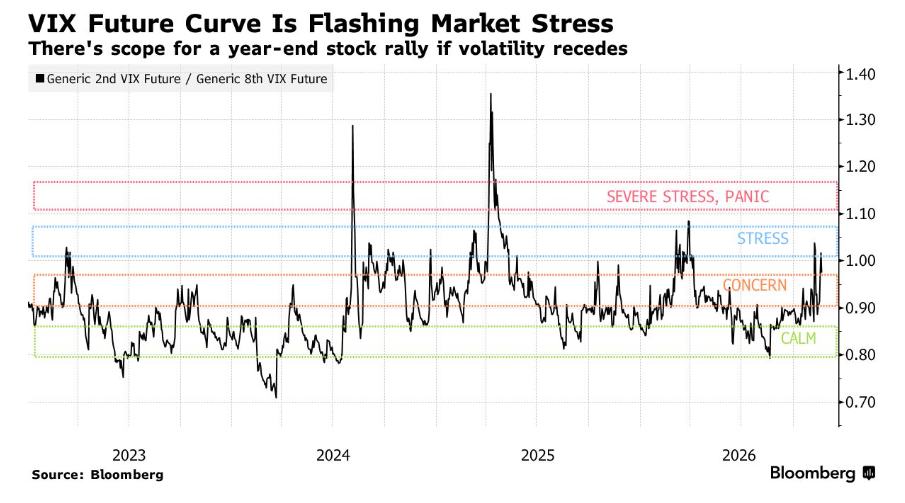
As shown in the chart above, the VIX Panic Index futures curve signals market pressure — if volatility falls back, global stock markets are expected to rebound at the end of the year.
Momentum trading is deleveraged very fast. According to a survey released by Bank of America this week, the net overallocation ratio of global fund managers to technology stocks plummeted by 25 percentage points in November, the biggest decline in 20 years.
Overall stock positions also hovered at low allocations. Although some retail traders are still enthusiastic, pessimism prevails among institutional investors. Goldman Sachs's main brokerage business data shows that the net leverage level of funds using a fundamental long and short strategy is still close to the bottom of the past four-year range.
Furthermore, the systematic strategy has sold off stocks in a big way over the past few weeks. This means that once market sentiment improves, these strategies may soon shift to buying.
Nomura's cross-asset strategist Charlie McEligot estimates that the systematic stock strategy has sold $116 billion worth of stocks in the past two weeks, reducing its overall risk exposure to the 10th percentile in history. He believes that since the market has removed quite a bit of risk exposure, once the volatility starts to decline, the higher the stock price and the more they are attracted to the market, investors who have previously reduced their positions may be forced to buy at higher prices.
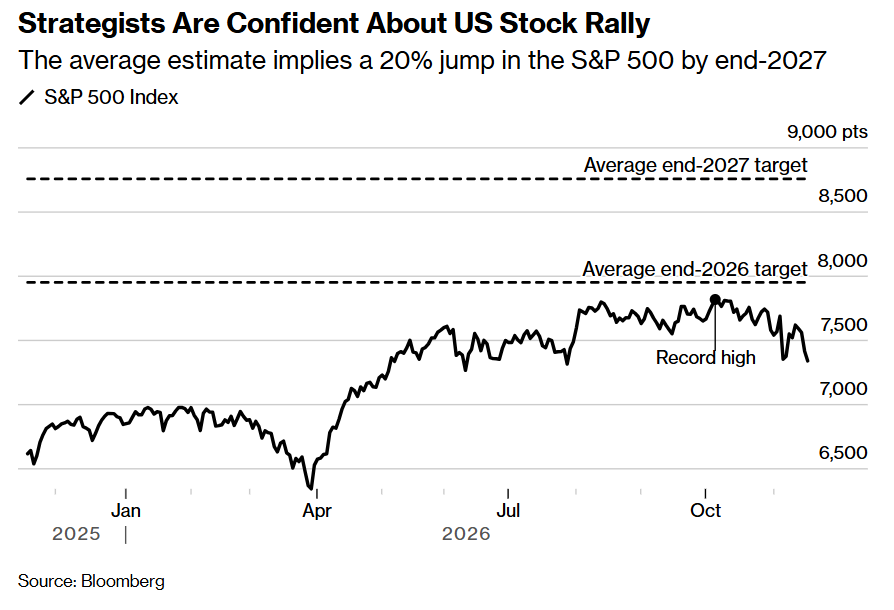
As shown in the chart above, Wall Street's top strategists are confident that US technology stocks will rebound in the future — the Wall Street average forecast means that by the end of 2027, the S&P 500 index, where technology stocks hold more than 50% of the weight, will rise 20% from current levels.
Market strategists are also generally optimistic that the stock market will rise further this year. According to data compiled by Bloomberg, the average target given by more than 30 forecasters is 7,952 points, which means that by the end of 2026, the S&P 500 index will rise another 9%. Their predictions for next year are more optimistic, and the index is expected to rise 20% from current levels.
Underpinning this judgment is a strong corporate profit outlook. After another high-performing earnings season, data compiled by Bloomberg Think Tank shows that S&P 500 companies' profits are expected to increase 29% this year, the fastest growth rate since 2021. The situation is similar in Europe. After three years of weak growth, the profits of companies in the Stoke Europe 600 Index are expected to increase by 20% in 2026.
However, there are also different judgments in the market. The TS Lombard team downgraded global stocks to low allocations in the November asset allocation report and cut AI-related exposure. Daniel von Allen, the agency's strategist, warned that risks facing US corporate profits are rising, partly due to higher interest rates and a further warming of the labor market.
The interest rate swap market is also becoming increasingly uneasy about interest rate prospects. Traders' pricing reflects that the market expects the Federal Reserve to raise interest rates three times by June next year. Federal Reserve Governor Christopher Waller urged the central bank on Wednesday to consider raising interest rates by 50 basis points during the December meeting.
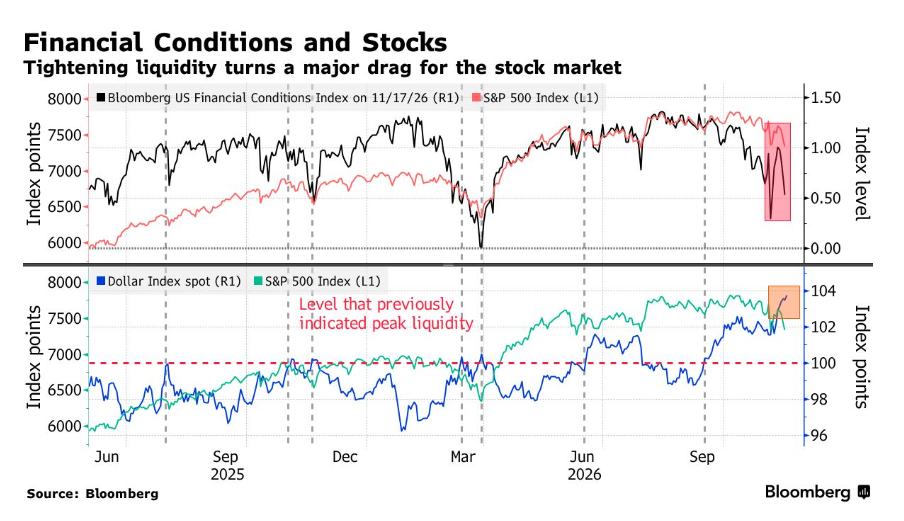
The above chart shows financial conditions and the stock market — tightening liquidity is a major drag on the stock market.
Since September, the US dollar has risen against a basket of currencies, and financial conditions have tightened accordingly. Judging from historical experience, declining liquidity and a stronger dollar are generally bad for the stock market.
Even when these factors are taken into account, conditions still exist to attract investors back to the market. Corporate profits continue to grow, some bubbles in valuation have subsided, and global economic growth is expected to accelerate next year. This time, the market may cover more markets and industries, and the increase is also expected to spread from major technology stocks.
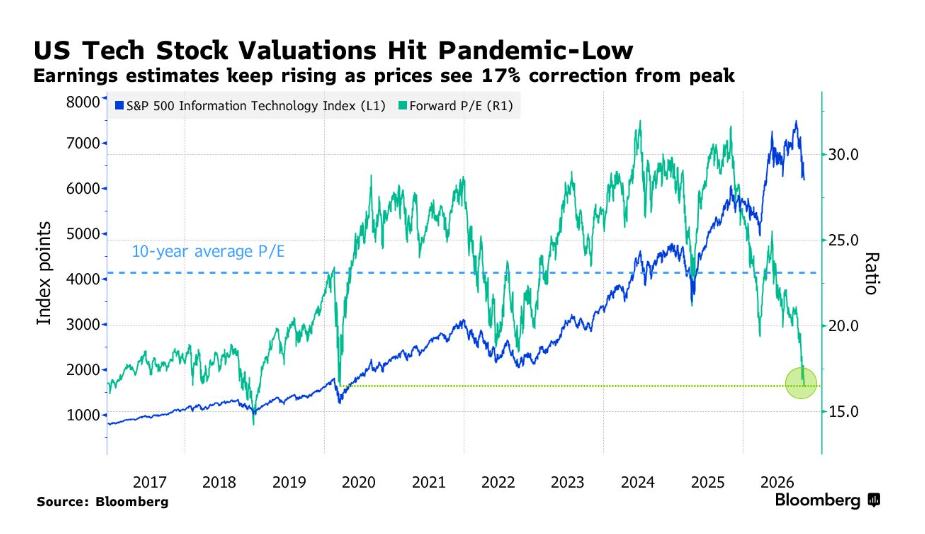
As shown in the chart above, the valuation of US technology stocks fell to their lowest point since the pandemic — the benchmark share price level has retreated sharply by 17% from its peak, yet profit expectations are still rising.
Strategists, including the UBS Global Wealth Management team, believe that Europe is expected to be a market with outstanding return on investment. At the same time, how to select targets between companies providing AI technology and infrastructure and companies that use AI will still dominate market discussions.
Mohit Kumar, a senior stock market strategist from Jefferies, another Wall Street giant, said, “We do think the recent sell-off has created quite a few buying opportunities. However, by 2027, performance will be divided even within the tech industry. Gone are the days where you can easily make money by buying just about anything.”
The biggest IPO in history hit the debut of “GTA6”! Players pay for the game, and Wall Street starts bidding for Claude's future
“Selling technology stocks and freeing up positions for Anthropic” can explain part of the sell-off trading logic, but it cannot explain the recent sharp decline in the entire technology stock theme. Behind the sharp decline in technology stocks, it was also triggered by major recent negative events in AI transactions, such as the slowdown in AI data center construction expectations due to the Democratic Party's victory in the election, the resignation of Huang Renxun, and the US government's increase in chip export restrictions.
Before Anthropic went public, the market feared that such a huge IPO would prompt some institutions to sell existing technology stocks and free up funds for subscription. This concern has a logical backbone — Anthropic's public offering alone reached US$81.34 billion, and another US$26 billion was raised through simultaneous private placement. However, subscribers can either reduce their stock holdings or use existing cash; it is impossible to estimate how much selling pressure technology stocks are under based on the amount issued alone.
Meanwhile, the Bank of America survey in November showed that the net overallocation ratio of global fund managers to technology stocks fell from 37% to 12%, the biggest monthly decline in 20 years, and 52% of the fund managers surveyed expect that at least one major cloud vendor will announce capital expenditure cuts in the next six months. The latest survey, combined with a series of negative AI trading events, revealed another reason for the adjustment of technology stocks: even if there is no capital requirement to subscribe for new shares, concerns about computing power orders and profit growth rates are enough to push investors to lower the valuations of some AI companies. After Anthropic pricing, Nasdaq 100 futures once rose 2%, which clearly shows that the same IPO may not only bring pressure to adjust positions during the subscription phase, but may also boost confidence in the entire sector after strong subscriptions and bullish market demand are verified.
Anthropic publicly issued 980 million shares, with a transaction value of US$81.34 billion, of which approximately US$1.96 billion came from the sale of shares by old shareholders. Another $26 billion was simultaneously sold in private placement, and the two totaled about US$107.34 billion. Subscribers can sell their current positions to raise capital, or use recently accumulated money market exposure and cash.
However, what is more noteworthy is the differentiation after Anthropic's dark market pricing: at a time when NASDAQ 100 futures once rose 2%, the Taiwanese stock market, which has eaten up AI infrastructure dividends in recent years, fell sharply by 4.4%. Hebe Chen, a senior analyst at Vantage Global Prime, pointed out that the launch of the cutting-edge model provides investors with a channel to directly participate in the growth of AI applications, and may also divert funds previously concentrated in the hardware supply chain in Taiwan and South Korea. At the end of the year, even if there is an AI computing power and even a broad technological carnival, the stock prices of chips/semiconductors, cloud computing platforms, data center power chains, and AI model companies may follow different paths.
Anthropic provided this rotation with a valuation scale that can be continuously tracked. The company's annualized revenue operating rate reached 81 billion US dollars at the end of October, an increase of 10 billion US dollars over the end of September. However, the share of computing power and infrastructure costs in the third quarter increased from 48% to 58% of revenue, and operating results also changed from a profit of US$974 million in the previous quarter to a loss of US$567 million. The company disclosed procurement and leasing commitments of approximately US$909 billion, mostly related to computing power and infrastructure.
For tech investors focusing on AI computing power and the semiconductor sector, Claude's entry into more corporate workflows is just the first step. Whether the utilization rate of existing computing power can be increased with the amount of pay-as-you-go expenses and whether the inference costs required to complete a customer task can be reduced will determine how much of the additional revenue can be left over and become profit.
GTA6 provides another, more intuitive verification of requirements. Some media recently quoted Sensor Tower estimates. The pre-sales volume of this game has exceeded 17 million copies, with sales exceeding 1.65 billion US dollars, which is equivalent to about RMB 11 billion.
British Opinium estimates based on the latest survey that players' vacation due to the launch of GTA may involve about 4.1 million working days; the US market may “lose 1 billion US dollars in productivity.” The real investment comparison of this much-anticipated “double launch” is that Take-Two can use purchases that players have already paid to verify demand that has been built up for 13 years, while Anthropic's trillion-dollar valuation requires corporate renewal, computing power utilization, and profits for multiple quarters to be fulfilled.
Goldman Sachs looks ahead to the year-end Christmas market: the real increase may be concentrated after December 15
As far as investors' expectations of the global stock market at the end of the year are concerned, the most powerful sign is that at a time when the net overallocation ratio of global fund managers to technology stocks has dropped from 37% to 12%, the market is still able to undertake a record AI share offering. Previously, investors feared that huge subscriptions would divert funds from technology stocks, but now higher-than-expected pricing gives low-position institutions a reason to reevaluate their decision to reduce their positions.
The reason why Anthropic can change the atmosphere of AI trading is that it allows investors to test both sides of the transaction for computing power at the same time. Nvidia's higher-than-expected revenue guidance shows that customers are still ordering next-generation computing systems; Anthropic's annualized revenue operating rate as of the end of October reached 81 billion US dollars, an increase of 10 billion US dollars in a single month, indicating that the company's demand for payment for model services is also expanding.
However, Anthropic's third-quarter computing power and infrastructure costs rose from 48% to 58% of revenue, and operating results changed from a profit of US$974 million in the previous quarter to a loss of US$567 million. The two sets of numbers explain why IPOs can boost the risk appetite of the entire AI sector, but subsequent returns may be clearly divided: chip makers rely on delivery computing power to confirm revenue, and model companies also rely on paid calls, pricing, and reasoning efficiency to turn purchased computing power into profit.
After the ignition, the buyers already present were retail investors and listed companies that bought back shares. According to statistics from the Goldman Sachs strategist team, retail investors made net purchases of about US$6.2 billion in US stocks last week, the highest in 11 weeks. Among them, Nvidia alone attracted 1.75 billion US dollars. Meanwhile, about 94% of S&P 500 companies are in the open buyback window.
Institutional choices are more recognizable: Goldman Sachs main brokerage clients cut short positions in US-listed ETFs by 8.6%, yet continued to net sell individual stocks, and the long/short ratio of US technology stocks fell to 1.5 times the lowest since records began in 2016. This means that institutions have begun to reduce their bets on the general market decline, and there are still differences over the profit prospects of single technology stocks. Retail investors can hold back the first round of rebound; to spread the gains, more institutions are needed to move from making up for the bears to actively go long.
What is most likely to amplify this round of rebound is the systematized capital, which previously sold the fastest. Nomura estimates that this strategy has sold about 116 billion US dollars of stocks within two weeks, and the overall risk exposure has dropped to the 10th percentile in history. Goldman Sachs's trend tracking strategy (CTA) model shows that if the market moves sideways in the coming week, net purchases are expected to be about 23 billion US dollars; if the market rises, the purchase scale may expand to 30.8 billion US dollars; if it falls, net sales are expected to be about 6.1 billion US dollars.
Therefore, the most favorable outcome of Anthropic's debut for the market was that the index was able to maintain growth even after the subscription fever had passed, so that trend strategies could gradually make up, and funds that controlled their positions according to volatility could also conditionally increase their positions. The time window is also important: if the decline continues for a month, the potential sales corresponding to the Goldman Sachs model could reach about $123 billion.
The reason why December 15 is worth watching is that the historical increase is more concentrated after that, and the current buyback may begin to weaken around December 13. Goldman Sachs found in retrospect that in the past 36 years, the S&P 500 rose 27 years from December 15 to the end of the year, with an average increase of about 1.22%. If you only look at the 17 years where VIX reached or exceeded 18 in mid-November, although the 14-year volatility declined at the end of the year, from mid-November to the end of the year, the index rose for only 59%, and the median of the biggest retracement during the period reached 3%.
More favorable conditions for this year are forecasts compiled by Bloomberg Think Tank, showing that S&P 500 companies' annual profits are expected to increase by 29%. Therefore, judging whether Anthropic can ignite a real year-end market, the market may focus on whether the upward momentum can expand from a hot new stock and a few AI leaders to more technology companies with improved profit expectations after the Federal Reserve's December resolution is implemented. This shows more than the first-day premium in the dark market, whether Wall Street is willing to re-position itself for profit growth in 2027.