


EN
Walt Disney (DIS) Beats On Earnings And Lifts Dividend, Is The Stock Fully Valued?
Walt Disney (DIS) just put fresh numbers on the board, with fiscal fourth quarter revenue of US$25.95b and net income of US$2.61b, alongside a 33% dividend increase.
Those results have reset the tone around Walt Disney, with the share price up 11.65% over the past month and 14.01% over 90 days. The 1-year total shareholder return of 18.59% points to momentum rebuilding after a weaker 5-year total shareholder return, which is down 16.61%.
Scan how Walt Disney's rebound compares with other media and entertainment stocks by checking out the hand-picked 35 high quality undervalued stocks.
After that earnings reset and the recent 52 week high, Walt Disney now trades just below analyst targets and almost level with one intrinsic value estimate. So where does a sensible fair value range actually land?
Preferred P/E Ratio of 21.4x: Is it justified?
On current numbers, Walt Disney trades on a P/E of 21.4x, which prices the stock above the broader US Entertainment industry but below closer peers and one fair value estimate for its earnings multiple.
The P/E ratio compares the share price with earnings per share. For a content heavy group like Walt Disney, this measure helps you see how much the market is willing to pay for each dollar of profit, given its mix of streaming, studios and parks cash generation.
Right now the market is assigning Walt Disney a richer P/E than the US Entertainment industry average of 17.2x, which points to investors paying up relative to the sector. At the same time, that 21.4x sits well under the peer group average of 44.7x and below the estimated fair P/E of 26.1x. This suggests the valuation could feasibly migrate closer to that higher level if sentiment and fundamentals stay aligned with that view.
Explore the SWS fair ratio for Walt Disney.
Result: Price-to-earnings of 21.4x (ABOUT RIGHT)
Still, higher expectations leave Walt Disney exposed if streaming subscriber trends wobble again or if park spending softens from current levels.
Find out about the key risks to this Walt Disney narrative.
Another View: What the SWS DCF Model Says About Walt Disney
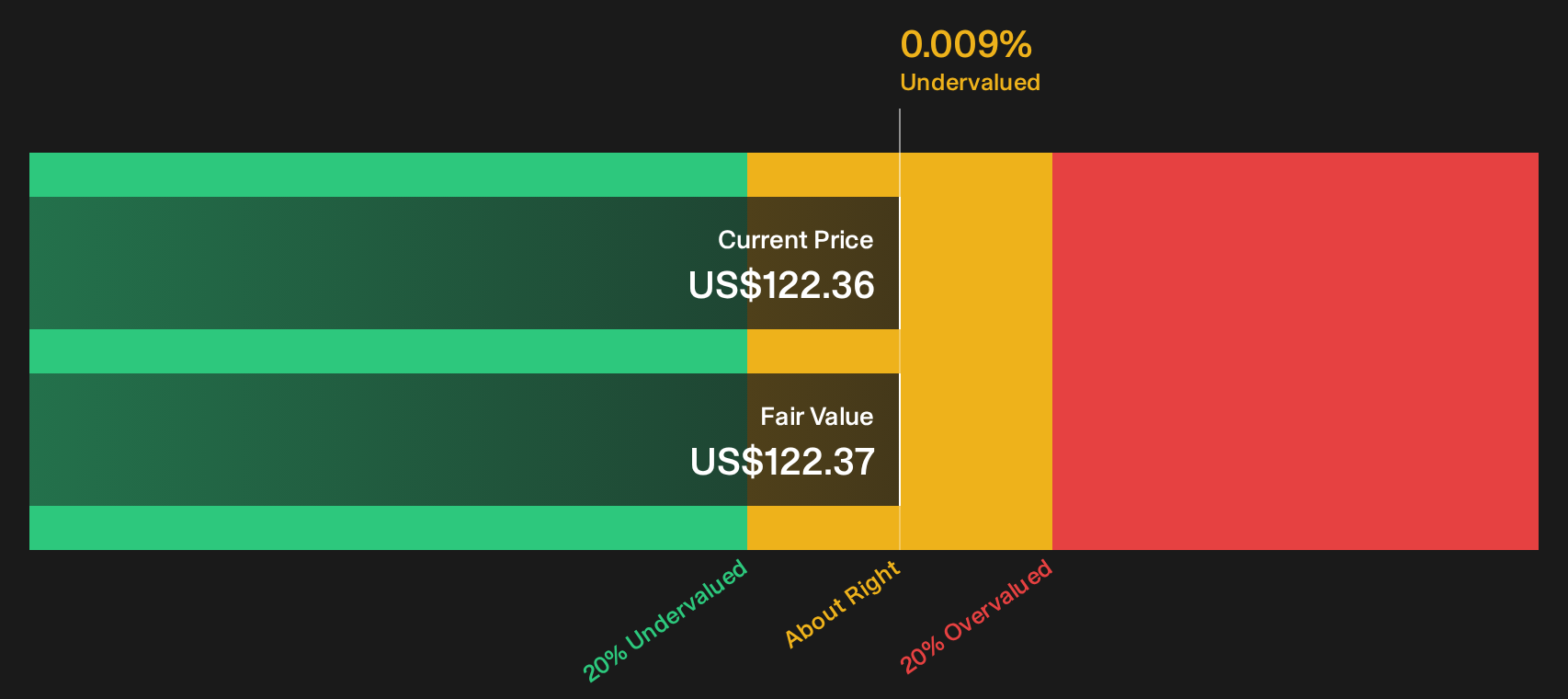
While the P/E lens puts Walt Disney on a premium to the wider US Entertainment group, the SWS DCF model lands in a very different place. It pegs fair value at about $122.37 per share, almost identical to the recent $122.36 price. This implies the stock is effectively fully priced on this cash flow view.
That kind of razor thin gap leaves little room for error. If cash generation ends up even slightly below the assumptions in that model, there is not much valuation cushion for investors to fall back on. On the other hand, if execution matches or beats those inputs, the question becomes whether the current quote already captures most of that potential upside.
Look into how the SWS DCF model arrives at its fair value.
Simply Wall St performs a discounted cash flow (DCF) on every stock in the world every day (check out Walt Disney for example). We show the entire calculation in full. You can track the result in your watchlist or portfolio and be alerted when this changes, or use our stock screener to discover 35 high quality undervalued stocks. If you save a screener we even alert you when new companies match - so you never miss a potential opportunity.
Next Steps
If the mixed signals around Walt Disney leave you unsure, act quickly and put the numbers in context for yourself by weighing both the 2 key rewards and 1 important warning sign.
Looking for more ideas beyond Walt Disney?
Do not stop your research with Walt Disney. The best opportunities often sit just outside the headlines, where fewer investors are paying attention.
- Target resilient balance sheets by screening a list of solid balance sheet and fundamentals (24 results) that can better handle shocks when conditions change suddenly.
- Hunt for quality at a reasonable price by reviewing a curated 19 high quality undiscovered gems that many investors may be overlooking.
- Prioritise steadier portfolios by focusing on a 30 resilient stocks with low risk scores that keeps overall risk scores in check.
Have feedback on this article? Concerned about the content? Get in touch with us directly. Alternatively, email editorial-team@simplywallst.com