


EN
Woodward beats Q3 CY2026 sales expectations, but CY2026 EPS guidance fall short

Aerospace and defense company Woodward (NASDAQ:WWD) reported calendar Q3 2026 [fiscal Q4 2026] results beating Wall Street’s revenue expectations, with revenue up 16.6% year on year to $1.16 billion. Its non-GAAP profit of $2.83 per share was 12.3% above analysts’ consensus estimates.
For more on Woodward, read the full research report for free.
Woodward Q3 CY2026 highlights:
- Revenue $1.16 billion vs S&P analysts’ consensus estimates of $1.14 billion (16.6% year-on-year growth, 1.8% beat)
- Adjusted EPS $2.83 vs S&P analysts’ consensus estimates of $2.52 (12.3% beat)
- Adjusted EBITDA $266.9 million vs analysts’ consensus estimates of $249.8 million (23% margin, 6.8% beat)
- Adjusted EPS guidance $10.45 at the midpoint for fiscal 2027, missing analysts’ consensus estimates by 2.8%
- Operating margin 19.7%, up from 15.1% in the same quarter last year
- Free cash flow margin 11.3%, down from 18.2% in the same quarter last year
- Market capitalization $18.29 billion
“Woodward delivered another year of record sales and earnings, with 22% sales growth and significant margin expansion across both segments, reflecting strong demand and disciplined execution," said Chip Blankenship, Chairman and Chief Executive Officer. "In Aerospace, higher aircraft production rates and continued strong inputs to repair centers drove double-digit growth in Commercial OEM and Services. In Industrial, strong demand across our end markets, combined with disciplined operational execution, drove significant earnings growth and margin expansion.
Revenue growth
Reviewing a company’s long-term revenue performance reveals insights into its quality. Even a poor business can perform well for one or two quarters, but a high-quality one grows for years. Woodward’s 14.2% annualized revenue growth over the last five years was strong. Its growth surpassed that of the average industrials company and shows its offerings resonate with customers.
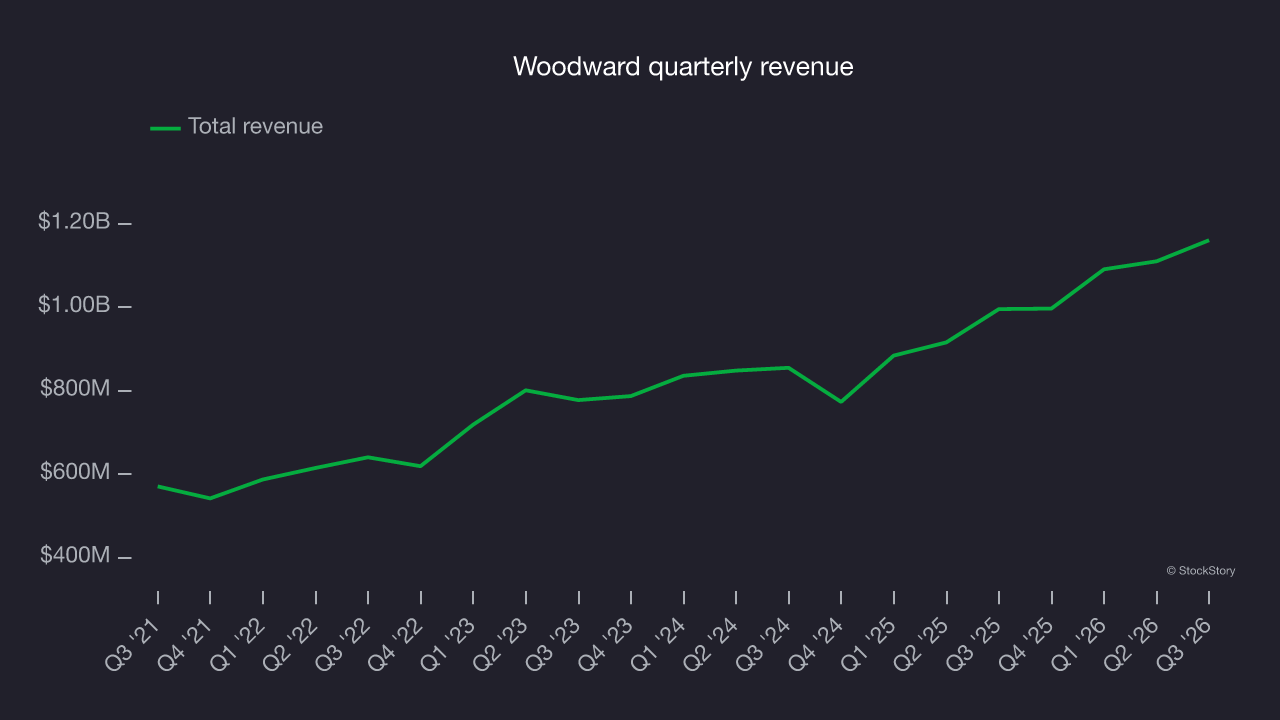
Long-term growth is the most important, but within industrials, a half-decade historical view may miss new industry trends or demand cycles. Woodward’s annualized revenue growth of 14.5% over the last two years aligns with its five-year trend, suggesting its demand was predictably strong. 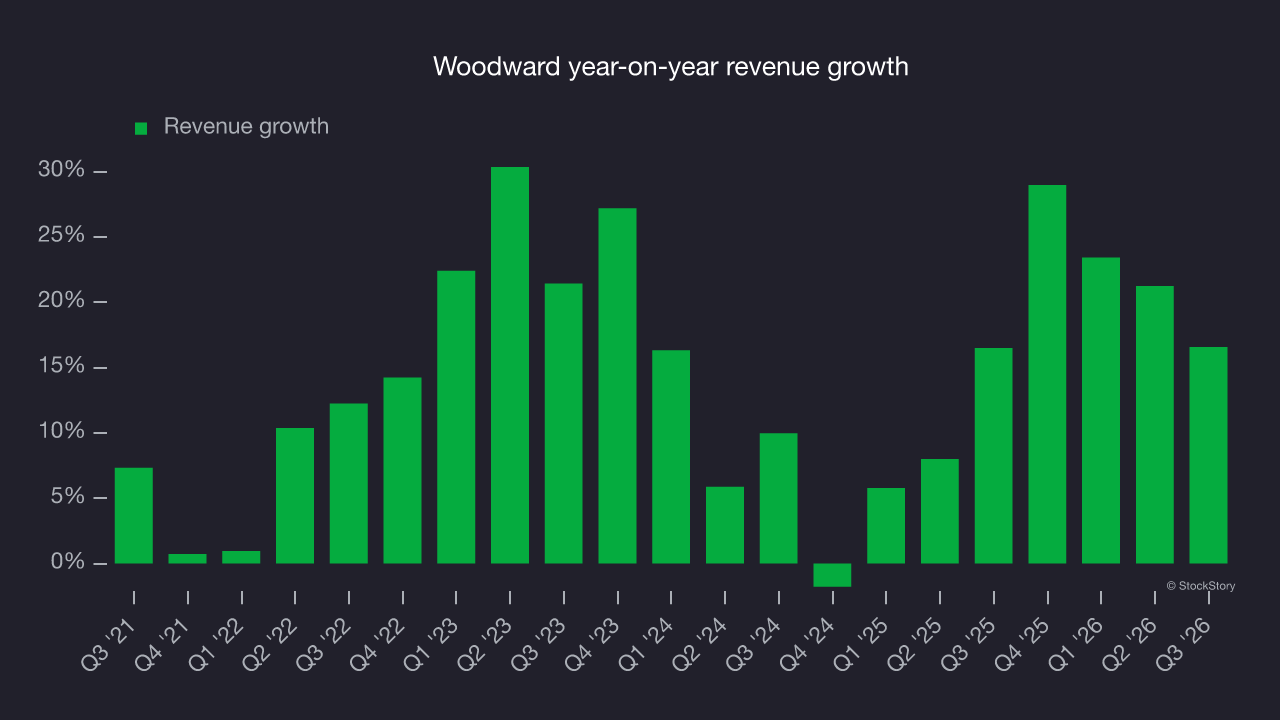
This quarter, Woodward reported year-on-year revenue growth of 16.6%, and its $1.16 billion of revenue exceeded Wall Street’s consensus estimates by 1.8%.
Looking ahead, sell-side analysts expect revenue to grow 8.2% over the next 12 months, according to S&P, a deceleration versus the last two years. Despite the slowdown, this projection is noteworthy and suggests the market sees success for its products and services.
Operating margin
Over the last five years, Woodward’s operating margin rose by 8.4 percentage points. This improvement shows its costs declined relative to revenue. Its trailing 12-month operating margin was 17%.
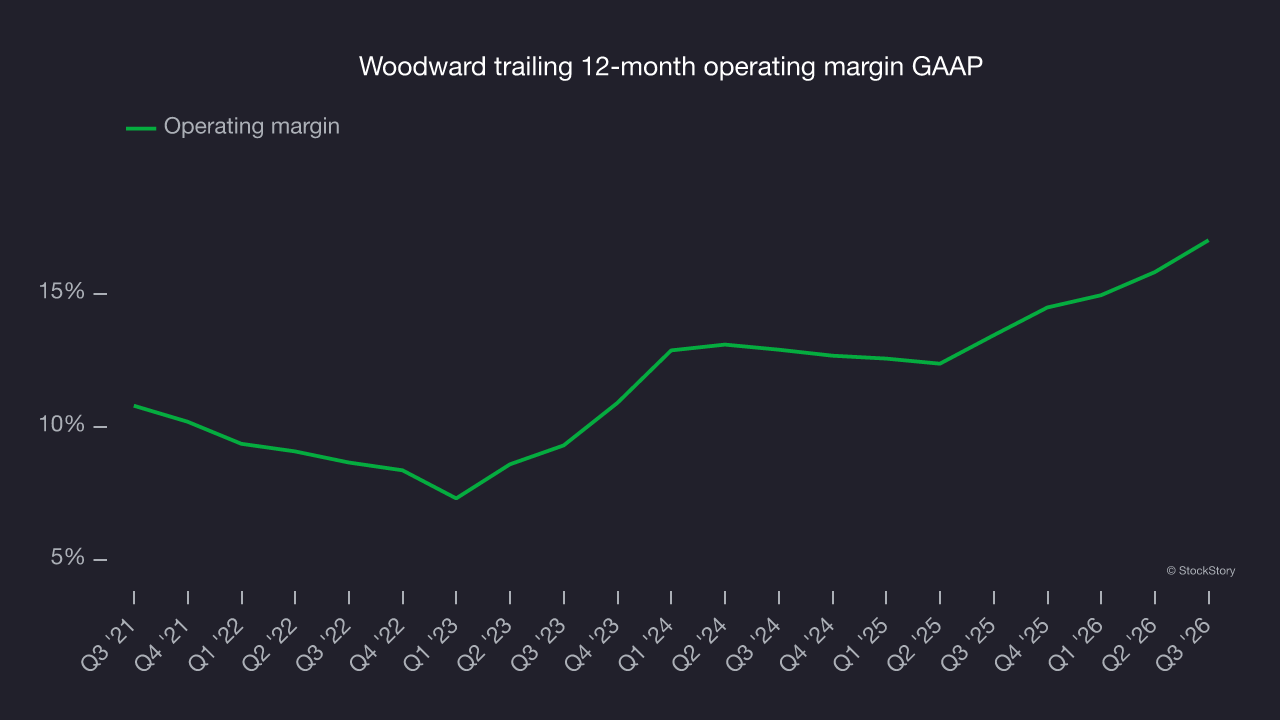
In Q3, Woodward generated an operating profit margin of 19.7%, up 4.6 percentage points year on year. The increase was a positive sign, showing improved efficiency.
Earnings per share
We track the long-term change in earnings per share, or EPS, for the same reason as long-term revenue growth. Compared to revenue, however, EPS highlights whether a company’s growth is profitable.
Woodward’s EPS grew at a 24.8% compounded annual growth rate over the last five years, higher than its 14.2% annualized revenue growth. This indicates the company became more profitable on a per-share basis as it expanded.
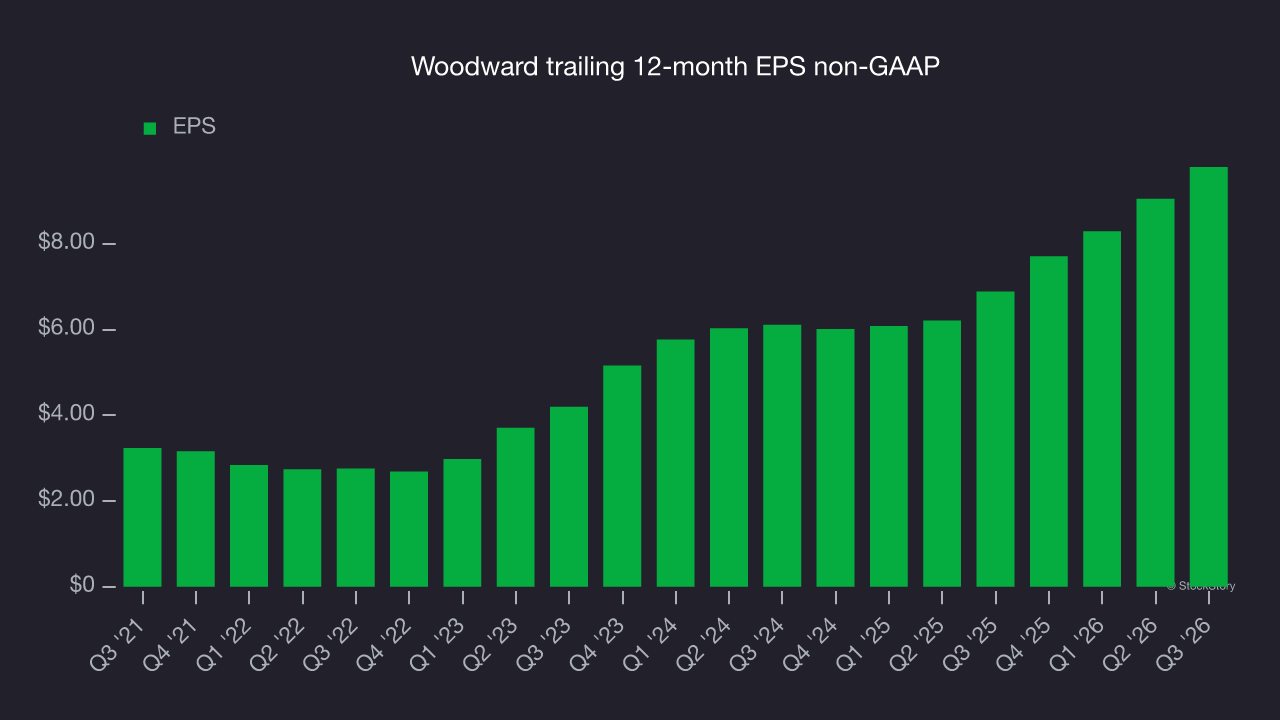
A closer look at Woodward’s earnings helps explain its performance. As mentioned earlier, Woodward’s operating margin expanded by 8.4 percentage points over the last five years. In addition, its share count shrank by 8%. These are positive signs for shareholders because improving profitability and share buybacks boost EPS growth relative to revenue growth. 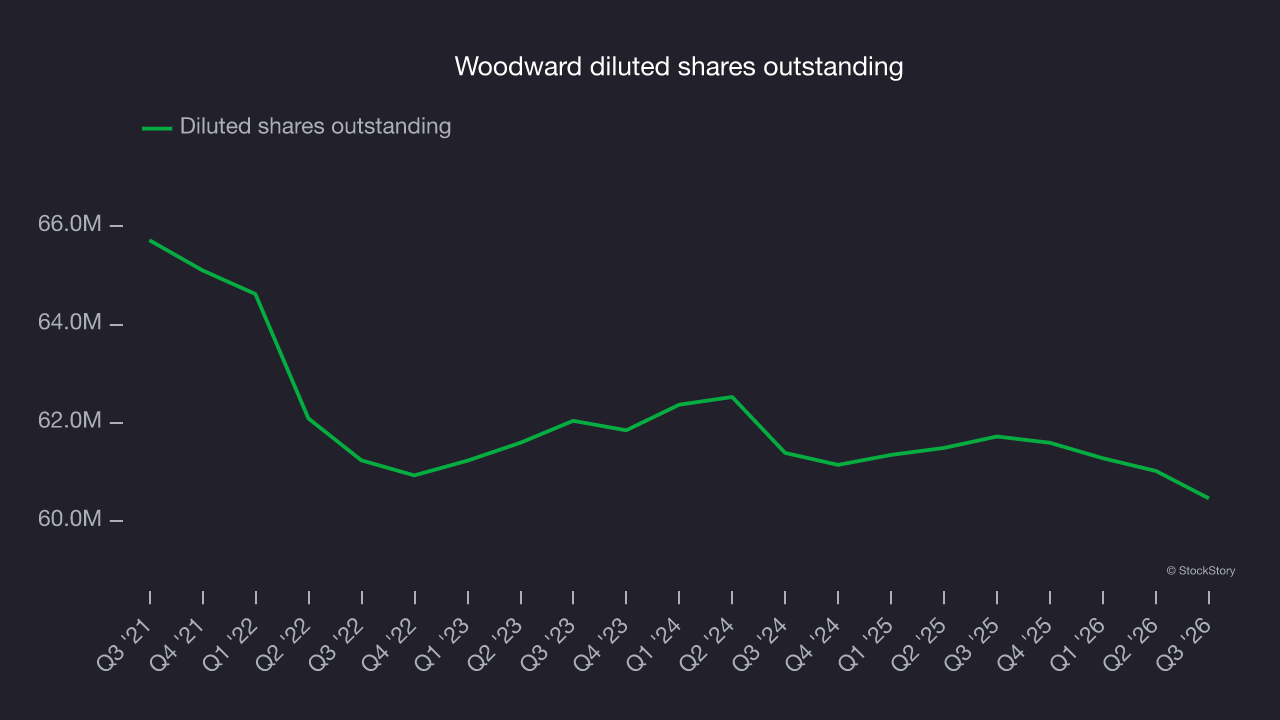
As with revenue, we analyze EPS over a more recent period because it can provide insight into an emerging theme or development for the business.
For Woodward, its two-year annual EPS growth of 26.6% was higher than its five-year trend. That acceleration is a positive sign, especially given the already high growth base.
In Q3, Woodward reported adjusted EPS of $2.83, up from $2.09 in the same quarter last year. EPS easily cleared analysts’ consensus estimates, a positive result for shareholders. Over the next 12 months, Wall Street expects Woodward’s full-year EPS to grow 10% from $9.79 to $10.77, according to S&P.
Key takeaways from Woodward’s Q3 results
Revenue and EBITDA both topped Wall Street’s consensus estimates, giving Woodward’s quarter some key positives, but its full-year EPS guidance fell short. The market seemed to be hoping for more: Shares edged lower 1.8% to $312.50 immediately after the report.
The latest quarter matters, but longer-term business quality and valuation matter more when deciding whether to invest in Woodward. For more on business quality and valuation, read our full research report here (it’s free).