


EN
Dear SpaceX Stock Fans, Mark Your Calendars for November 19
Just days after SpaceX (SPCX) grabbed headlines by catching Starship’s upper stage with its launch tower’s mechanical arms, the company is turning back to its workhorse rocket. The catch came after Starship deployed Starlink satellites and completed its orbital flight. Now SpaceX is targeting Thursday, Nov. 19, for its next Falcon 9 launch.
Just weeks after the company reported $14.6 billion in revenue across all its businesses, the mission gives shareholders a closer look at one of them. That figure shows how much SpaceX brought in across all its businesses, but it doesn’t show what goes into delivering a single launch.
So what can Thursday’s Falcon 9 mission tell shareholders about how SpaceX runs its launch business? Let’s find out.
What the Falcon 9 Launch Could Signal
SpaceX moved its USSF-317 mission from Wednesday to Thursday, Nov. 19. The four-hour launch window opens at 6:46 p.m. Pacific, or 9:46 p.m. Eastern, at Vandenberg Space Force Base in California. If Thursday’s attempt slips, SpaceX lists a backup opportunity for Friday, Nov. 20, at 8:26 p.m. Pacific.
The Falcon 9 booster is set to fly for the 11th time. Its first 10 flights included eight Starlink missions and two government launches. After separating from the rocket’s upper stage, the booster is slated to land on a droneship in the Pacific. That flight history shows the value of reuse as SpaceX can deploy its own satellites and serve government customers without building a new first stage for every launch.
The bigger opportunity is the Space Force’s national security launch program, which projects 28 missions for SpaceX with an anticipated value of about $5.9 billion. That’s an estimate for the broader program, and not the price of Thursday’s mission.
If Thursday’s mission goes to plan, SpaceX will have another example of a reused booster delivering for a government customer. That strengthens its track record, but it doesn’t tell shareholders how profitable the flight was.
How SpaceX Stock Stacks Up
SpaceX reported third-quarter results on Oct. 20, with revenue rising 161% year over year to $14.6 billion, above Wall Street’s estimate of roughly $12.7 billion.
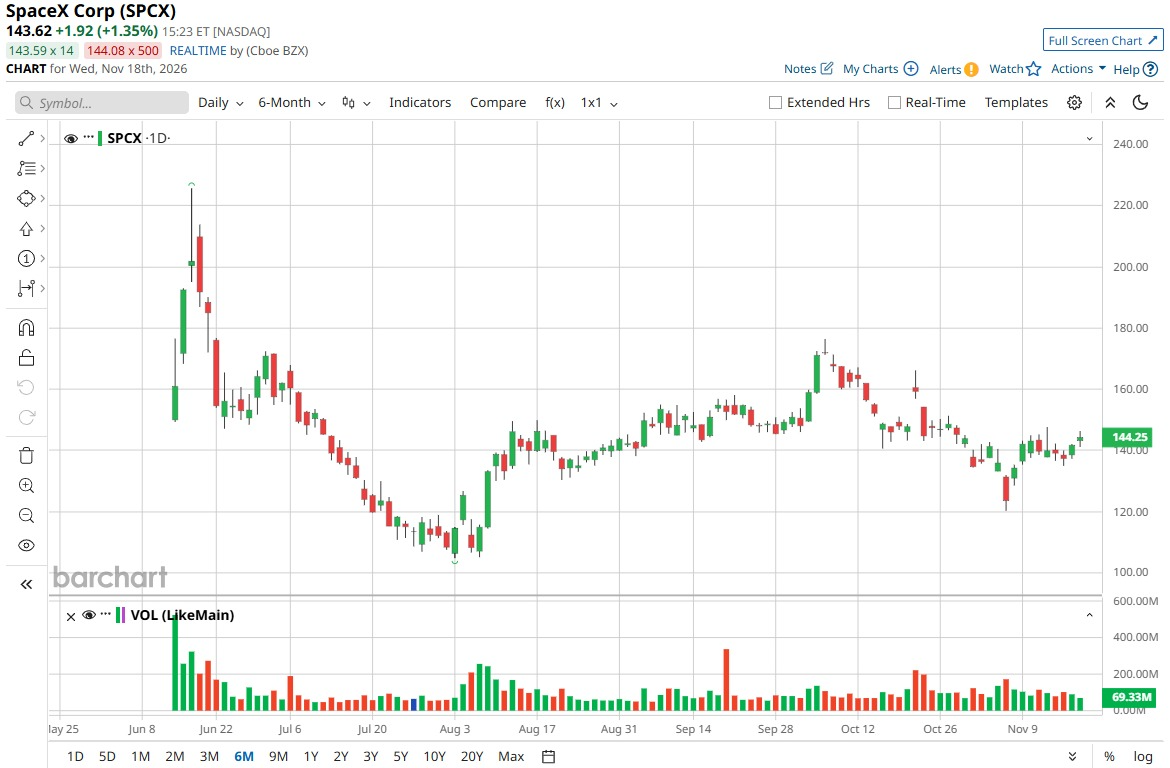
By Nov. 18, SPCX was trading at $143.50, up 2.49% over five days and 0.36% over three months, putting its market capitalization at about $1.92 trillion.
SpaceX’s Connectivity segment grew revenue 69% to $5.25 billion and generated $2.37 billion in operating income. Its Starlink consumer subscriber base reached 13.6 million, up from 12 million in June and 7.2 million a year earlier.
Beyond connectivity, two government awards give SpaceX a clearer schedule of future launch work. In August, the U.S. Space Force awarded the company a $1.6 billion contract covering 18 Falcon 9 national security launches through 2027.
NASA followed in September with a $946 million award for three more crewed Dragon missions to the International Space Station. That award extends SpaceX’s Commercial Crew contract through 2030, bringing it to 17 missions and $5.92 billion in cumulative contract value.
What Wall Street Expects From SpaceX
SpaceX’s next earnings report is tentatively set for January 19, 2027, and will cover the December quarter. The consensus estimate of $0.31 per share is four cents below the $0.35 SpaceX earned in the September quarter.
Cathie Wood’s ARK Invest isn’t waiting for that report. The firm bought about $49 million worth of SpaceX shares on Nov. 5, bringing its purchases over two days to roughly $96 million. Jim Cramer sees promise in the AI business, too, but he’s holding off on buying because he considers its projected costs “astronomical.”
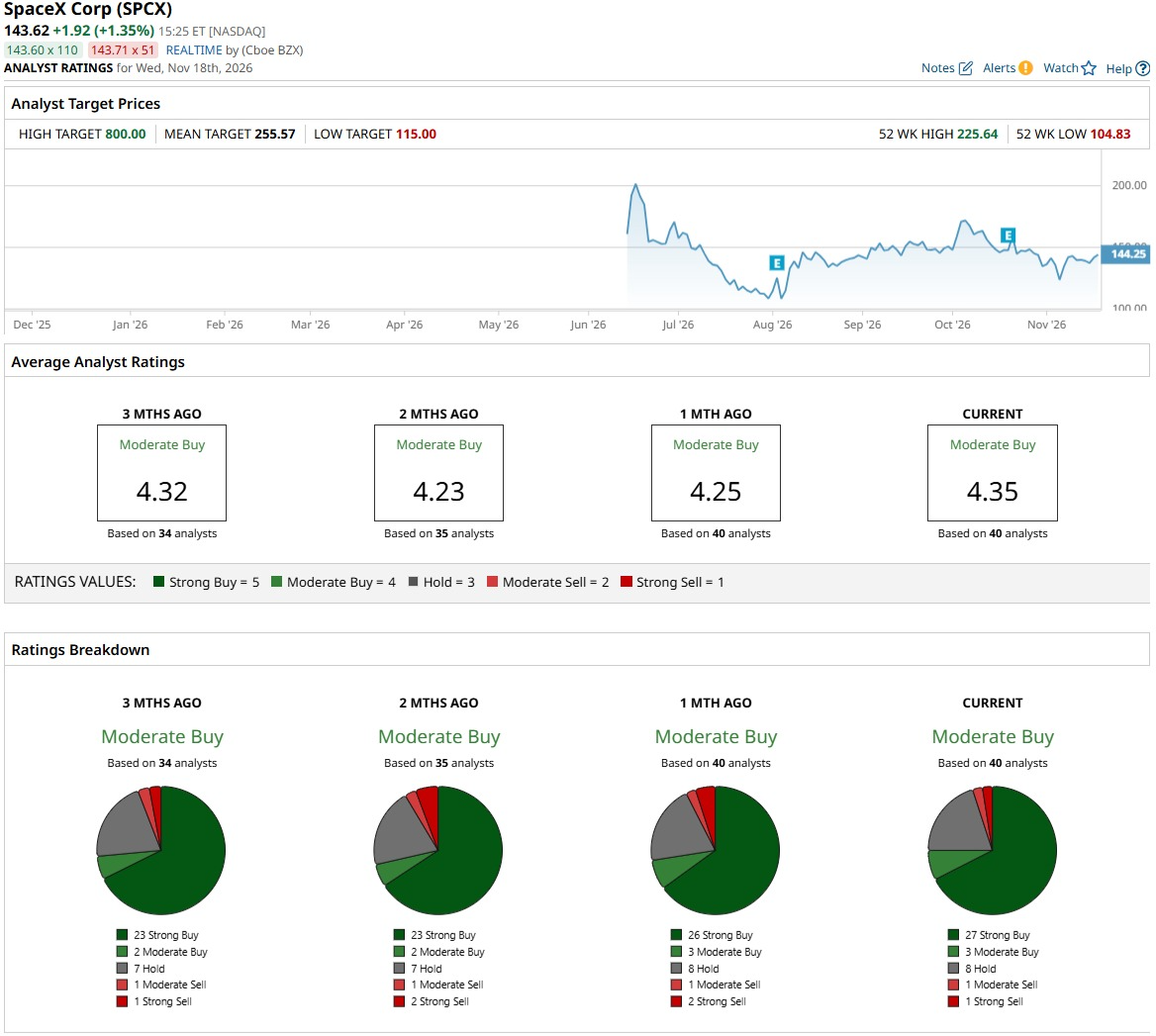
Wall Street still sees room for the stock to rise. The consensus among 40 analysts is a “Moderate Buy” rating, and the average 12-month price target of $255.57 implies about 78% upside.
Conclusion
SpaceX’s planned Falcon 9 launch is worth watching because it puts a booster that has already flown 10 times back to work for a government customer. If the mission goes to plan, it’s more likely to reinforce confidence in SpaceX’s launch business than to lift the stock much on its own. The bigger test for the stock is whether Starlink can keep adding customers and whether the AI business can earn enough to justify what SpaceX is spending on it.
On the date of publication, Ebube Jones did not directly have a position in any of the securities mentioned in this article. All information and data in this article is solely for informational purposes. For more information please view the Barchart Disclosure Policy here.