


EN
This Company (10%+ Yield) Has a Giant Presence, But It Carries Giant Risks. Stay Away from the Value Trap.
Tuesday’s markets were in the red across the board, with the Dow down 1.64%, the S&P 500 down just over 1%, and the Nasdaq Composite down 0.74%.
As expected, Nvidia (NVDA) reported excellent results after yesterday’s close, pointing to a rebound for the major indices in Wednesday's trading.
With the markets down on Tuesday, I’m going to focus on the top 200 bearish price surprises from yesterday. Cue Biopharma (CUE) had the highest standard deviation at -4.55 and lost 79.93% on the day. Among large-cap stocks, Salesforce (CRM) had the highest standard deviation at -3.59 and lost nearly 10%.
Looking through the top 200, an unfamiliar emerging market stock caught my attention. PLDT (PHI), formerly the Philippine Long Distance Telephone Company, had a standard deviation of 1.93 and lost 5.22%.
I’m always game to learn about companies I’m unfamiliar with or that analysts cover lightly. In PLDT’s case, just three analysts cover the smallish mid-cap.
Down 55% over the past five years, there are obviously reasons for the poor performance. Is it enough to label PLDT a value trap rather than a value play?
Here’s my two cents.
PLDT’s Stranglehold in the Philippines
Founded in 1928, the company is the Philippines' largest telco, offering legacy fixed-line, wireless, and broadband services.
PLDT reported its Q3 2026 results on Nov. 12. Revenues were 54.2 billion Philippine pesos ($863.3 million), up 0.4% from Q3 2025. Net income was 5.23 million Philippine pesos ($83.2 million), down 15.5% from a year ago.
Between Dec. 31, 2021, and Sept. 30, 2026, its revenues increased by 15.2% cumulatively, while its net income increased by 6.3%. However, using net income at the end of 2022, it grew at a much faster cumulative rate of 167.3%.
Regardless, its best year for net income since 2000 was 40.22 billion Philippine pesos ($922.2 million) on revenue of 150.81 billion Philippine pesos ($3.46 billion) in 2010.
In 2022, its net margin was 26.7%. In the latest 12 months ended Sept. 30, it was 12.7%, an indication that the competitive environment in the Philippines telco industry has increased significantly.
In 1981, PLDT acquired its second-largest competitor, Republic Telephone Company, becoming a virtual monopoly. Reforms began in the late 1980s and accelerated in 1993, when President Fidel Ramos issued an executive order requiring all telcos to interconnect, forcing PLDT to let other carriers onto its network. Five years later, the Philippines had 6.5 million installed phone lines, up from one million.
By the early 2000s, PLDT and Globe Telecom controlled the Philippines telco industry. A concerted push for a third nationwide competitor grew stronger until Dito Telecommunity Corp. relaunched as a mobile-focused carrier in March 2021. As Dito’s predecessor evolved into a wireless carrier in the 2010s, ICT Converge built out a pure-play broadband business.
Despite the introduction of these two firms, PDLT and Globe Telecom still control the lion’s share (estimated at 83%) of the overall telecom business in the Philippines.
In some ways, the Philippines market seems very similar to Canada, where four large companies control the entire marketplace, and a deal is on the table to reduce that to three.
In my experience, big isn’t always best in the Canadian telecom industry, so it’s worth considering when investing in PLDT.
There is a real risk that more competition will continue to grind down PLDT’s profitability.
The Value Play Angle for Income-Focused Investors
PLDT has a target payout ratio in place of 60% of its core telco earnings per share. That policy’s been in place since 2019. At one time, it was as high as 100% (2007-2013) of its core earnings. In 2022, it paid out 88% of its core telco EPS, which included special dividends above the 60% ceiling.
As profitability has declined over the past two decades, dividends have fallen. That said, the payout remains quite generous, reducing the effect of lower share prices in down years, such as 2026. The stock’s total return year-to-date is -23.84%, according to Morningstar.com, about 791 basis points less than the stock’s return.
PLDT pays dividends twice a year in April and September. In 2026, it paid out $1.50 per ADR (American Depositary Receipt). At current prices, it yields a high 10.0%.
Keep in mind that PLDT’s stock fluctuates greatly. Despite the twice-yearly dividend payments, its annual total return from 2021 through 2026 has been 33.93%, -30.21%, 11.20%, 1.81%, 5.66%, and -23.84%, respectively.
So, for income-focused investors, it’s important to buy the stock when it’s significantly lower in any given year.
For example, its share price closed 2021 at $35.72. By the end of 2022, it was 36% lower at $22.80. In 2026, its share price is 31% lower year-to-date, but more importantly, it started the year just $1.06 (5%) lower than its 2022 close.
The chart below shows PLDT’s market cap-to-sales multiple over the past five years. At 0.97x, it’s at a five-year low. The most likely reason is that the stock has been re-rated lower due to a lack of growth. When the share price was over $35 at the end of 2022, the multiple was over 2.0x.
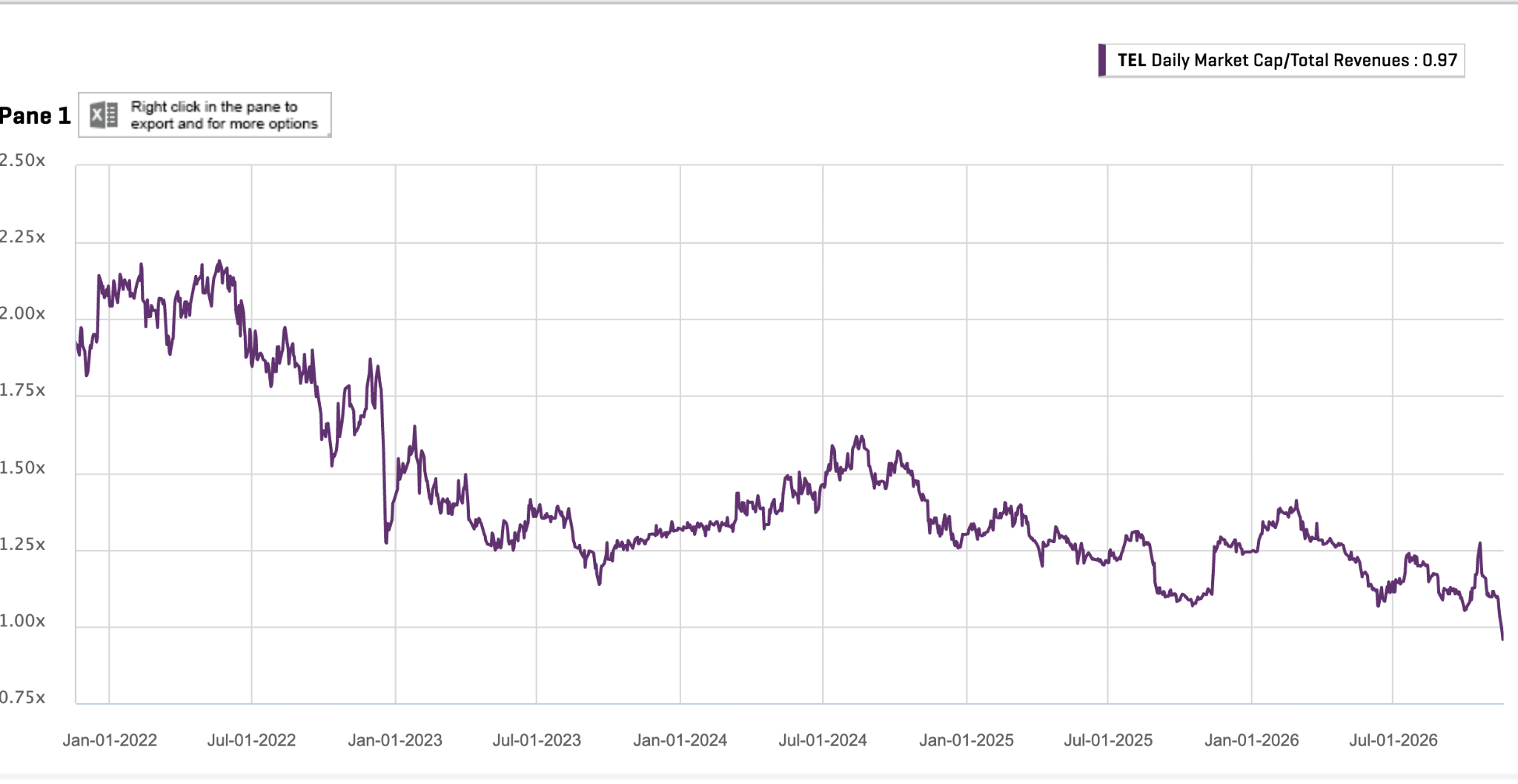
Source: S&P Global Market Intelligence
But before you throw the baby out with the bathwater, let’s look at total debt as a multiple of EBITDA (earnings before interest, taxes, depreciation, and amortization), less Capex, over the past five years. It’s shown below. Currently, the multiple is 7.51x, the lowest since 2022.
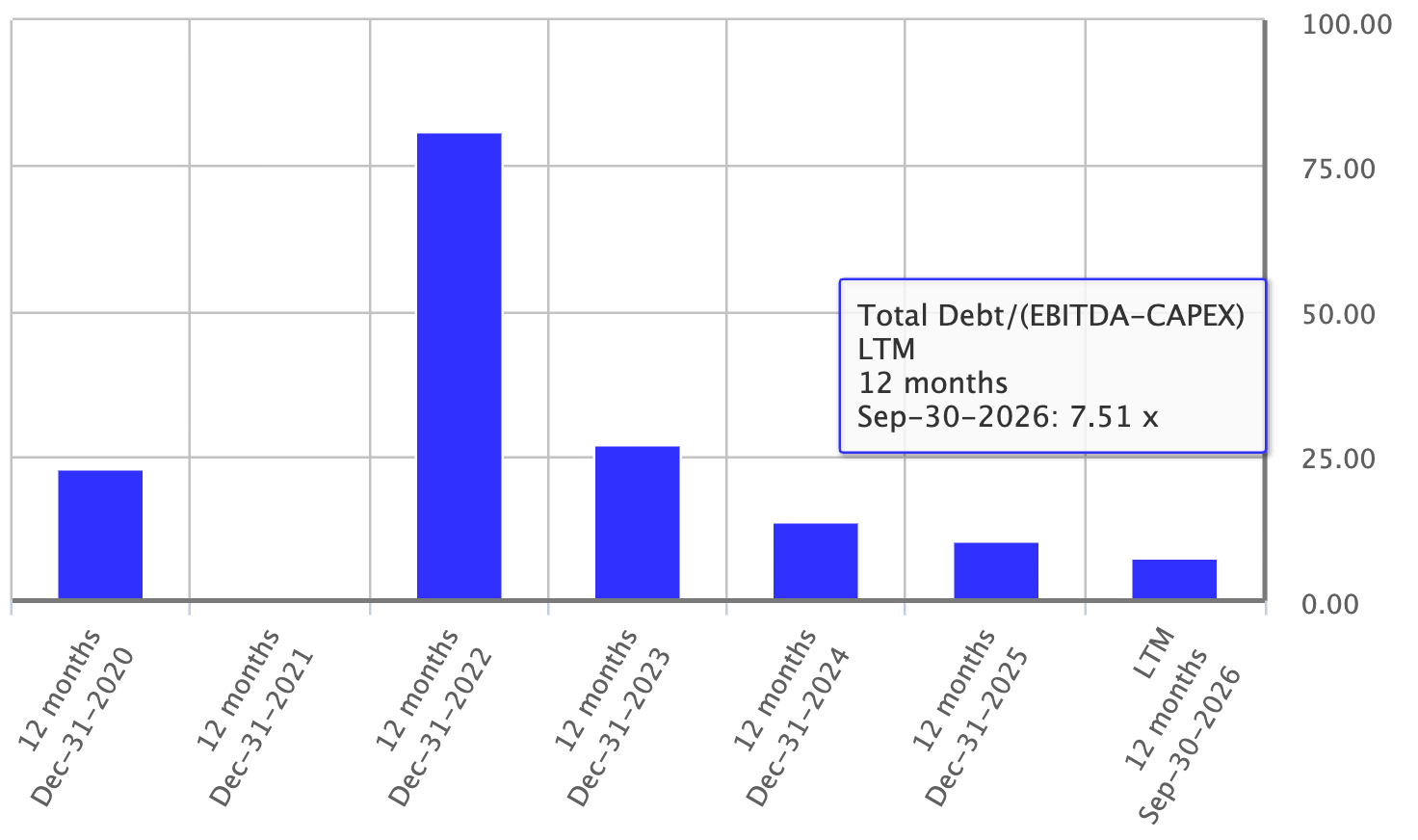
Source: S&P Global Market Intelligence
Since 2021, PLDT’s capital expenditures have fallen by 64%, from $2.02 billion to $736.3 million in the 12 months ended Sept. 30, leading to positive free cash flow of $842.7 million. The $316.4 million in dividends paid out during this period is just 37.5% of its free cash flow. Based on an enterprise value of $8.82 billion, its free cash flow yield is 9.6%. I consider anything above 8% value territory.
Is PLDT stock a value play or a value trap? I would say it’s a little of both.
By that, I mean you’re not going to get rich owning it. If this were baseball, I’d say it’s a solid single that shouldn’t be stretched into a double. I like the income, but we all know that total return also includes capital appreciation. For many, this likely rules out buying the Philippines’ largest telco.
On the date of publication, Will Ashworth did not directly have a position in any of the securities mentioned in this article. All information and data in this article is solely for informational purposes. For more information please view the Barchart Disclosure Policy here.