


EN
Why Nvidia Just Slashed Its Stake in Intel Stock by 25%
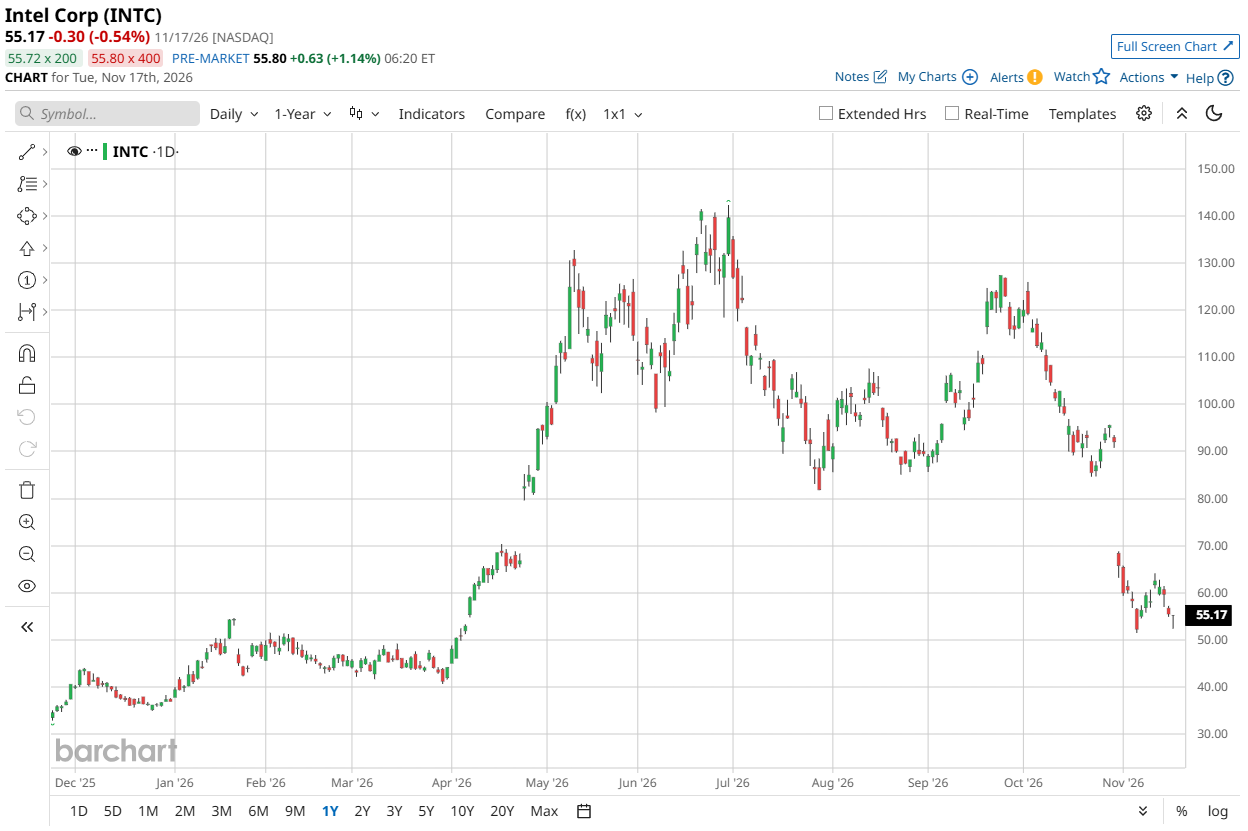
Intel (INTC) remains an established force in the semiconductor industry, with a strong presence in PC and data center processors and ambitious plans to restore its advanced chip-manufacturing capabilities. However, its stock performance this year has been anything but steady. After soaring to highs of more than $142, Intel shares have retreated sharply and are now trading around $55.
Behind the steep decline are several challenges confronting its turnaround, including manufacturing bottlenecks, mounting competitive pressure, and weakness in the PC market, all of which became evident in its latest earnings report. Adding another twist to the story, Nvidia (NVDA) disclosed on Monday, Nov. 16, that it had reduced its Intel holdings by 53.7 million shares, or 25%, during Q3.
The move brought its position down from 214.8 million shares to 161.1 million, although the chip giant has offered no public explanation for the reduction. The latest filing showed that Nvidia held 161.08 million Intel shares at the end of Q3, compared with 214.78 million at the close of Q2.
The timing is particularly interesting, considering Nvidia's $5 billion strategic investment in Intel at $23.28 per share in September and its plans to collaborate on data-center and PC processors. There was another significant adjustment in Nvidia's portfolio during the quarter. Its Space Exploration Technologies (SPCX) holdings increased by approximately 6%, making the aerospace business its largest disclosed equity position.
While the reasons behind these changes remain unclear, the transactions highlight a shift in its disclosed portfolio allocation. That said, the latest filing comes at an uncomfortable time for Intel, whose shares are already facing pressure from shareholder lawsuits and growing questions about its recovery.
About Intel Stock
Intel is a global technology business specializing in the design, manufacturing, and sale of semiconductors, processors, graphics, networking products, and artificial intelligence (AI) solutions. With a market cap of nearly $294.8 billion, its operations span businesses, cloud providers, and manufacturers worldwide through its Client Computing, Data Center and AI, and Intel Foundry segments.
Based in Santa Clara, California, the semiconductor heavyweight has gained 57% over the past 52 weeks, while its year-to-date (YTD) climb stands at 46%. However, the recent selloff has considerably changed the picture, with shares falling 44% over the past three months and plunging 40% in the last month.
On the valuation front, INTC stock is currently trading at 37.11 times forward-adjusted earnings and 4.75 times sales. Both multiples are above industry averages, indicating that the stock continues to command a premium valuation despite its recent weakness and the execution hurdles surrounding its turnaround.
Surpasses Q3 Earnings
On Oct. 29, Intel delivered its Q3 FY2026 performance, which had a few hiccups. As a result, the stock plunged 3.6% that day and then 28.6% in the following trading session. Net sales increased 20.9% year-over-year (YoY) to $16.5 billion. Revenue exceeded management's expectations for the eighth consecutive quarter while also beating analysts' estimates of $16.42 billion.
The strength was not limited to revenue growth. Non-GAAP gross margin expanded to 44.1%, while non-GAAP operating margin improved to 19.6%. Non-GAAP net income rose 169.4% from its year-ago level to $2.8 billion, and non-GAAP EPS climbed 126.1% YoY to $0.52, comfortably ahead of the $0.40 estimate.
Much of that momentum came from Data Center and AI (DCAI), where revenue surged 78% YoY to $7.3 billion. Growth stretched across hyperscalers, enterprise customers, and neocloud providers, reflecting stronger CPU requirements for AI infrastructure and agentic workloads. However, supply has struggled to keep pace, as advanced packaging shortages and manufacturing constraints continue to limit shipments.
Elsewhere, Client Computing and Physical AI (CCPG) remained a softer spot, with revenue slipping 5% from the previous year’s period to $8.1 billion. Higher memory prices, tighter IT budgets and inventory reductions among original equipment manufacturers (OEMs) weighed on PC demand.
Intel Foundry provided another encouraging contribution, with revenue rising 58% YoY to $6.7 billion. Meanwhile, adjusted free cash flow was up 92.9% YoY to $1.7 billion. Looking ahead, management expects Q4 revenue of $15 billion to $16 billion, alongside a non-GAAP gross margin of 38% and a non-GAAP EPS of $0.25.
Analysts have their own expectations. Q4 FY2026 EPS is projected to increase 275% YoY to $0.15, while the full-year FY2026 estimate stands at $1.04, representing a 966.7% increase from the previous year. For FY2027, the EPS forecast of $1.31 implies growth of 26% from the prior year.
What Do Analysts Expect for INTC Stock?
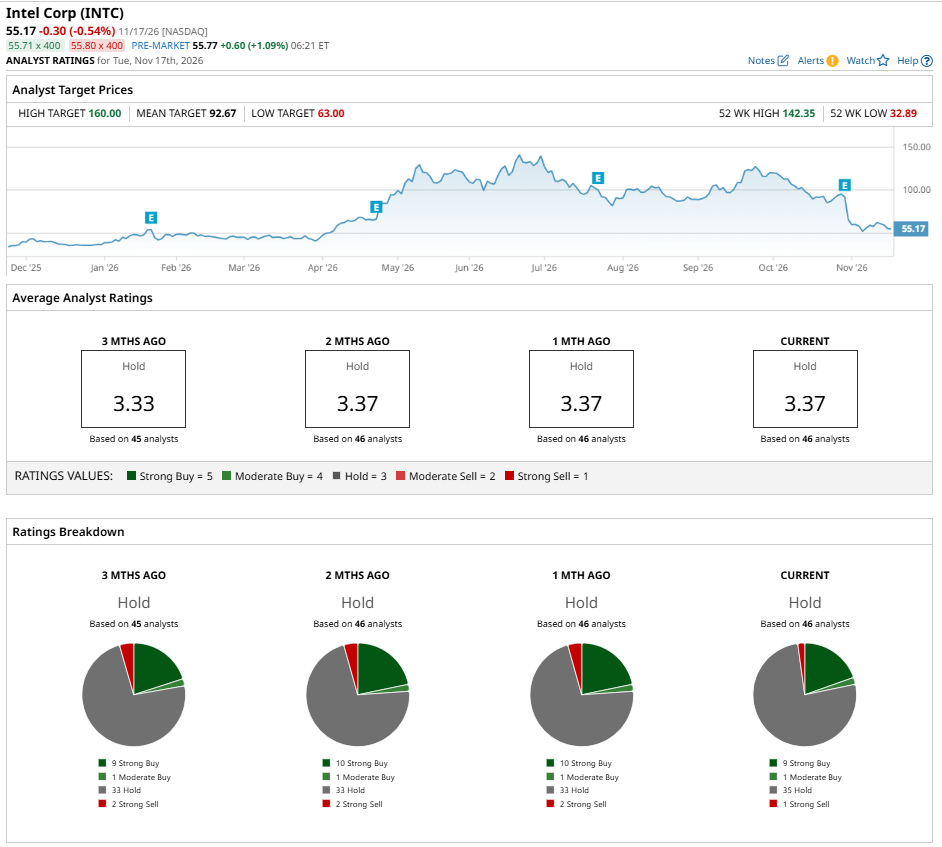
Despite the recent share-price weakness, Wall Street's overall assessment of Intel remains at “Hold.” Of the 46 analysts covering INTC stock, nine recommend a “Strong Buy,” one has a “Moderate Buy” rating, and 35 maintain a “Hold” recommendation. At the other end of the spectrum, one analyst has issued a “Strong Sell” rating.
The average price target of $92.67 indicates a potential upside of 68%. Meanwhile, the Street-high target of $160 points to possible gains of 190% from current levels.
On the date of publication, Aanchal Sugandh did not directly have a position in any of the securities mentioned in this article. All information and data in this article is solely for informational purposes. For more information please view the Barchart Disclosure Policy here.