


EN
‘I Would Be Honored to Answer These Calls and Return as CEO,’ Jensen Huang Says as Employees, Fellow Tech Leaders Rally Behind the Nvidia Founder
For years, Nvidia (NVDA) has been the undisputed poster child of the AI boom, turning its graphics chips into the hardware backbone of the AI revolution and sending its market value soaring into the trillion-dollar stratosphere. Jensen Huang became the face of that success, and investors couldn’t seem to get enough of the company.
But 2026 brought a twist nobody on Wall Street had on their bingo card. Back-to-back controversies involving Huang’s multiple disclosed affairs, two with employees, and one with Chinese businesswoman Alice Huang, who has alleged links to Chinese intelligence, and claims of $7.5 billion in chip shipments to Chinese firms turned a tech success story into a corporate and national security headache. The fallout was brutal—Huang resigned as CEO, president, and board member on Nov. 12, and Nvidia’s shares tumbled, dragging its market cap below $4 trillion for the first time since 2025.
But apparently, this goodbye might not be the final curtain. In a statement, Huang revealed that he had received an outpouring of calls from employees, investors, business partners, and customers urging him to return. He even said he would be “honored” to resume the CEO role if the board believed it was in shareholders’ and the company’s best interests. While he acknowledged his personal mistakes and expressed remorse for creating problems for the board, his comments have reignited speculation about Nvidia's leadership future.
For now, CFO Colette Kress is steering the company on an interim basis, while Nvidia searches for a permanent replacement.
President Trump has also voiced support for Huang’s possible return, although Nvidia’s board appears to have other plans. During the Q3 earnings call, Chairman Harvey Jones emphasised that the board had unanimously accepted Huang’s resignation and wasn’t exactly rushing to bring him back. But the leadership drama hasn’t slowed Nvidia down. Q3 numbers beat expectations, and management insists it’s “business as usual.”
So, let’s see where Nvidia stands and what Wall Street expects next.
About Nvidia Stock
Founded in 1993 as a graphics card maker for gamers, Nvidia has come a long way from its gaming roots. Today, its GPUs power everything from AI models and cloud data centers to robotics and autonomous vehicles. The company has become the backbone of the artificial intelligence (AI) boom, partnering with tech heavyweights and cloud giants racing to build the next generation of AI infrastructure.
Its chips have become essential to Silicon Valley’s AI ambitions, and investors have rewarded that dominance handsomely. At its peak, Nvidia’s market cap flirted with $6 trillion, making it one of the world’s most valuable companies. But lately, the AI chipmaker’s winning streak has stalled. Concerns over AI spending, intensifying competition, and the Jensen Huang controversy have weighed on sentiment, dragging its valuation down to roughly $3.8 trillion. That’s a steep drop for Wall Street’s former AI darling.
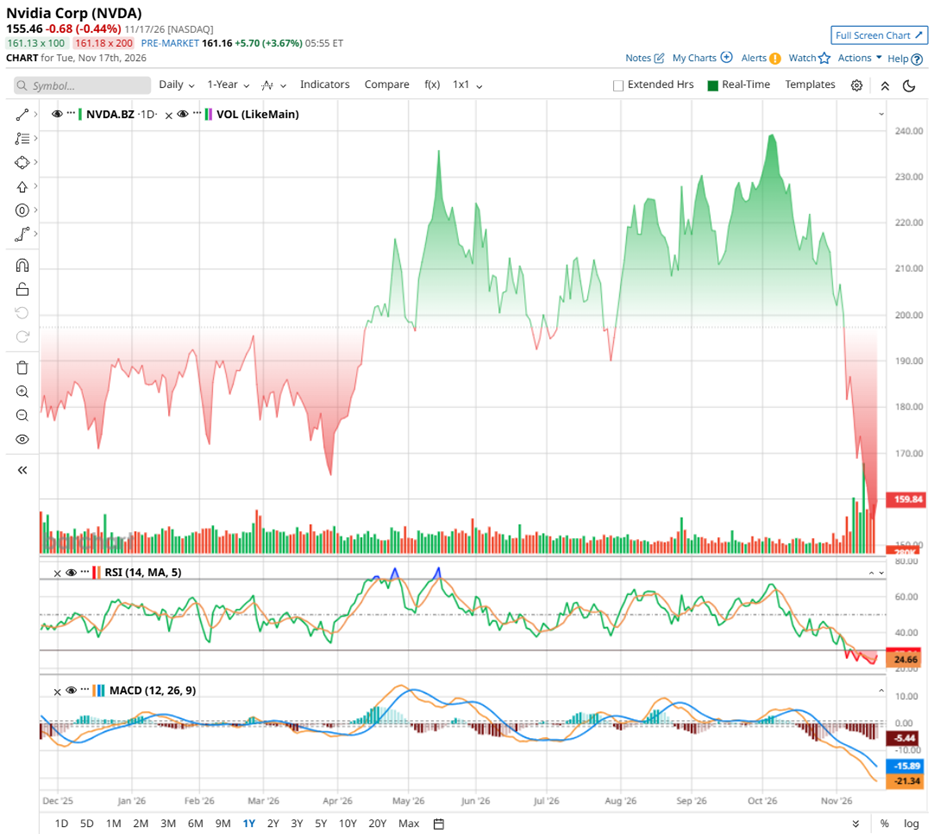
Nvidia went from breaking records to testing investors’ patience in weeks. After climbing to a record high of $243.37 on Oct. 6, shares went into a tailspin, hitting a 52-week low of $148.80 on Nov. 12. Although the stock has bounced 4% since then, that’s hardly a victory lap when it’s still down 36% from its peak.
NVDA stock declined 17% on a year-to-date (YTD) basis, shed 31% over the past three months, and dropped 11% in just five trading sessions. However, there may finally be a little breathing room. Following its stellar Q3 results, shares moved higher in after-hours and pre-market trading, giving bulls something to cheer about for a change.
The 14-day RSI sits at 24, firmly in oversold territory, suggesting the selling may have gone a little overboard. Meanwhile, the MACD remains below its signal line, with red histogram bars pointing to continued bearish momentum.
Nvidia’s selloff has made its valuation a little easier to swallow. The stock now trades at 16.64x forward adjusted earnings, below its sector average and historical multiple. Its 9.10x forward price-to-sales (P/S) ratio is still no bargain, but investors aren’t paying quite the premium they once did.
On the dividend front, Nvidia pays $0.25 per share quarterly. Nothing to cheer about for income seekers, but with a payout ratio of just 3.5%, the company retains plenty of cash to fuel growth.
A Closer Look at Nvidia’s Strong Q3 Numbers
Nvidia’s earnings are always a Wall Street spectacle, but this quarterly report was different. It's the first earnings results since Huang’s exit put interim CEO Colette Kress in the spotlight, with management insisting it was “business as usual.”
Revenue for the third quarter of fiscal 2027 more than doubled year-over-year (YoY) to a whopping $115.8 billion, while adjusted EPS surged 105% annually to $2.68, comfortably beating Wall Street’s estimates. Non-GAAP net income also climbed 109.4% YoY to $64.9 billion, and operating income jumped 116% to $77.9 billion. Non-GAAP gross margin improved to 74.9% from 73.5% in the year-ago quarter.
The data center business revenue hit a record $107.6 billion, up 110% from the year-ago quarter, while edge computing revenue rose 42% to $8.2 billion.
Nvidia’s next-generation Vera Rubin platform is already making waves. The company began shipping its Vera Rubin NVL72 systems, marking the fastest product ramp in its history. The Rubin platform generated nearly $20 billion in its first quarter of production shipments, yet demand continues to outstrip supply. Its systems are already running at partners including CoreWeave (CRWV), Google Cloud, Microsoft Azure, Oracle Cloud Infrastructure, and Nebius (NBIS), with deployment at SpaceXSI expected soon.
Nvidia is expanding supplier capacity as purchase commitments reach $390 billion. Meanwhile, combined data center lease and cloud service commitments exceeded $100 billion, with neocloud agreements accounting for another $32 billion at quarter-end. The partnership pipeline is expanding, too, with new collaborations involving Mercedes, Firebird, and Palantir (PLTR), alongside an expanded relationship with Meta (META).
Financially, Nvidia generated $48.3 billion in operating cash flow and $43.8 billion in free cash flow. Cash and equivalents reached $29.1 billion, while long-term debt stood at $32.4 billion. The company also returned $28.1 billion to shareholders through buybacks and dividends during the quarter, with $227.3 billion still available under its repurchase authorization, and announced a $150 billion buyback.
Interim CEO Kress said, “The momentum is real.” And management backed that confidence with an upbeat outlook. They expect Q4 FY2027 revenue of $130 billion, plus or minus 3%, and anticipate the quarter will mark a bottom in gross margins. For fiscal 2028, it raised its revenue growth forecast to 75% YoY from the earlier 70% estimate, with gross margins expected to improve to the 72% to 73% range.
Of course, the elephant in the room has not disappeared. The board has ruled out reinstating Huang and hired Heidrick & Struggles to find a permanent CEO. But with demand running ahead of supply, a record-breaking product ramp, and management raising its growth expectations, Nvidia’s business is making a pretty convincing case that the AI engine has not stalled just because its longtime driver has stepped away.
Analysts tracking Nvidia project fiscal Q4 2027 revenue around $128.5 billion, while EPS is projected to climb by 73.3% YoY to $2.72. Zooming out, EPS is expected to be $9.26 in fiscal 2027, representing annual growth of 102.6%, and the bottom line could rise by another 68% YoY in fiscal 2028 to $15.55 per share.
What Do Analysts Expect for NVDA Stock?
Wall Street seems to have found a few reasons to breathe easier after Nvidia’s Q3 earnings, even with the leadership mess still hanging over the company. One big win was its improved fiscal 2028 revenue growth outlook. Gil Luria of D.A. Davidson called this the most important takeaway, arguing that stronger growth visibility mattered more than the surrounding drama.
Analysts also welcomed Chairman Harvey Jones’ firm stance on Jensen Huang’s departure. Argus Research’s James Kelleher said the board’s unanimous acceptance of Huang’s resignation and decision not to invite him back provided much-needed clarity. Cody Acree of StoneX agreed, calling it the right decision despite acknowledging that Nvidia won’t be the same without its founder.
China, however, remains a tricky chapter. Interim CEO Colette Kress disclosed $2.4 billion in Q3 sales of licensed Hopper chips and related products to China but said Nvidia would stop these sales going forward. Acree found the sales surprising but viewed excluding China from future expectations as the sensible move.
There was also some relief around Nvidia’s financing commitments. Kress said the company would rigorously evaluate future deals, leaving room to reconsider certain investments. Gil Luria viewed that flexibility positively, although he cautioned that companies relying on Nvidia’s funding should not get too comfortable.
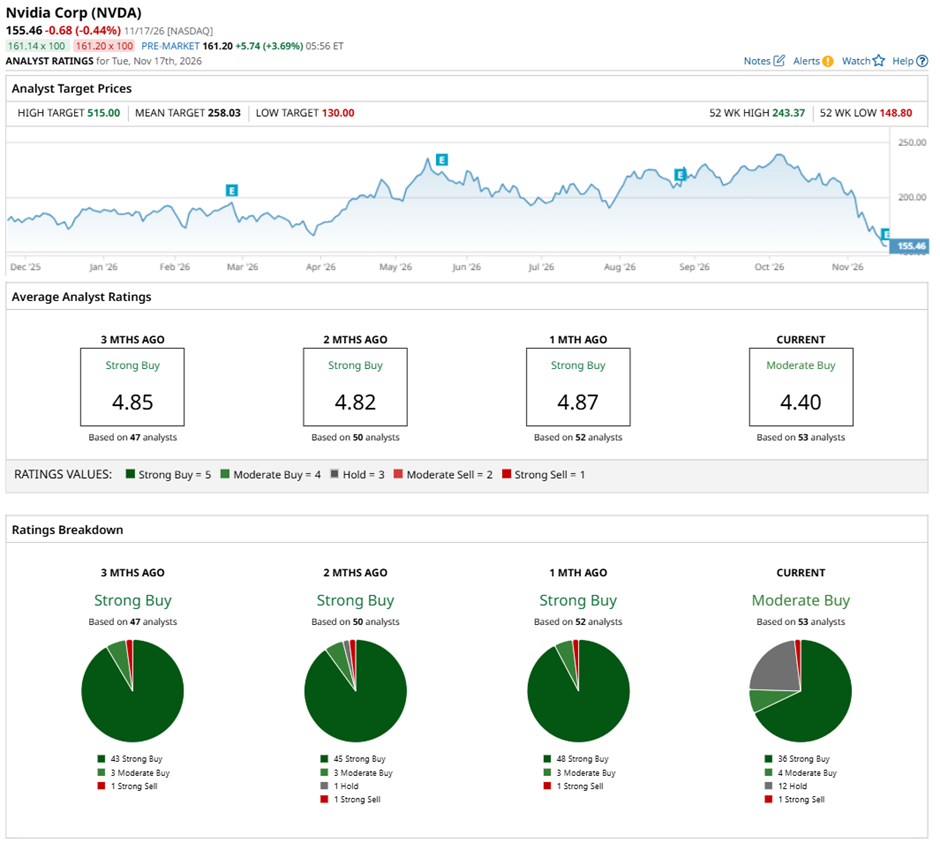
Wall Street remains optimistic about Nvidia’s growth potential, but the enthusiasm has cooled a notch. The stock currently carries a consensus “Moderate Buy” rating, a step down from its previous “Strong Buy” status. Of the 53 analysts covering the stock, 36 advise a “Strong Buy,” four recommend a “Moderate Buy,” 12 have a “Hold” rating, and only one is outright skeptical, suggesting a “Strong Sell.”
The average analyst price target for NVDA is $258.03, indicating a potential 66% rebound. The Street-high target price of $515 suggests that the stock could rally as much as 231% from here.
On the date of publication, Sristi Suman Jayaswal did not directly have a position in any of the securities mentioned in this article. All information and data in this article is solely for informational purposes. For more information please view the Barchart Disclosure Policy here.