


EN
Nvidia Shrinks Neocloud Backing to $32 Billion as CoreWeave and Nebius Rallies Fade Fast
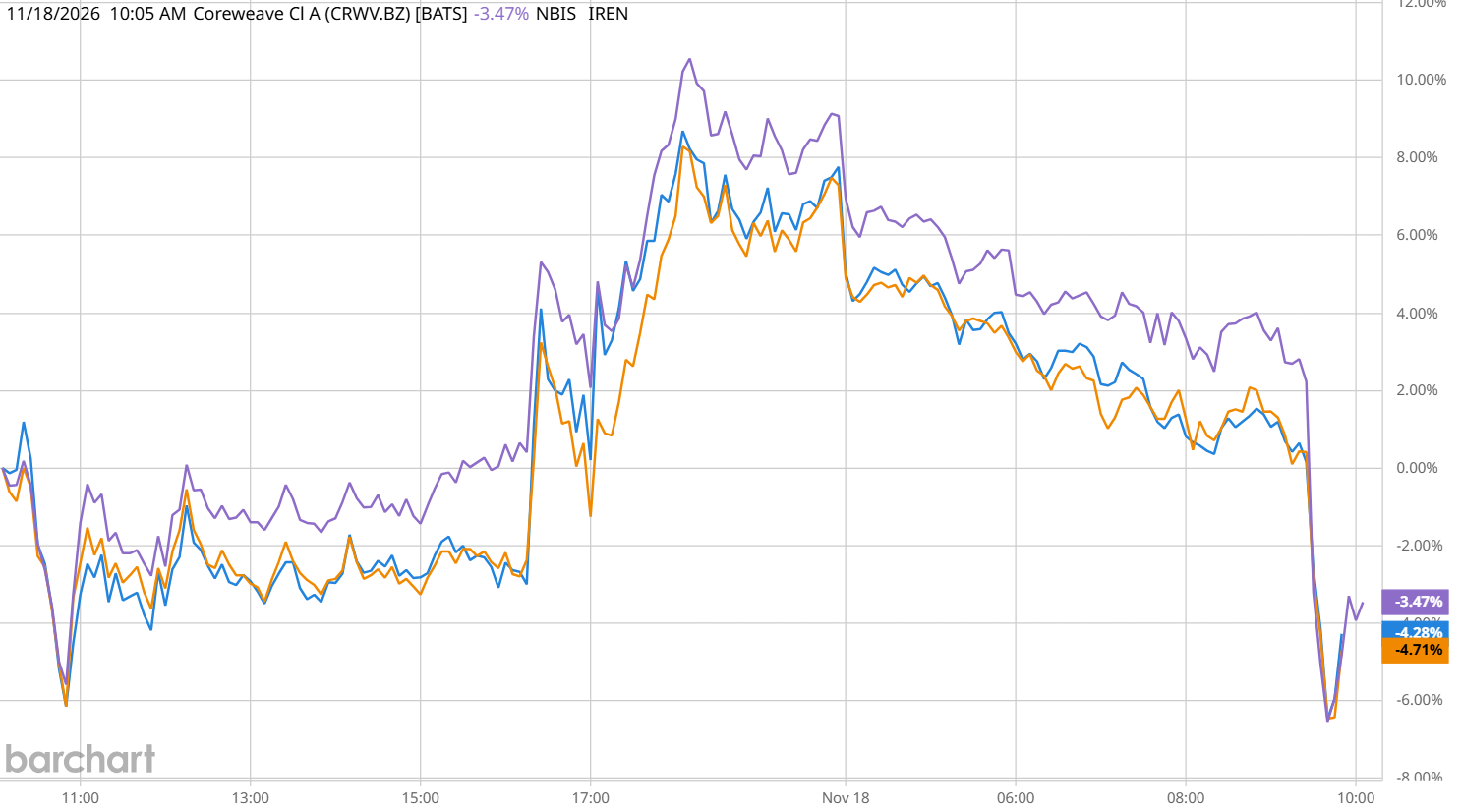
Neocloud stocks CoreWeave (CRWV), Nebius (NBIS) and IREN (IREN) gave back a sizable chunk of their overnight surge Wednesday morning, as investors looked past Nvidia's (NVDA) blowout quarter and zeroed in on a quieter detail — the chipmaker's financing commitments to the group slipped to $32 billion from $36 billion last quarter and now come with strings attached.
CoreWeave is now down 3.5% and IREN is down 2.4%, while Nebius has pared its intraday gain from about 4% to a slimmer advance of 1%.
Nvidia Just Crushed Q3 Earnings
Nvidia reported fiscal third-quarter revenue of $115.8 billion, up 103%, with data center sales of $107.6 billion making up the overwhelming majority of the haul.
The company also guided fourth-quarter revenue to roughly $130 billion — about $5 billion above a consensus near $125 billion — and lifted its fiscal 2028 growth outlook to 75%, numbers that initially sparked the neocloud rally.
That strength reinforces the broader picture of the AI infrastructure spending boom, yet the beat did little to shield neoclouds from financing questions.
"Disciplined and Selective" Backing
The cooling stems from interim CEO Colette Kress's message that Nvidia will keep backing neoclouds — specialized cloud providers that rent out GPU capacity — but on a disciplined and selective basis.
Those $32 billion in commitments activate only once a provider secures its own financing and brings capacity online, and delayed projects forfeit that support entirely.
That $4 billion sequential decline in commitments is the notable but underappreciated number in the report, signaling a shift in how Nvidia supports its customers.
Some analysts warn the tighter funding stance could slow growth for weaker operators, effectively turning Nvidia from an unconditional backstop into something closer to a gatekeeper.
Balance Sheets Become the Dividing Line
CoreWeave grew revenue 168%, yet it carries $46.9 billion in debt and saw its net interest expense nearly triple, a combination that leaves it exposed if outside financing gets harder to obtain.
Nebius trimmed the low end of its guidance on third-party data center delays while planning $40 billion to $45 billion of capital spending in 2027, a massive build that hinges on execution.
Still, Nebius's relatively cheap convertible financing and its early access to Vera Rubin capacity may favor it as Nvidia grows more selective, which helps explain its relative resilience from a price action perspective.
Is This Rally Built to Last for CRWV?
The initially positive response to NVDA earnings is better read as a relief bounce from deeply oversold levels than as a confirmed bottom for the group.
Rising Treasury yields, Fed rate-hike expectations, and leadership uncertainty at Nvidia, which is operating under an interim CEO, all remain unresolved headwinds for capital-hungry names.
For these stocks, that macro backdrop of rising yields and Fed hike odds may matter as much as Nvidia's quarter itself.
Leverage cuts both ways here, since the same debt that powered CoreWeave's 168% growth now magnifies its sensitivity to higher borrowing costs.
The Next Catalyst to Watch
The key test is which providers can secure their own funding and bring capacity online on schedule, because that is now the explicit trigger for Nvidia's support.
In that environment, providers with funded pipelines and demonstrated execution look structurally stronger than highly leveraged names dependent on outside backstops.
Nvidia is still writing checks — it just wants to see everyone else's financing first.
This article was created with the support of automated content tools from our partners at Sigma.AI. Together, our financial data and AI solutions help us to deliver more informed market headline analysis to readers faster than ever.
On the date of publication, Sarah Holzmann did not directly have a position in any of the securities mentioned in this article. All information and data in this article is solely for informational purposes. For more information please view the Barchart Disclosure Policy here.