


EN
AI “safe haven” ferry tickets are getting more expensive! Apple's (AAPL.US) price-earnings ratio reached 37 times, the highest level since 2007
The Zhitong Finance App notes that for big tech stocks, these have been crazy weeks — the midterm elections, and the shocking removal of Huang Jen-hoon by NVDA.US (NVDA.US) continued to shock Wall Street. But there is one stock that is stable as a rock in the midst of turmoil: Apple (AAPL.US).
While investors are selling off all stocks related to artificial intelligence — from chip makers to hyperscale cloud service providers to “new cloud” providers — Apple continues to rise steadily.
The stock has risen 29% this year, making the company one of the best performing “Big Seven” technology stocks so far. It is also the stock that has contributed the most points to the S&P 500 index, contributing 28% of the 7.2% increase in the benchmark index. In the process, it also became the world's largest company with a market capitalization of $5.1 trillion.
The reason is pretty simple. While many of its big-market peers are investing heavily in and chasing AI, Apple is largely sidelined — it sells iPhones and Macs, and is preparing to let people use this emerging technology on their devices once AI technology is fully mature.
However, the cost of buying this “AI haven” is getting higher. The current price-earnings ratio of Apple stock is 37 times the expected profit for the next 12 months. This is a valuation multiple not seen since 2007, making the stock one of the 25 highest-valued stocks in the S&P 500 index. In other words, its valuation is approaching a level that might make investors think twice before buying.
YieldMax ETFS strategist Mike Kuh said, “People who follow Apple should be aware that this is its 'golden year'.” “The volatility of this stock is very low, but it has only improved since then, and considering that its valuation has been excessively stretched from a historical perspective, it is difficult to raise this multiple any more reasonably. When you put all of this together, you have to be aware of the possibility that some of the premiums will be squeezed out.”
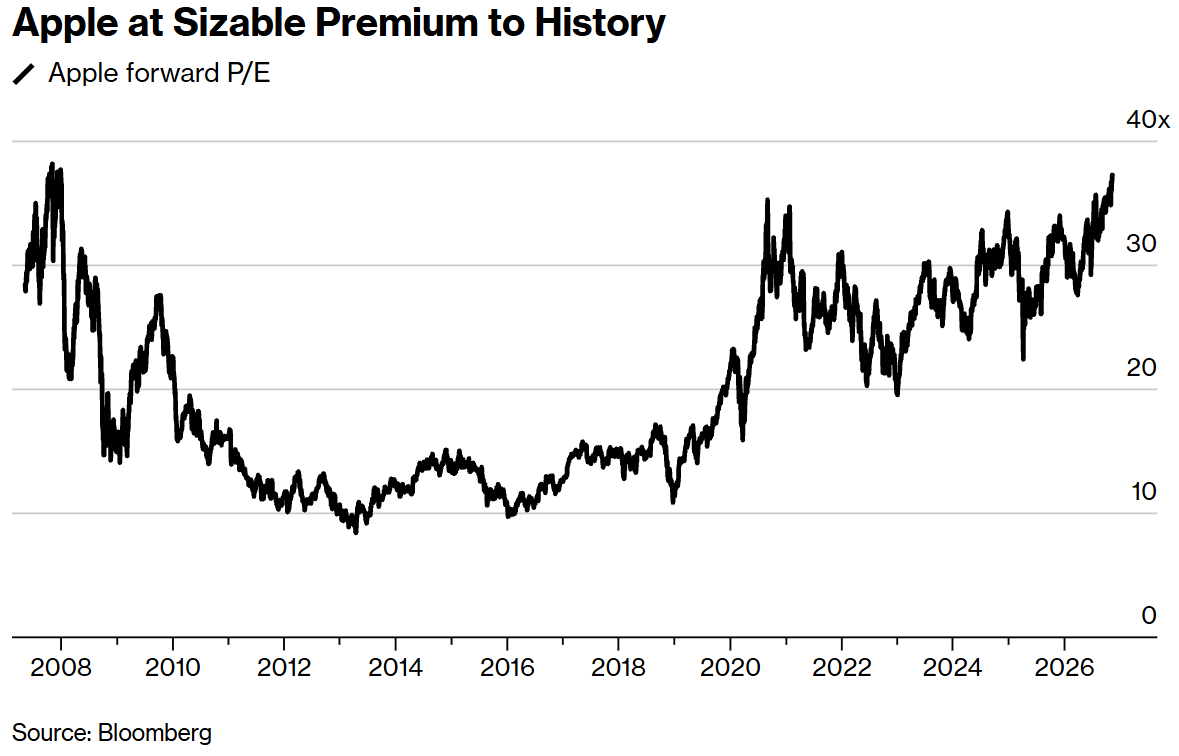
Apple's valuation is far above historical levels
Investors are betting that Apple's stability will continue. CBOE Apple VIX, which tracks market estimates of the stock's future volatility, has dropped nearly 10% this month, while the Nasdaq 100 index's volatility index jumped 25%.
Apple launched a number of new products this year, including a folding screen iPhone — which, despite starting at close to $2,000, has sparked a frenzy among consumers. But the stock's strength lies not so much in what the company is doing, but rather because it's not doing anything — that is, it hasn't invested heavily in AI. It is this type of investment that has boosted the capital expenses of many other large capitalized technology companies and depleted their cash flow.
Bernstein analyst Mark Newman said that avoiding this competition made Apple “immune to the risk of falling AI data center capital expenses (such as semiconductors, storage, and other components) plaguing upstream stocks, as well as the free cash flow collapse currently experienced by hyperscale cloud service providers.”
He added that considering the company's “customer loyalty, profit durability, growth, free cash flow generation ability, and shareholder returns,” the stock's valuation multiples are not outrageous.
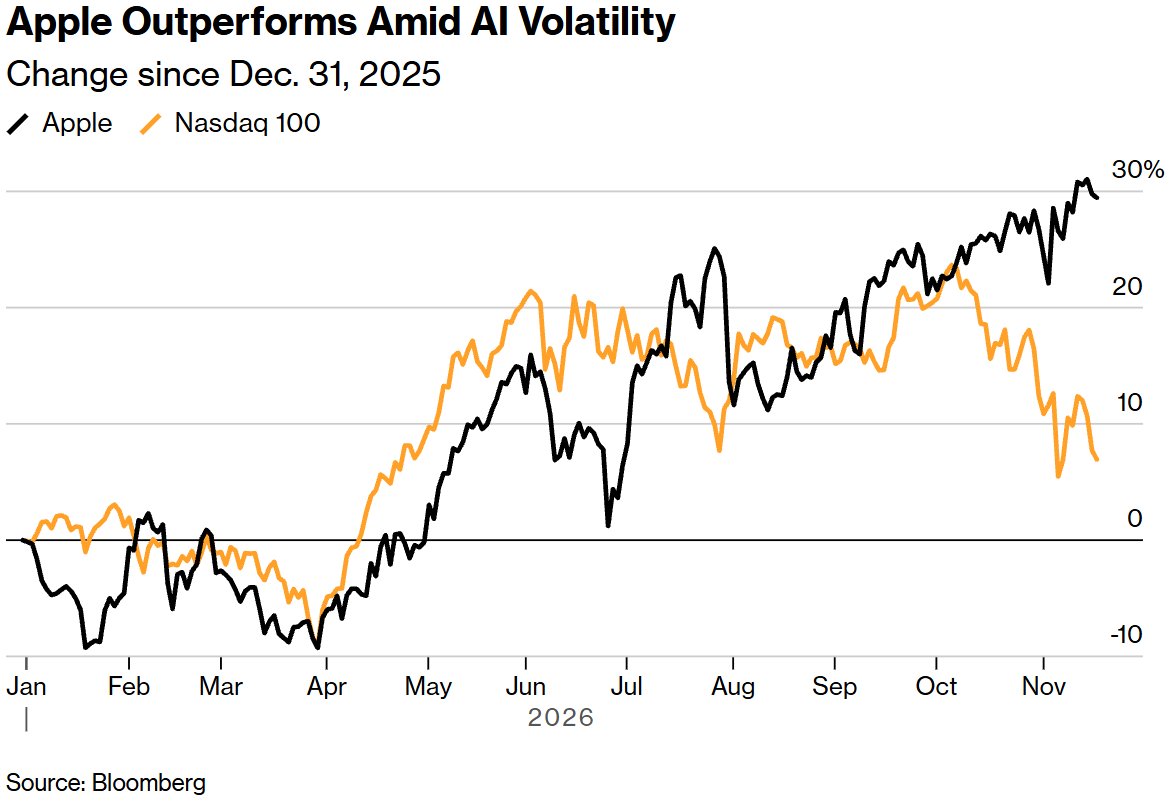
Apple excels in AI market fluctuations
Of course, that doesn't mean everything is smooth sailing.
The profit margin outlook given by Apple earlier this month is disappointing because it is facing supply restrictions, particularly for memory chips. And its growth is slowing. Revenue is expected to grow 10% for the 2027 fiscal year ending in September, compared to 15% for the 2026 fiscal year. This growth rate is expected to slow further over the next two fiscal years.
Apple's PEG ratio (a measure of stock value using price-earnings ratio divided by profit growth rate) is currently 5.3, the highest in history since data became available in 2005. PEG above 1 usually means the stock is overvalued. In contrast, Nvidia's PEG is less than 0.15, the lowest in history, as its profits are expected to double in the current fiscal year, while the valuation has dropped sharply.
Apple's valuation seems to be holding Wall Street back. Out of 59 analysts covering the stock, only 36 gave buying suggestions, which is a low percentage among large cap stocks.
The stock is currently trading above analysts' average target price, which means it is expected to fall over the next 12 months. Apple is the only stock in the “Big Seven” with an implied negative return.
Despite this, according to Dan Niles, founder and portfolio manager of Niles Investment Management, Apple's unique position as the leading consumer brand in the tech industry is still a reason to hold its shares. He listed the stock as one of his top five picks this year. He said that if AI development continues, Apple will eventually benefit from users using the technology through their smartphones and laptops; and if the AI cycle is reversed, the stock should also continue to act as a hedge.
“The fact that it crushed other tech stocks this year just explains why it's so valuable,” he said. “It performed steadily during the risk appetite period, and was much more resistant to decline than its peers during the safe-haven period. It has withstood the rigors, and there is no reason to think that this momentum will not continue next year. Other than the valuation I don't really like, it's an excellent stock for the current environment.”