


EN
How Much Was Jensen Huang Worth to Nvidia? More Than $6.7 Trillion, According to One Wall Street Analyst.
Key Points
Nvidia co-founder Jensen Huang resigned on Nov. 12 following several allegations (and one admission) of having extramarital affairs.
One Wall Street analyst slashed his firm’s price target on Nvidia by 60%, representing an eye-popping difference in market value.
Moreover, this scandal has violated the trust of Wall Street and investors, as well as put the company’s numerous circular financing deals into question.
For the last four years, the evolution of artificial intelligence (AI) has propelled Wall Street's major stock indexes to record highs. According to IDC, AI can transform workplaces and represents a cumulative $22.5 trillion economic opportunity from 2025 to 2031.
No company has been the foundation of the AI infrastructure build-out quite like Nvidia (NASDAQ:NVDA). Its graphics processing units (GPUs) are staples in AI-accelerated data centers, and its CUDA software platform keeps clients loyal to the brand.
Missed Nvidia in 2009? This Rare Signal Is Flashing Again. In 2009, a "Double Down" signal flashed for a little-known chipmaker called Nvidia. For the first time in years, that same "Total Conviction" signal is flashing for a company 1/100th the size of Nvidia. Continue »
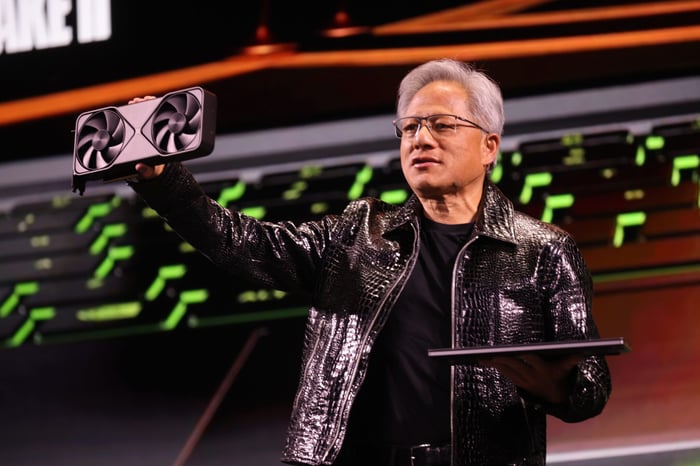
Jensen Huang was central to Nvidia's identity. Image source: Nvidia.
But Jensen Huang also played an important role in Nvidia's success. Now that he's resigned as CEO, Wall Street analysts' price targets are crashing down. According to one analyst, Jensen's departure is worth up to $6.74 trillion in lost value for the company he helped co-found.
Huang's resignation craters analysts' price targets on Nvidia
On Nov. 12, Huang resigned as CEO after admitting to an extramarital affair with an alleged Chinese spy, and following other allegations of affairs with two co-workers. Though he stepped down, a federal investigation into possible national security issues is ongoing.
Over the last week, nearly a dozen Wall Street firms have lowered their price targets for Nvidia, none of which stands out more than Mark Lipacis at Evercore ISI, the institutional equities and research division of Evercore (NYSE:EVR). Lipacis slashed his firm's price target from $465 to $186, representing a difference of $6.74 trillion in market value.
In a research note released by Evercore ISI, Lipacis pointed to an expected contraction in price-to-earnings multiples, similar to what's been observed in previous late-stage semiconductor cycle peaks. Lipacis expects inventories of AI hardware to eventually grow, hurting Nvidia's pricing power and dragging down its margins.
The research note also highlights Huang's departure and the lack of a clear succession plan.

Image source: Nvidia.
Nvidia has been left without an identity
But there's arguably much more to worry about than Nvidia lacking a clear succession plan.
Jensen Huang has been the face of the company for more than three decades, and he's arguably been the foundational figure of the AI data center build-out. Without Huang, Nvidia has lost a key component of its identity.
Furthermore, Nvidia has violated the trust of Wall Street, investors, and businesses. As billionaire investing titan Warren Buffett once said, "It takes 20 years to build a reputation and five minutes to ruin it." Even several quarters of solid sales and earnings growth may not be enough to instill confidence in the company.
Pick your poison: NVDA's circular financings or its off-balance sheet commitments. https://t.co/tCMu6HJRs7
— zerohedge (@zerohedge) November 13, 2026
Jensen Huang's departure also brings into question the countless circular financing deals he'd arranged. Nvidia had agreed to invest big bucks into several hyperscalers, neoclouds, and large language model developers, which, in turn, would purchase Nvidia's top-of-the-line GPUs. The aforementioned loss of identity and trust, coupled with the unknowns of these circular financing deals, creates more questions than answers for what had been the largest publicly traded company until recently.
Sean Williams has no position in any of the stocks mentioned. The Motley Fool has positions in and recommends Evercore and Nvidia. The Motley Fool has a disclosure policy.