


EN
The Nvidia (NVDA.US) General Meeting attracted a lot of attention! Who will clap for “the next CUDA”? The test of the “post-Hwang In-hoon era” has just begun
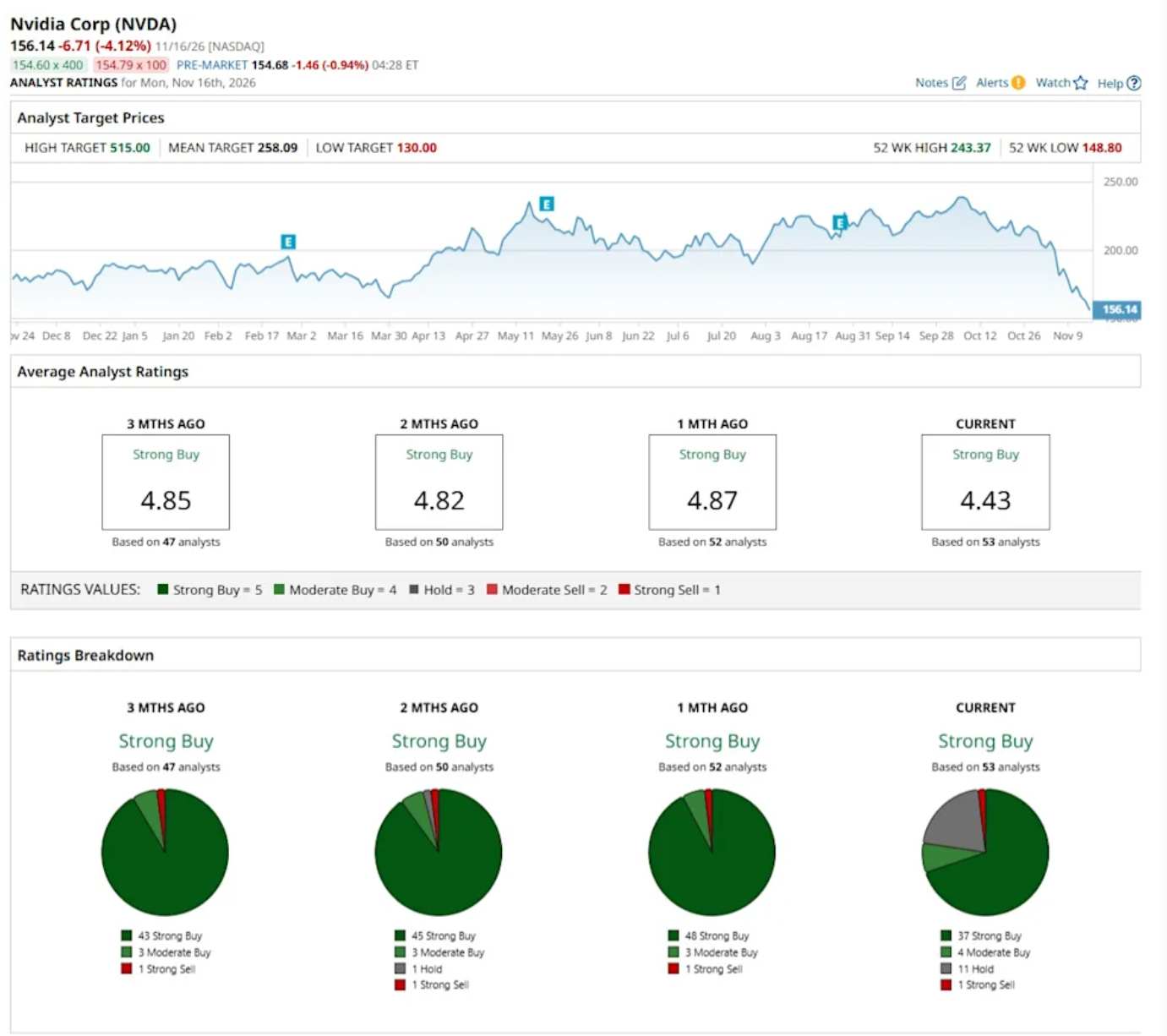
The Zhitong Finance App learned that at 1 a.m. on the 19th Beijing time, Nvidia's acting CEO Colette Kress, who temporarily replaced Huang Renxun, will face a series of major issues that Nvidia employees are most concerned about about Nvidia's AI computing power product line roadmap and important issues relating to Huang Renxun's dynamics. On November 17, Nvidia's regular trading closed down 0.44% to $155.46. After the earnings report was released, the stock price returned to some post-market gains, then strengthened again after the company's management raised growth expectations for the future fiscal year. The stock price continued to rise after the market; as of press release, Nvidia's stock price rose more than 3% before the market.
For Nvidia, the next test will undoubtedly be completely internal to the company. Revenue of nearly 20 billion US dollars validates the technical route determined by Nvidia founder Hwang In-hoon during his tenure, and the test facing Kress and the management team is one step ahead: after Hwang In-hoon leaves the CEO, when the next emerging technology has no major customer orders and R&D must be started a few years early, who can judge that it is worth betting on, and how much resources can be mobilized? This is the suspense that the General Conference deserves investors' attention.
Interim CEO and Chief Financial Officer Colette Kress will meet with all employees at around 12 p.m. EST, or 1 a.m. on November 19, Beijing time. In an internal memorandum, she promised to actively communicate with employees about the company's future. Nvidia's senior developer technical director Nadal Khalil has previously sent a letter to executives and directors warning some of the core talents to consider leaving soon after Huang Renxun leaves as CEO.
“We are playing an important role in building the technology that will drive the AI revolution, and there is still important work ahead,” Kress said in an email to Nvidia employees.
For shareholders, what is most worth listening to at this conference is who will coordinate and how to coordinate some important long-term chip manufacturing and advanced packaging and testing partners, including TSMC and SK Hynix in the future, how to coordinate AI software developer platforms and AI computing power cluster teams for major cloud computing customers, and how management can retain key personnel to advance Nvidia's product iterations on an annual basis.
Huang Renxun has stated that he is willing to return if the board of directors believes that it is in the interests of the company and shareholders. Nvidia Chairman Harvey Jones reiterated during the earnings call that the board of directors unanimously accepted his resignation and had no intention of reinstating him as CEO. Semafor quoted people familiar with the matter as saying that a few directors still support Wong In-hoon's reinstatement. At least one of these discussions occurred before financial reports and Hwang In-hoon's public statement. However, judging from the board of directors statement, it appears that the company is still publicly promoting the selection of CEO successors other than Nvidia founder Wong In-hoon.
Whether Huang Renxun can return to the position of CEO depends on whether Nvidia's board changes its current position that it has no intention of reinstating him. It is worth noting that Huang Renxun and related entities hold about 3.5% of the company's shares, and the shareholding period has met the requirements, and is eligible to nominate up to two independent director candidates before the annual shareholders' meeting. If the candidate is supported by shareholders' votes, Hwang In-hoon may indirectly influence future CEO selection by influencing the composition of the board of directors.
At 1 a.m. on the 19th, Beijing time, what the Nvidia Staff Conference wanted to answer was how the management of “daring to gamble” Huang Renxun left office to update and iterate AI technology
At 1 a.m. on the 19th, Beijing time, one of the highlights of the Nvidia Staff Conference was who can clap the next generation computing platform and mobilize the company's resources to make it after Huang Renxun leaves office; that is, can Kress's management clearly explain to employees who is responsible for the technical route and who makes the final decisions on customer delivery during the transition period, thus stabilizing the core technical team.
Looking back at Hwang In-hoon's own important decisions, he is a tech superhero who “dares to gamble” on emerging technology routes, and can bet on future trends almost every time. Therefore, according to some senior Nvidia employees who have worked with Hwang In-hoon since the CUDA development period, no one but Hwang In-hoon can fill the position of Nvidia CEO.
In 2006, GPU general computing had pioneers in research, but the commercial prospects were far from clear. Huang Renxun still promoted CUDA, allowing developers to write parallel computing programs using chips that originally mainly served graphics rendering. In 2016, Nvidia launched the DGX-1, which integrates multiple GPUs, interconnect, and deep learning software into a single deliverable system. In 2019, the company also announced that it plans to acquire Mellanox for 6.9 billion US dollars, betting that when computing power is extended to the entire data center, the speed of moving data between GPUs will directly determine how much time expensive chips can be used for computing.
All three of these decisions went a step further than replacing conventional products. For investors, interim CEO Kress has promised careful capital allocation during the conference call. What is more worth listening to at the conference is how she explained this trade-off between prudence and long-term investment: when the core technology team sees the next bottleneck or potential major trend, and customer orders are not enough to prove the return, who has the right to invest several years in advance in R&D budgets, lock in supply chain production capacity, and who is responsible for final delivery?
Interim CEO and Chief Financial Officer Colette Kress is about to address all Nvidia employees against this background and internal questioning. For investors, the two sessions answered questions of different time periods. Financial reports reveal products that have already been delivered and orders that can be predicted, and the staff meeting relates to who can make timely decisions on behalf of the company when next-generation products encounter engineering trade-offs, customers require adjustment of delivery plans, and suppliers require early locking in production capacity.
Strong guidance from Nvidia led the US stock futures index and Asian technology stocks to rebound for a while, then their gains weakened. The market has regained some confidence in recent demand for computing power, and is still awaiting evidence on whether the new management can continue the execution efficiency of the founders era.
The risk of key figures left by Hwang In-hoon can be seen more clearly from the list of recipients of an internal letter. According to the Wall Street Journal, Nader Khalil, the director of developer technology, sent a letter to the board of directors, executives, and about 60 direct subordinates of Huang Jen-hoon, warning that the company may lose talent that is difficult to replace. This organizational structure has allowed chip design, CUDA software, supply chain, and major account teams to quickly hand over differences to the same decision maker.
Take a scarce batch of high-bandwidth memory as an example. Which product is assigned to it will simultaneously change the delivery date to cloud customers, the gross profit margin of the products that have already been ordered, and the verification progress of the next generation system. Kress revealed during the conference call that TSMC management visited Nvidia that week. The two sides are coordinating the supply gap, and Nvidia has also implemented the supply of some memory and advanced packaging. The most valuable signal of the staff meeting is whether management can let engineers know who will decide on similar trade-offs in the future and how the critical technical adjudication system is different and similar compared to Wong In-hoon's time, and also let customers know who has the right to promise delivery dates.
Hwang In-hoon's desire to return made this internal communication even more sensitive. He has publicly stated that he is willing to return if the board determines that reinstatement is in the interests of shareholders, employees and the company. Chairman Harvey Jones later made it clear during the earnings call that the board of directors unanimously accepted his resignation and had no intention of reinstating him as CEO.
Semafor quoted people familiar with the matter as saying that a few directors still support Hwang In-hoon's return, and he has discussed this possibility with at least one director. It is worth noting that this conversation took place before Hwang In-hoon's public statement and financial report was released. Governance procedures also have clear boundaries. Huang Renxun and related entities hold about 3.5% of the shares. They are eligible to nominate up to 2 independent directors according to their shareholding period. Whether they can be elected is still dependent on shareholders' votes. Shareholders who have held shares continuously for one year and hold at least 15% of the total shares can apply for a special shareholders' meeting; if directors are to be removed without cause, they must obtain two-thirds support of the voting rights represented by all issued voting shares. Needless to say, the support of a few directors left room for discussion on the return, and the official entry into force still depends on board decisions.
Compared to reinstatement speculations, the governance adjustments that have already been implemented by the board of directors have had a more direct impact on revenue expectations. The newly established National Security and Export Control Supervisory Committee is chaired by Suzanne Norah Johnson, and the National Security and Global Trade Compliance team reports to the Committee and Kress at the same time. The independent director has also commissioned former acting federal attorney Joon H. Kim and the Wachtell Law Office of the Southern District of New York to conduct an investigation. The commercial meaning behind these measures is that the AI chip is handed over to which cloud vendor, who will eventually use the computing power, and what revenue can be included all now require more clear review responsibilities.
In the third fiscal quarter, Nvidia still delivered approximately US$2.4 billion of licensed Hopper data center products to China. The fourth fiscal quarter guidelines have been prepared based on zero revenue calculated from data centers in China. Even if the founder's stay continues to dominate the headlines, shareholders can still judge the extent to which the new management can rely on other markets to deliver growth.
From CUDA's core developers to the head of ARM, who can turn Rubin's technological leadership into cash flow for customers and shareholders?
Looking for a successor, the board of directors essentially has to decide how to take on the three responsibilities that Huang Renxun has been working together for a long time — determining where the computing architecture is going, getting suppliers and cloud customers to invest capital around the same product line, and deciding how much risk Nvidia is willing to take on this industry chain.
Kress has been in charge of finance since 2013 and is familiar with customer credit, procurement commitments and return on capital. Ian Barker, who joined Nvidia in 2004, is one of CUDA's main developers. He is currently responsible for hyperscale computing and high-performance computing, and is closest to software and hardware collaboration and cloud customer deployment. For the first time, Buck was invited to attend the Q&A session of this earnings call, but he did not speak at all.
Buck's real public display of technical leadership was at the Global Supercomputing Conference in the same week, where he introduced Vera CPU racks, Rubin high-performance computing GPUs, scientific research intelligence platforms, and quantum computing collaborations with IBM and Fermi National Accelerator Laboratories. Externally, according to the Wall Street Journal, Heidschel, led the search by Jeff Sanders, has reached out to Arm CEO Rene Haas. Haas worked at Nvidia for seven years and later led the Arm listing. He has experience coordinating chip designers, authorized customers, and manufacturing partners. Each of the three people's resumes answered part of the succession question, but the board has yet to determine the final candidates.
To measure this kind of leadership, the best place to start is to look at how a Rubin system changes revenue from Nvidia to revenue for cloud customers. In other words, depending on whether Nvidia can continue its technical leadership after Hwang In-hoon leaves office, investors may first observe whether the new team can work with cloud vendors to deploy Rubin racks that have already been shipped on schedule as computing power that customers are willing to pay to use. This tests the ability to deliver on the existing road map. The longer-term test is who can determine the direction and set the stage for several years of R&D investment when the next generation computing architecture has not yet been clearly ordered.
Whether Vera Rubin can go live on schedule in the cloud will test management's ability to coordinate chip, network, software, and customer deployment. Nvidia's sales system earns revenue. After cloud vendors purchase the system, they also need to complete deployment and attract customers to pay to use it before they can obtain revenue from computing power services. These are two different deals, separated by deployment cycles, computing power utilization, and rental prices. As to whether management can choose a technical direction when the needs are not clear, like Huang Renxun bet on CUDA back then, is another level of leadership.
The Vera Rubin NVL72 integrates 72 Rubin GPUs and 36 Vera CPUs in one rack. When running large models across multiple GPUs, training tasks require frequent exchange of intermediate results. The sixth-generation NVLink in the rack determines how long the GPU will wait for other GPUs; after expanding to multiple racks, the bandwidth and congestion control of InfiniBand or Ethernet will also affect the efficiency of the entire cluster. When it comes to long-context reasoning, the system has to read model weights and cached historical information over and over again.
At this point, the performance that customers are really willing to pay for is how many effective terms the system can deliver to how many users per second at a given response speed and power supply capacity. In the initial MLPerf Endpoints test announced by Nvidia, with each user getting at least 50 terms per second as the threshold, Rubin handled the Kimi K3 workload, the throughput per kilowatt was about 10 times that of the GB300, and the other two models were about 5 times and 9 times that of the other two models. The power access to the computer room is close to the upper limit, which means that the same power contract has the opportunity to support more payment requests.
Nvidia's earnings report gave two figures that are closer to return on investment than the benchmark: Rubin contributed nearly $20 billion in revenue in the first quarter, and large cloud customers put the system into production for about a month, which took about half of the time required for the previous generation Grace Blackwell. The client also has cross-validation. Oracle Cloud announced the official commercial use of NVL72 on October 27, and Google Cloud opened Rubin-based A5X instances on November 6.
Nvidia can confirm sales according to the contract after delivery of the equipment, while cloud vendors must complete power supply, cooling, networking, and software verification, and only charge for usage after opening the instance. The reduction in deployment time is a direct reduction in the number of days the equipment has taken up capital and is not yet billable. Whether the next purchase can arrive depends on the paid utilization rate, rental price, and financing costs after going online. This also explains why a technical leader familiar with a major account engineering team is at the center of succession discussions.
In addition to the 75% growth target, Wall Street is still calculating a cash return
The gold content of Nvidia's latest growth guidelines should also be judged along this critical computing power delivery chain. Revenue for the third fiscal quarter was US$115.8 billion, up 103% year on year, higher than market expectations of about US$109.5 billion. Adjusted earnings per share increased 111% year over year to US$2.68. Data center revenue was US$107.6 billion, of which hyperscale cloud customers contributed US$60.1 billion, up 71% year on year, and AI cloud, industrial and enterprise customers contributed a total of US$47.5 billion, up 195% year over year.
Nvidia expects revenue for the fourth fiscal quarter, which includes an additional week, to reach 130 billion US dollars, fluctuating 3%, and raising the revenue growth forecast for the 2028 fiscal year ending January 2028 from 70% to about 75%. It is worth noting that Kress clearly included customer financing capabilities and computer room readiness in the judgment when raising the guidelines.
At the same time, the company must fulfill some of the purchase orders it has previously accepted, and also absorb the increase in memory prices and mass production costs for new products in the short term. The gross margin for the fourth fiscal quarter is expected to drop to 71% to 71% to 72% from 74.9% adjusted this quarter. Therefore, the combination that can best test the execution of the new team is: product delivery on schedule, timely customer production, and combined with new order pricing, to bring the gross margin back to 72% to 73% expected by management in fiscal year 2028.
Goldman Sachs maintains a target price of 220 US dollars, and behind it there is a capital allocation problem that is more difficult than chip shipping. Of the $518 billion future contract commitments disclosed by Nvidia, 390 billion US dollars were used for supply and production capacity, an increase of 111 billion US dollars over the previous quarter, mainly from multi-year memory purchases.
The conditional commitments of the new cloud agreement disclosed separately by Nvidia have been reduced from 36 billion US dollars to 32 billion US dollars, and will not take effect until the partners obtain financing, deploy computing power, and pass inspection; the maximum exposure to the financing guarantee is 118 billion US dollars.
According to Goldman Sachs, the three types of arrangements carry different risks: locking in supply facilitates delivery, promising to use cloud capacity affects future cash expenses, and providing guarantees may trigger payments when partners default. After Kress clarified that the new cloud support terms followed the existing arrangements, the post-market increase of companies such as CoreWeave and Nebius increased, indicating that the market is not only pricing GPU demand, but also pricing whether downstream can raise money to receive goods.
Goldman Sachs obtained a target price of $220 with a normalized earnings per share of $10 and a price-earnings ratio of 22 times, which implied an upward margin of about 41.5% from the closing price on November 17. Following the same profit assumption, the closing price of $155.46 was only equivalent to about 15.5 times, and the differences centered on how many times the market was willing to pay for this profit.
Nvidia generated about $43.8 billion in free cash flow this season, while the number of accounts receivable turnover days rose from 60 days to 64 days. The company also plans to execute the remaining repurchase authorization of approximately $227.3 billion by the end of fiscal year 2028. The early morning general meeting is related to who has the power to decide on the technology route. What affects the next stage is whether Rubin can continue to go online, whether customers can pay according to the contract, and how much cash can be returned to shareholders after fulfilling supply and financing commitments; if Nvidia can put Rubin into production faster, turn sales into cash more quickly without continuing to expand customer credit exposure, and the forces that clap the technology route are unanimously recognized by internal employees, only Wall Street has a fuller basis for narrowing the valuation discounts brought about by this management handover.