


EN
AI sell-off can't stop the market enthusiasm! Anthropic (ANT.US) perpetual contracts bet on “going up as soon as they go public”, with an implied valuation of about $1.7 trillion
The Zhitong Finance App learned that crypto futures linked to Anthropic (ANT.US) have declined along with artificial intelligence (AI) stocks, but the implied valuation of the contract is still as high as $1.7 trillion, which is significantly higher than the $1.4 trillion valuation corresponding to the upper limit of the company's IPO guide price range.
These perpetual futures do not have an expiration date, and traders can bet on Anthropic's stock price performance after listing without directly purchasing shares. Such contracts can reflect market speculation in advance, but traders involved in betting may not necessarily buy the company's shares after the official listing.
The launch performance of SpaceX (SPCX.US) in June has confirmed the limitations of such market signals. According to data from trading platform Talos, the opening price of SpaceX on the first day of listing was $150, higher than the issue price of $135, but far lower than the trading price of the crypto futures contract of about $176 in the morning of the same day. Anthropic will land on the secondary market on Thursday, and investors will once again verify the gap between the crypto market's pricing and the opening price of new shares — and this time, the AI sector is under a lot of pressure.
Since the US midterm elections this month, the AI sector has weakened. The market is concerned about the risk of an AI bubble and huge capital expenditure pressure. Combined with major personnel changes at Nvidia (NVDA.US) and the resignation of Hwang In-hoon as CEO, multiple factors continue to suppress AI stocks.
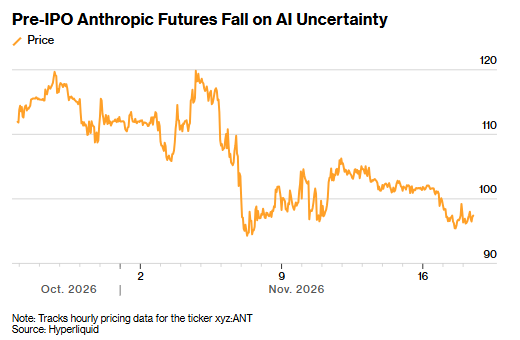
Derivatives distribution platform Trade.xyz relies on Anthropic contracts issued on the Hyperliquid chain, with the biggest drop of 21% since November 4; during the Asian trading session on Wednesday, the contract price was around $97. Even so, the price is still about 24% higher than Anthropic's $78 per share guide IPO price cap.
Kelly Ye, head of research at Talos, said, “The perpetual contract market is still betting that IPOs will rise, but the expected increase is narrower than a week ago.”
According to Talos data, two days before Anthropic's expected listing, the nominal value of the Anthropic perpetual contract on the Binance and Hyperliquid platforms was approximately $422 million; while SpaceX's unclosed position volume in the same period before listing was only $251 million.
Anthropic pre-listing contracts also have a longer trading cycle: Anthropic pre-IPO contracts tracked by Talos have a median transaction length of about 170 days, while SpaceX pre-listing contracts are only traded for 22 days. In the past week, the size of open positions on Anthropic perpetual contracts has remained stable; on the other hand, the number of outstanding positions on Anthropic's contracts soared rapidly in the last few days before listing.
“It's still a fragmented, mostly offshore market, but it looks much more mature than it was in June,” Kelly Ye said.
Anthropic's current IPO is expected to raise up to $64.4 billion for the company and existing shareholders; based on the upper limit of the issuance range, the valuation is $1.4 trillion after full dilution. The company also arranged a separate $26 billion private placement with Nvidia and many other tech giants participating.
The market's interest in perpetual contracts continued to heat up this year, and the trading volume of Hyperliquid and its competitor platforms increased, and received widespread attention. This type of product allows traders to bet on various types of targets such as cryptocurrencies and commodities with high leverage. However, unlike direct shareholding, holding an Anthropic perpetual contract does not mean owning shares and voting rights in the company; leveraged positions also mean that traders bear the risks of high capital rates and forced liquidation of positions.
Furthermore, the contract price is not a reliable predictor. Some pre-IPO perpetual contracts were priced close to the opening price of the IPO, such as Cerebras Systems (CBRS.US), whose Trade.xyz contract was one hour before the official opening of the market, and the price deviation on the first day of listing was less than 3%. However, the SpaceX case is the opposite. Market fervor is driving up perpetual contracts, which are priced far higher than the stock's actual opening price.
Kelly Ye concluded, “Pre-IPO perpetual contracts are not a crystal ball for predicting stock prices.”