


EN
The overall revenue and profit guide exceeded expectations! Without Hwang In-hoon's Nvidia (NVDA.US), the AI story is “business as usual”?
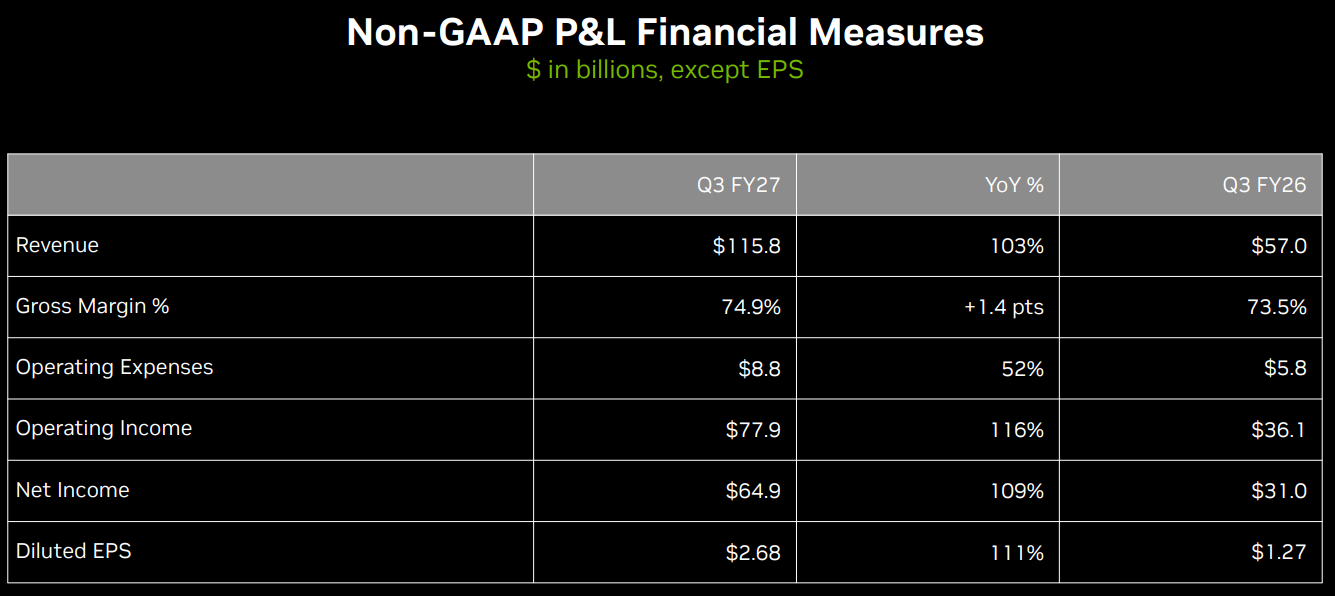
Zhitong Finance App learned that after the US stock market on Tuesday, Nvidia (NVDA.US) handed over the first report card after Huang Renxun's closing, and the first time in the company's 33-year history that no financial report was released without him at the helm: revenue of US$115.8 billion, up 103% year over year, and non-GAAP earnings of $2.68 per share, both of which greatly exceeded expectations; the fourth quarter revenue guide was US$130 billion, which was about 4% higher than market consensus; the company also raised its revenue growth forecast for the next fiscal year (2028) from 70% to 7575 %.
After the financial report was released, the stock price rose by about 5% after the market, and NASDAQ futures rose more than 1%. In contrast, the market has set the narrative framework before: the stronger the Q3 performance, the more likely it is to be viewed as a “aftertaste of the old era”; the more vague the guidance and long-term visibility, the more it will be included in the “New Era Discounts.” This financial report erased most of the second question mark — not only was the guidance given, but it was also raised; but the first question mark was still there.
Overall performance exceeded expectations
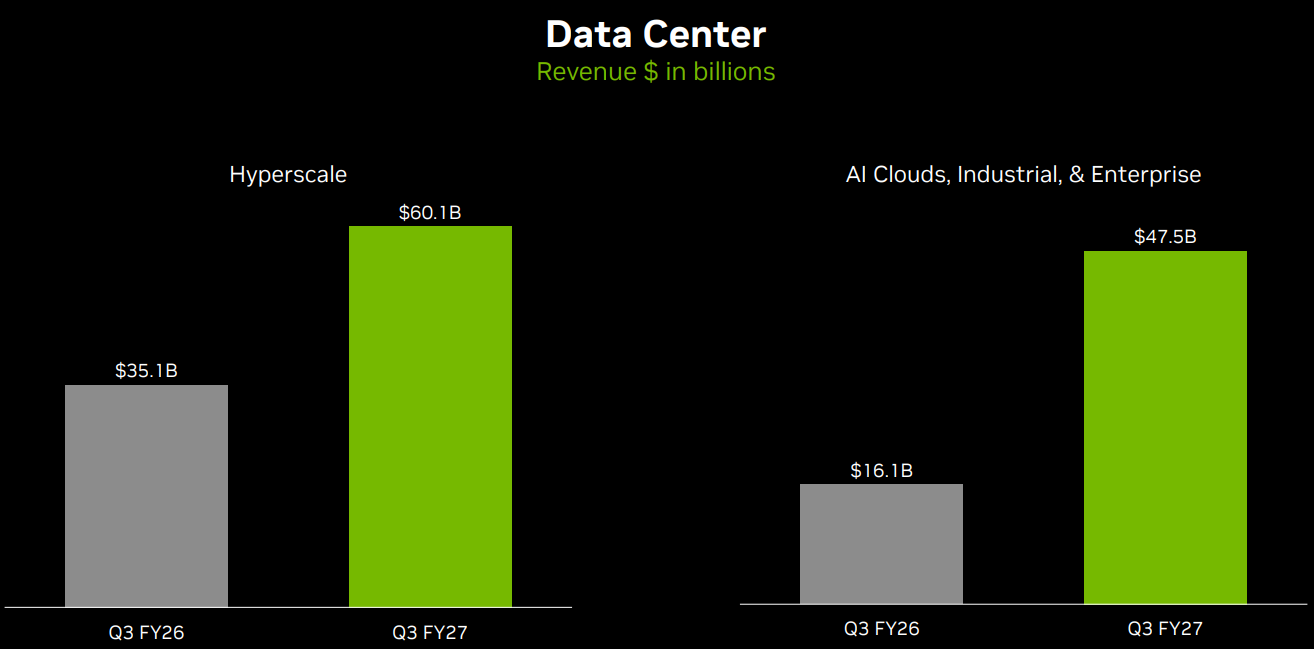
The digital level leaves no room for doubt. For the third fiscal quarter ending October 25, revenue was US$115.8 billion, up 103% year on year and 20% month-on-month. It was about 6% higher than the market consensus of US$109.1 billion according to LSEG statistics, and far higher than the median value of US$108 billion according to the company's own guidelines. Data center revenue was $107.6 billion, up 110% year over year, which is about $5.7 billion higher than the consensus — the scale of a single quarter has surpassed the combined annual revenue of rivals Intel (INTC.US) and Chaowei Semiconductor (AMD.US). Non-GAAP gross margin was 74.9%, higher than expected 74%; GAAP net profit of $65.287 billion, up 105% year over year. The edge computing business (games, robotics, and automobiles) generated revenue of $8.2 billion, up 42% year over year.
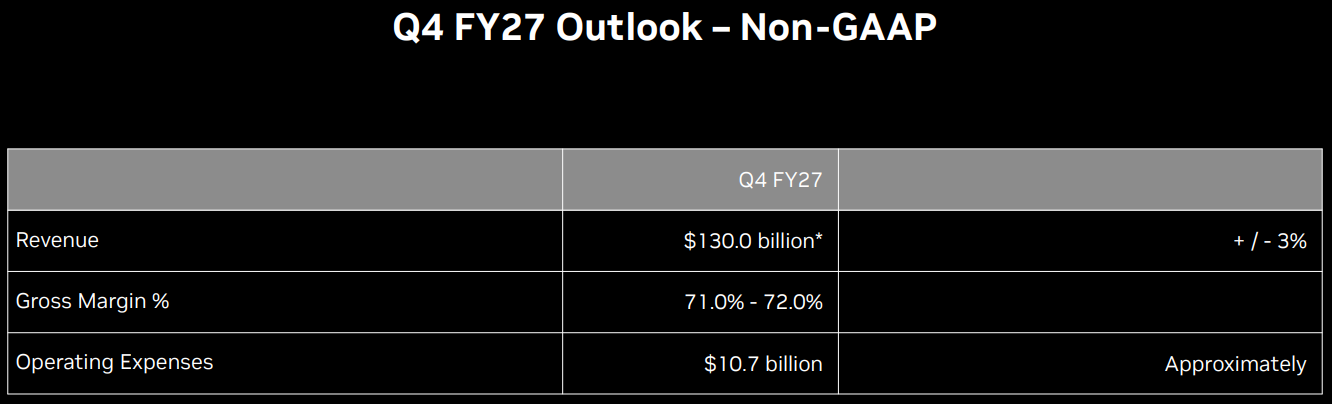
The more critical guidance is just as strong. Fourth-quarter revenue guidance was US$130 billion, fluctuating 3% (consensus was approximately US$125.3 billion), and continued not to include data center computing revenue from China. The gross margin guide fell back to 71% to 72%, down about 3 percentage points from 74.9% this quarter — Acting CEO and CFO Colette Kress (Colette Kress) said in a conference call that this season will be at the bottom of gross margin, mainly due to rising storage costs and climbing expenses for next-generation platforms.
Notably, investment banks almost collectively lowered expectations before the earnings report: HSBC cut the target price from $365 to $170, UBS lowered its target price from $300 to $240 (but still expected revenue of 111 billion to 112 billion US dollars, higher than the consensus), Goldman Sachs called the management handover “limited negative” and the target price dropped to $220; Morgan Stanley only estimated revenue of 108.1 billion US dollars in terms of forecasting, and believed that the biggest suspense was “the acting CEO is in place and the company may not give guidance next year.” The result: not only was it given, but it was also raised.
The product that supports 75% growth expectations is the next-generation platform Vera Rubin NVL72. The company confirmed in the financial report that it has achieved mass production and shipment, and called it “the fastest product release in the company's history”. Currently, the rack is running at CoreWeave, Google Cloud, Microsoft Azure, Oracle Cloud and Nebius, and SpaceX's supercomputing facility will soon be launched. Kress's words in the statement were: “Our momentum is real. Vera Rubin got off to a great start, our roadmap progressed as planned, and our ambitions have never been greater.”
$518 billion promise: evidence of need
The driving force behind the guidelines is a growing list of promises — this is where the market is most concerned about the core question “is AI demand real, or is it amplified by Nvidia's own cyclical role in investing in customers and customers then purchasing GPUs”.
Nvidia's total contract commitments have soared from $366 billion in the previous quarter to $518 billion: of this, the supply chain portion increased by more than $100 billion over three months, mainly to lock in memory chip supply. SK Hynix, Samsung Electronics, and Micron are the biggest beneficiaries; the company plans to invest 2030 billion US dollars in component suppliers in fiscal year 2028. The supply chain announcement issued on the same day as the earnings report lists the promised direction: Kinsus (Kinsus) will increase ABF carrier board production capacity exclusive to Nvidia by more than 3.5 times; Amkor (Amkor) will obtain a multi-year agreement totaling nearly $3 billion (including prepayment); and the expansion of advanced packaging production of SPIL under Sun Moon Light will be supported by Nvidia's multi-billion dollar investment and locked in until mid-2029.
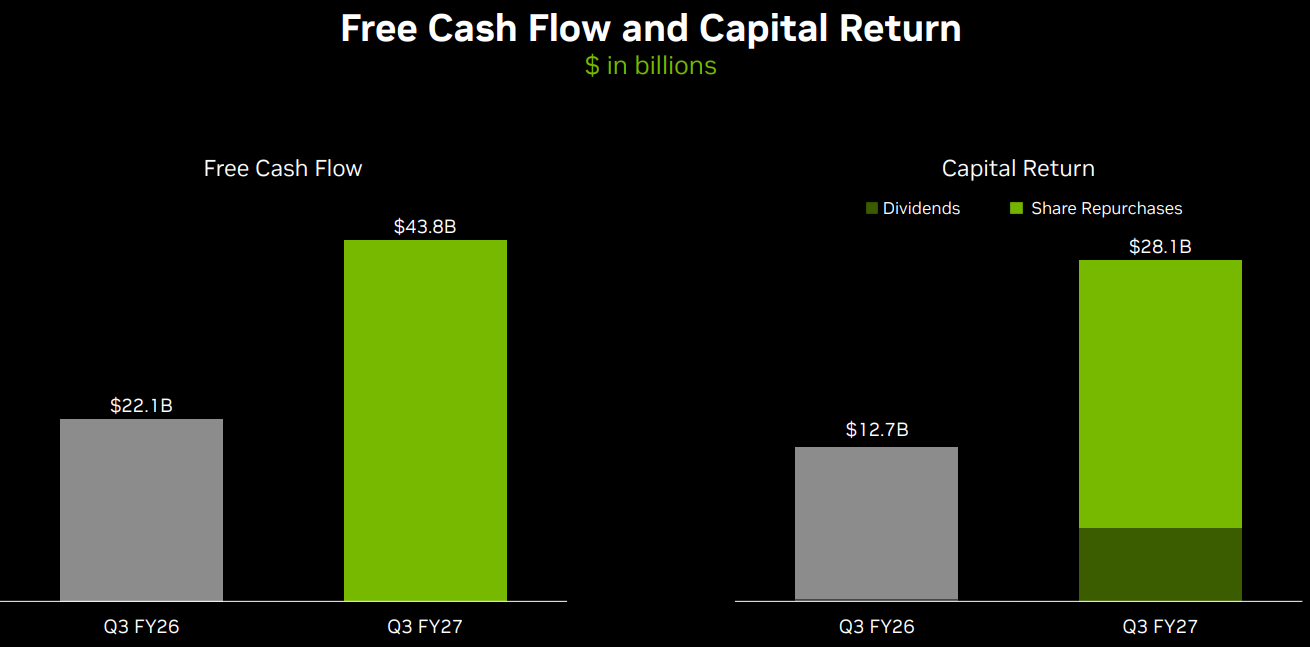
The balance sheet provides evidence on both sides. On the one hand, there is a positive sign: free cash flow doubled from $21.3 billion to $43.7 billion last quarter, and free cash flow can still double against the backdrop of accounts receivable tripling year over year, indicating that profit quality has not deteriorated — the surge in receivables stemmed from large-scale contracts with cloud service providers such as Meta and SpaceX easing payment terms. The other side is hard to ignore: the balance of tradable equity securities increased from $12.9 billion at the beginning of the year to $44.2 billion, and inventories nearly doubled from $21.4 billion to $39.7 billion. During his tenure, Hwang In-hoon promised to provide more than $100 billion in financing to companies related to AI infrastructure construction. Today, the list of promises is still expanding, but he is no longer present.
 A regulatory searchlight followed. It was reported on Tuesday that the US Securities and Exchange Commission (SEC) is investigating Nvidia, focusing on whether the company misled investors through misleading disclosure of information. The exact focus is unclear. Brian Smedley (Brian Smedley), chief investment officer of hedge fund Cynosure Strategies, concluded: “Investors have factored in a much higher risk premium. What really weighed on the stock price was the forced departure of Hwang In-hoon and the uncertainty this incident brought about in the company's strategic direction and execution.”
The board of directors closed the door to reinstatement, and Kress said “business as usual”
At the beginning of the call, Chairman of the Board Harvey Jones (Harvey Jones) first put down the reinstatement rumors: “Nvidia's board of directors unanimously accepted his resignation, and there is no intention of getting Hwang In-hoon back as CEO.” He revealed that the board of directors has hired headhunting company Heidrick & Struggles to lead the selection. In the eyes of both internal and external candidates, the goal is as soon as possible, but not in a hurry: “Until we find the right person, we won't hastily appoint them to catch up.”
Huang Renxun, who resigned due to the private morality scandal on November 12, issued a statement with a different tone earlier in the day: admitting that “the company did not meet the standards expected of everyone, made serious mistakes in my personal life, and created problems for the board of directors”; at the same time, he said that if the board of directors believes that his return “is in the interests of shareholders, employees, the company, and the United States,” “I will be honored to respond to these calls and return to CEO.” The list of endorsements for him is not short — according to reports, both President Trump and Musk have publicly stated their support for his return, and there is also a joint letter circulating from senior employees within the company; Altimeter and Atreides, two investment institutions, have asked the board of directors to handle succession issues in a “slow, careful, and thoughtful” manner.
Second, according to the company's power of attorney and company documents, Huang Renxun has the right to nominate two directors to Nvidia's board of directors and vote before the company's annual shareholders' meeting, which enables the co-founder to influence the company in the future. Chip industry managers, investors, and customers are closely watching Nvidia to learn what role Wong In-hoon will play in the company after stepping down as CEO last week. The ability to nominate directors (who are responsible for selecting leadership and supervising) could be a powerful tool to influence the future direction of this leading AI chip company.
However, any shareholder or shareholder group that holds 3% or more of Nvidia's voting rights and has held it for at least three years has the right to nominate directors. These directors will be included in the company's power of attorney materials and vote at the company's annual shareholders' meeting, which is usually held in June.
According to LSEG data, Hwang In-hoon and his associated entities have held more than 3% of Nvidia's shares for more than three years. Currently, he holds approximately 3.5% of the company's shares. Wong In-hoon is free to nominate any person who qualifies as an independent director. The candidate will be placed on Nvidia's proxy voting list. Nominating board members does not guarantee a seat on the company's board of directors; shareholders are required to vote to approve potential candidates. Nvidia also has the right to disqualify candidates from nominating if they violate the company's articles of association.
Acting CEO Kress's debut attitude was “business as usual”: communication with customers, suppliers, and partners was uninterrupted, and “they support us 100%”. Faced with the Democratic Party winning both houses of the Senate and the House of Representatives in the midterm elections, and according to lawmakers and congressional staff, after taking over the National Assembly in January, she did not shy away from regulatory communication, but emphasized “demand, especially agentic (smart) demand, not only through FY27, but will continue into FY28.”
Washington's risk list is still growing: Hwang In-hoon agreed to testify before three House committees on December 1, followed by General Counsel Tim Teter (Tim Teter) on December 2; the board of directors announced the establishment of a new “National Security and Export Control Supervisory Committee” on the same day to coordinate export control compliance and global trade risk management. On the export side, the company said it will no longer ship authorized Hopper data center products to China — previously this was permitted under US export rules, but congressmen's backlash against technology sales to China made it unsustainable; US Treasury Secretary Basent also specifically emphasized the accounting and final flow of advanced AI processors in the Asian market this week, and related matters are being investigated by the federal government.
Settlement date for surplus temperature and discount
The market reaction is the best footnote to understand this financial report. Prior to the earnings report, Nvidia's stock price fell by about 28% in a month, closing at $155.46 on November 17, retreating 36% from the high of $243.37 on October 6. The market capitalization shrank from over $5 trillion in early October to about 3.7 trillion dollars, giving way to Apple; in November, the share of institutional “buy/increase” ratings plummeted to 78% from 95% in October, and the average target price of 58 institutions was $276.98, in the range of 130 515 dollars. To appease the market, the board of directors approved an additional $150 billion repurchase authorization in September. In the third quarter, the company returned US$28.1 billion through repurchases and dividends, leaving an amount of about US$227.3 billion.
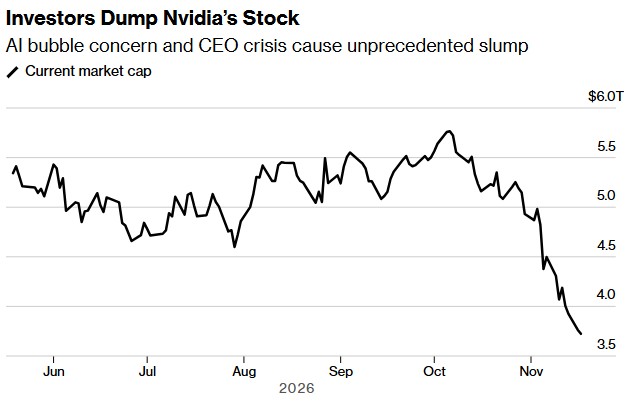
The bears' arguments were ready before the earnings report: Research firm SemiAnalysis cut the 2028 AI capital expenditure forecast by nearly 30% on November 16; J.P. Morgan estimates that Nvidia GPUs account for only 39% of the AI computing power purchased by OpenAI and Anthropic in the future, far below the level of about 83% from 2023 to 2025. Jacob Bourne (Jacob Bourne), an analyst at the market research firm eMarketer, summed up the plight of many companies in one sentence: “Even explosive performance exceeding expectations cannot take the spotlight off Nvidia's leadership crisis. The situation is still changing.”
The actual significance of this financial report is that it pushes the pricing power of “New Era Discounts” from emotions to fundamentals. On the demand side, in addition to Vera Rubin's volume, the hyperscale cloud vendors summarized in the Daimo earnings forecast attachment still point to delivery bottlenecks in 2027 rather than exhaustion of demand — Amazon says it “installs an AI accelerator about every 14 seconds,” and Microsoft says “I would be surprised if the computing power to go live before the end of next year falls below 13 GW.” When the discount is lifted depends ultimately on the fulfillment of two things: whether gross margin actually bottomed out in the fourth quarter, and when the name of the successor CEO lands. Moreover, the fourth quarter is probably the first full quarter without the actual management of Hwang In-hoon.