


EN
High interest rates and AI shocks raise concerns that the US banking sector is approaching a rare “death cross” Goldman Sachs (GS.US) and MS.US (MS.US) stock prices fell about 20% from August highs
The Zhitong Finance App learned that major US bank stocks are approaching the “death cross” pattern seen as a bearish signal in technical analysis. As market concerns about artificial intelligence (AI) impacting the financial services industry, banking system failure, and rising financing costs increase, the Bank of America sector continues to be under pressure, and investors are wary that bank stocks may face the risk of further decline.
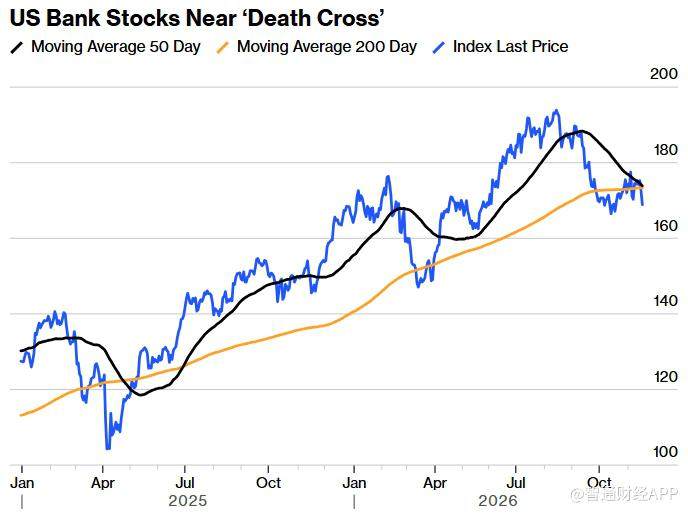
On Tuesday, the KBW Bank Index fell 2.4% intraday, pushing its 50-day moving average closer to the 200-day moving average. Once the short-term moving average falls below the long-term moving average, it will form a “death cross” in technical analysis. It is generally regarded as a sign that action under the market can increase, indicating that stock prices may continue to weaken in the short term.
One of the direct causes of the decline in bank stocks that day was reports of a breakdown in the US National Security Agency (NSA)'s highly confidential network used for internal communications. The day before, J.P. Morgan Chase (JPM.US) also experienced a system outage, putting pressure on bank stocks. Additionally, according to data from the network fault monitoring platform Downdetector, users reported problems with the Schw.US (SCHW.US) service on Tuesday.
However, the banking sector is facing much more pressure than recent system failures. Long before the banking industry announced mixed quarterly results last month, investors began to worry that the rapid development of artificial intelligence technology could disrupt the business model of the traditional financial services industry. At the same time, the Federal Reserve's re-tightening of monetary policy to curb continued high inflation also cast a shadow over the banking sector's prospects.
Bloomberg industry research analyst Herman Chan said that since September, major US bank stocks have continued to recover, mainly because expectations that interest rates will remain high for a longer period of time are weakening many of the key factors driving the rise in bank stocks this year.
He pointed out that the Federal Reserve's renewed interest rate hike and long-term treasury bond yields are driving up banks' financing costs and may inhibit economic growth. At the same time, continued high inflation has also caused investors to question whether bank loan growth can remain resilient and whether the previous relatively good credit quality can continue.
For banks that are highly dependent on capital markets, market concerns are more complicated.
Chan said investors are re-evaluating whether strong stock trading activity over the past period can continue, and whether rising capital costs will curb AI-related financing and initial public offering (IPO) activities.
Previously, the AI investment boom promoted large-scale corporate financing and boosted active stock trading and capital market businesses, which significantly benefited investment banks such as Goldman Sachs (GS.US) and Morgan Stanley (MS.US). However, as the cost of financing climbed, the market began to worry that this growth momentum might weaken.
This concern has been reflected in stock price performance. Since hitting a high in August, the stock prices of Goldman Sachs and Morgan Stanley have both fallen by about 20%, and J.P. Morgan Chase fell by about 9% over the same period.
Judging from technical trends, signs of weakness in bank stocks have continued for some time. The 200-day moving average of the KBW Bank Index began to flatten in late September. At that time, bank stocks had clearly fallen from the all-time high set in August. The index also fell below the 200-day EMA during the same period, the first time since the market correction from March to April this year. Today, with the 50-day EMA falling further, the banking index is only one step away from forming a “death cross.”
Notably, this technical pattern is not common in the Bank of America sector. The last time the KBW Bank Index, which consists of 24 bank stocks, had a “death cross” was in April 2025. At that time, the Trump administration announced the so-called “Liberation Day” tariff measures, causing sharp fluctuations in the financial market.
Over the past 10 years, the KBW Bank Index has experienced a total of eight “death crosses”, usually accompanied by increased macroeconomic pressure or major emergencies, such as the 2023 US regional banking crisis and the 2025 tariff shock.
Currently, the KBW Regional Bank Index is also nearing the formation of a similar technical pattern, indicating that the weakness of the banking sector is not limited to large financial institutions. However, the “death cross” is a lagging technical indicator, which does not mean that the stock price will fall further. The main reflection is that the market trend continued to weaken during the previous period, and that short-term price momentum deteriorated compared to the long-term trend.
Overall, Bank of America stocks are facing multiple challenges at the same time. That is, the Federal Reserve's further tightening of monetary policy pushes up financing costs. Continued inflation may weaken loan demand and credit quality, and changes in AI technology are also bringing new uncertainty to traditional financial services and capital market revenue prospects.
As bank stocks approach a rare technical bearish signal, investors will pay close attention to the future pace of the Federal Reserve's interest rate hikes, long-term treasury bond yield trends, and whether the banking industry can maintain loan growth and the profit performance of capital market operations.