


EN
Fermi Stock Drops After Q3 Results: How a $200M Hyperscaler Deal Could Drive a Recovery
When pre-revenue artificial intelligence infrastructure developers miss bottom-line expectations, sharp market pullbacks often force investors to weigh near-term cash burn against long-term commercial milestones. Evaluating how to navigate these volatile post-earnings swings requires looking past quarterly deficits to examine hyperscaler contract quality, project financing, and power delivery timelines.
Testing investor conviction with wider-than-expected quarterly losses of $0.22 per share against a $0.07 consensus estimate, Fermi (FRMI) is navigating heightened market volatility following its latest Q3 earnings miss.
About Fermi
Fermi, operating as Fermi America, is an energy infrastructure developer focused on building large-scale private electricity grids to support artificial intelligence (AI) data centers and advanced computing. Its flagship Project Matador in Texas aims to combine natural gas, nuclear energy, solar power, battery storage, and utility electricity to deliver reliable, gigawatt-scale power for hyperscalers.
Fermi's stock has experienced significant volatility in 2026, reflecting investor concerns over project financing, construction timelines, customer agreements, and the company's ability to commercialize its ambitious AI infrastructure plans. Shares closed at $2.06 on Nov. 12, gaining 13.8% after the company announced a major hyperscaler agreement involving approximately $200 million in upfront funding. However, FRMI shares pulled back during Friday's session, trading around $1.98, down approximately 3.9% intraday. Despite the recent rebound, the stock remains substantially below its 52-week high of $21.74, while its 52-week low stands at $1.44.
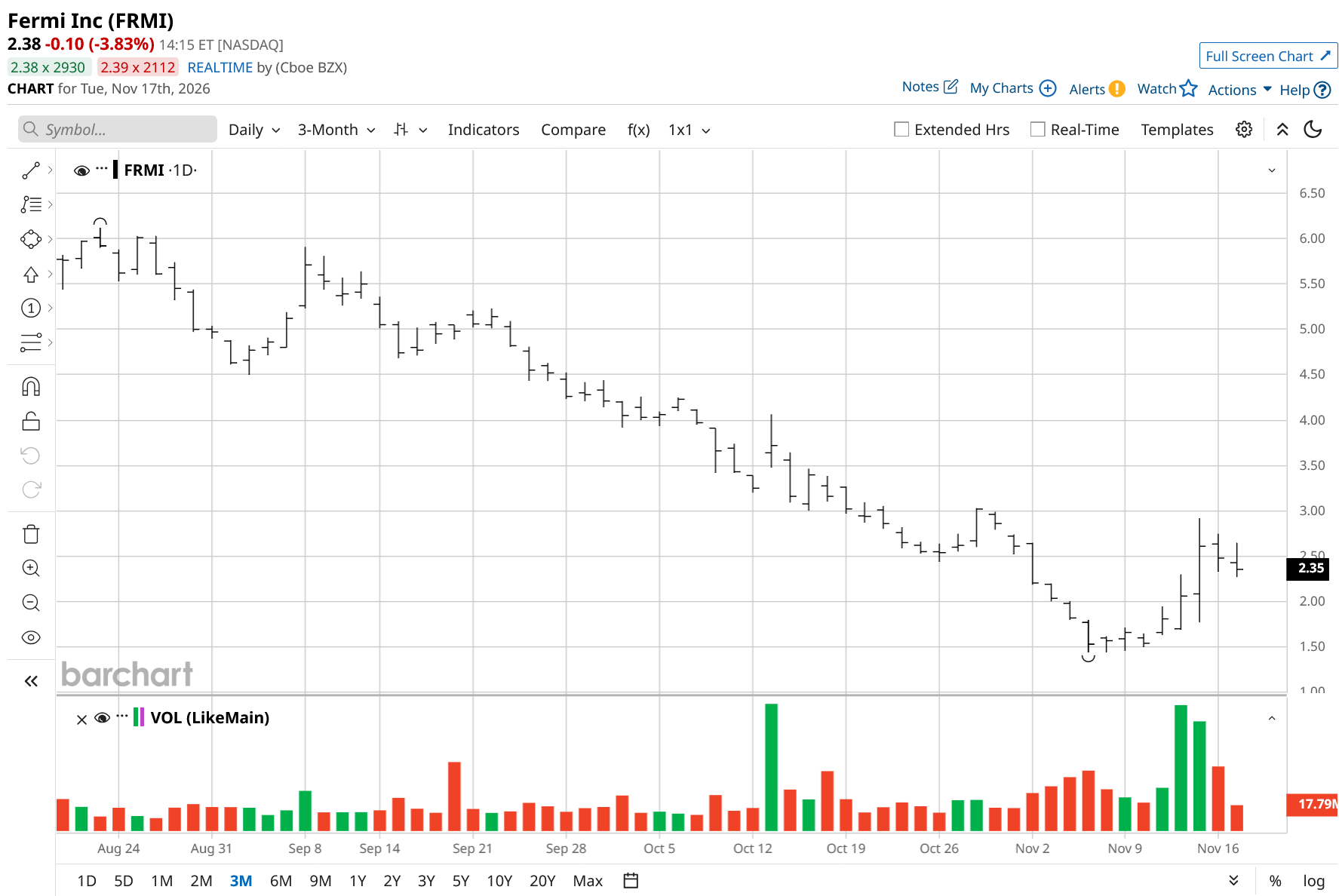
Weak Results
Fermi reported its third-quarter 2026 financial results on Nov. 12, with the company remaining in its pre-revenue development phase. Consequently, it did not report operating revenue or earnings growth, and conventional analyst revenue and EPS beat-or-miss comparisons were not applicable. The company recorded a net loss of $141.6 million, or $0.22 per diluted share, compared with a net loss of $346.8 million, or $0.84 per share, in the prior-year quarter. The latest results primarily reflect continued investment in Project Matador and the expenses associated with developing its large-scale AI power infrastructure.
From a financial perspective, Fermi reported approximately $315.5 million in cash and restricted cash at the end of September 2026. Capital expenditure reached $133.4 million during the quarter, bringing total investments in property, plant, and equipment to approximately $1.67 billion. Outstanding debt, net, stood at $958.4 million, highlighting the substantial capital requirements of its infrastructure expansion. General and administrative expenses reached $142.2 million, including $65.8 million in non-cash stock-based compensation and $21.5 million in financial advisory fees settled through common stock. These figures underline the company's considerable spending commitments ahead of commercial revenue generation.
Looking ahead, management remains focused on advancing Project Matador and converting prospective customer relationships into long-term leases. Fermi recently signed agreements with an undisclosed investment-grade hyperscaler to develop an initial 600 MW of power capacity beginning in 2027. The agreements include a $200 million customer prepayment, a $15 million early construction commitment, and a contemplated $90 million purchase of structural steel and building materials. CEO Lee McIntire highlighted the growing demand for readily available electricity among hyperscalers, expressing confidence in Fermi's ability to capitalize on the AI infrastructure boom.
Fremi's Stock Sells Off After Earnings Miss
Fermi shares experienced significant volatility after the company reported weaker-than-expected third-quarter 2026 earnings alongside new agreements with an undisclosed investment-grade hyperscaler for its Project Matador development in Texas. The agreements include a $200 million customer prepayment, a $15 million early construction commitment, and an additional contemplated $90 million materials purchase. The hyperscaler plans to develop an initial 600 MW of capacity beginning in 2027, ahead of finalizing a long-term lease. However, Fermi reported a Q3 net loss of $0.22 per share, missing the $0.06 loss expected by analysts. The company also terminated its previously announced TensorWave lease, adding uncertainty to its commercialization strategy. CEO Lee McIntire remains optimistic about converting Fermi's customer pipeline into leases to fill its planned 2.2 GW capacity.
How to Play FRMI Stock Post Selloff?
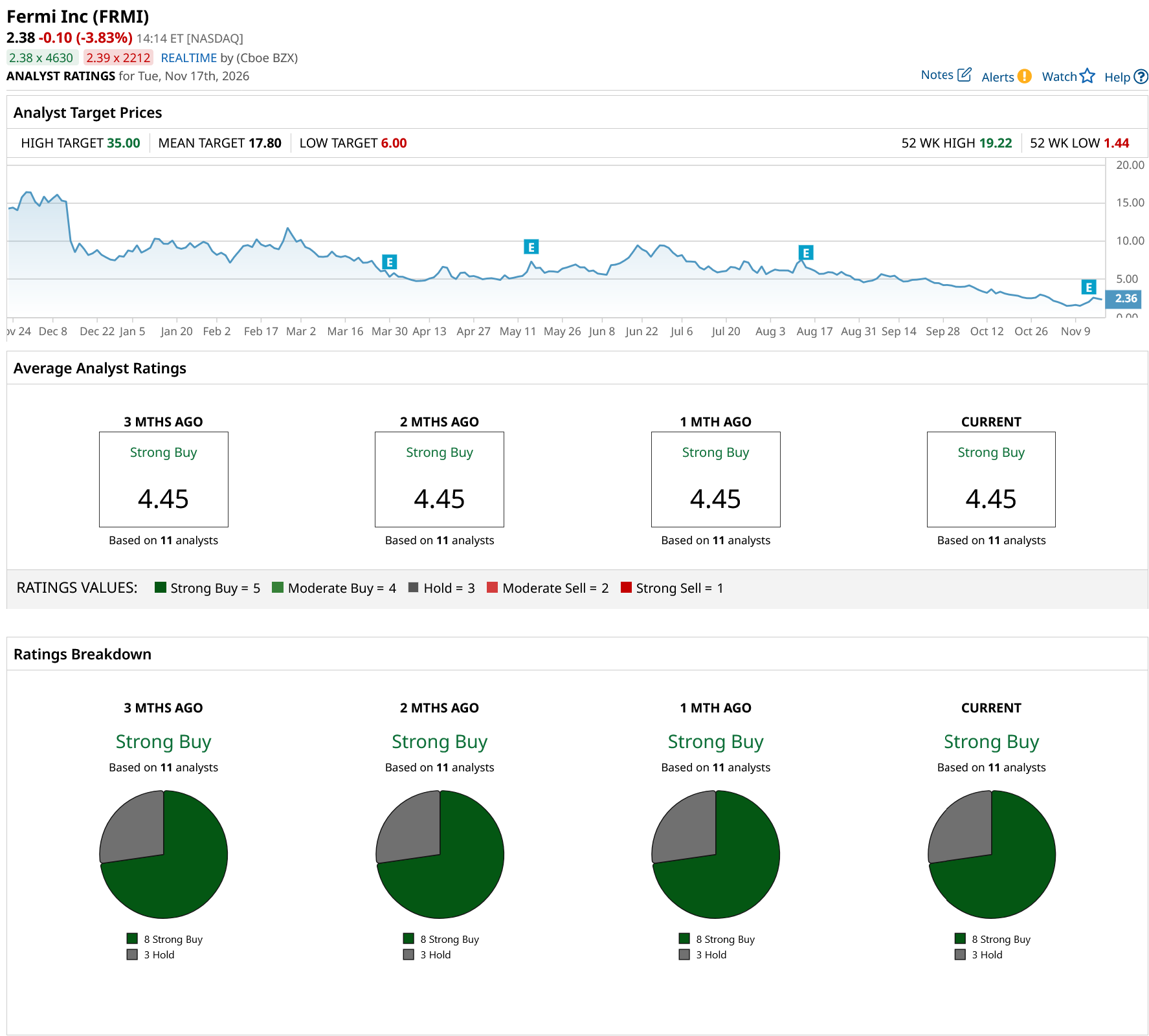
Despite Fermi's recent selloff following its disappointing Q3 2026 earnings and larger-than-expected losses, Wall Street remains optimistic about its long-term prospects. FRMI carries a consensus “Strong Buy” rating, with an average analyst price target of $17.80, suggesting approximately 648% upside from its current market price. Of the 11 analyst ratings, eight are “Strong Buy” and three are “Hold.” While Project Matador's development, financing requirements, and customer lease conversions remain key risks, Fermi's exposure to growing AI data center power demand could offer significant long-term growth potential.
On the date of publication, Ruchi Gupta did not directly have a position in any of the securities mentioned in this article. All information and data in this article is solely for informational purposes. For more information please view the Barchart Disclosure Policy here.