


EN
Nvidia (NVDA.US) Q3 holdings: SpaceX (SPCX.US) drastically reduces holdings, Intel (INTC.US) sticks to the new cloud and optical interconnection
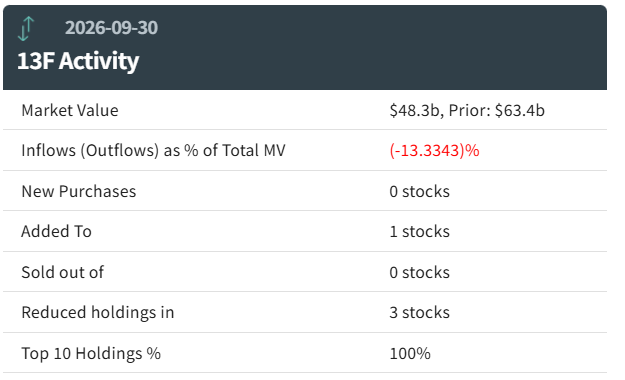
The Zhitong Finance App learned that according to the US Securities and Exchange Commission (SEC) disclosure, AI chip superleader Nvidia (NVDA.US) recently submitted a position report (13F) for the third quarter ending September 30, 2026. SpaceX became the only target to receive an increase in its holdings and replaced Intel as the most important position; Intel, Nokia, and Synopsys were significantly reduced, and the number of shares held by the other four companies remained the same.
Statistics show that the total market value of Nvidia's 13F holdings in the third quarter was about US$48.331 billion, compared with US$63.44 billion in the previous quarter, a decrease of about US$15.109 billion over the previous quarter, or about 23.82%. According to WhaleWisdom statistics, no new positions were created or cleared during the quarter. A total of 8 positions were disclosed. SpaceX and Intel together account for 80.80%. The size of the two heavy positions is closer, but the overall concentration level has not declined significantly. It should be noted that changes in the market value of positions are also affected by adjustments in the number of shares held and stock price fluctuations, and cannot be directly understood as the withdrawal of an equal amount of funds.
The heavy warehouse pattern changes: SpaceX reaches the top, and the layout of AI computing power and high-speed data center connectivity continues
SpaceX (SPCX.US), a commercial space and satellite communications company founded by Musk, ranked first, holding about 130 million shares and a market capitalization of about 19.683 billion US dollars, accounting for 40.73%. Nvidia increased its holdings by approximately 7.8081 million shares, an increase of 6.28%. However, at the end of the quarter, SpaceX's stock price fell from 170.86 US dollars to 150.86 US dollars, down about 11.71%, and the market value of its holdings still decreased by about 6.16% month-on-month. Its primary position comes from a combination of active holdings increase, Intel holdings reduction, and price changes for different targets.
The relationship between SpaceX and Nvidia also extends to the expansion of terrestrial AI computing power. Its superintelligence business revenue for the third quarter was approximately US$7.56 billion, covering cloud services, models and software; in October, it also reached a financial leasing commitment of approximately US$40 billion for GPUs and related equipment to be used to deploy Vera Rubin. Operating expansion and financing arrangements provide a background for understanding the industrial value of this shareholding, but they are not the reason for the increase in holdings disclosed by 13F.
Intel (INTC.US), an established US CPU processor and chip manufacturer, took second place, holding a position of about 161 million shares, with a market value of about 19.367 billion US dollars, accounting for 40.07%. Nvidia reduced its holdings by about 53.6941 million shares, a decrease of 25.00%; the combined quarter-end stock price fell by about 13.89% compared to the end of the second quarter, and the market value of its holdings decreased by about 35.42% month-on-month. Large holdings are retained even after holdings are reduced, and the contraction of equity exposure and product cooperation between the two parties should be assessed separately.
GPU cloud infrastructure service provider Coreweave (CRWV.US) ranked third, holding about 472,134 million shares, with a market capitalization of about US$4.113 billion, accounting for 8.51%. The number of shares held was the same as in the previous quarter. The two sides have announced plans to cooperate to build an AI factory and deploy multi-generation Nvidia computing platforms. This position preserves Nvidia's direct interest in the GPU computing power operation platform.
Coherent (COHR.US), a laser and optical communication device manufacturer focusing on the field of optical interconnection in AI data centers, ranked fourth, holding approximately 7.782 million shares, with a market capitalization of about US$2,242 billion, accounting for 4.64%. The number of shares remained unchanged. The cooperation between the two sides includes procurement and production capacity arrangements for advanced laser and optical network products. Its industrial value is to improve the data transmission capacity and energy consumption of large-scale AI clusters and support the collaborative operation of more GPUs.
Chip design EDA software and engineering simulation software provider Synopsys (SNPS.US) ranked fifth, holding a position of about 4.3541 million shares, with a market value of about US$1,894 million, accounting for 3.92%, reducing its holdings by about 467,600 shares, or 9.70%. The cooperation previously announced by the two sides covers CUDA acceleration chip design, verification, and physical simulation. This business collaboration cannot be judged solely on changes in shareholding.
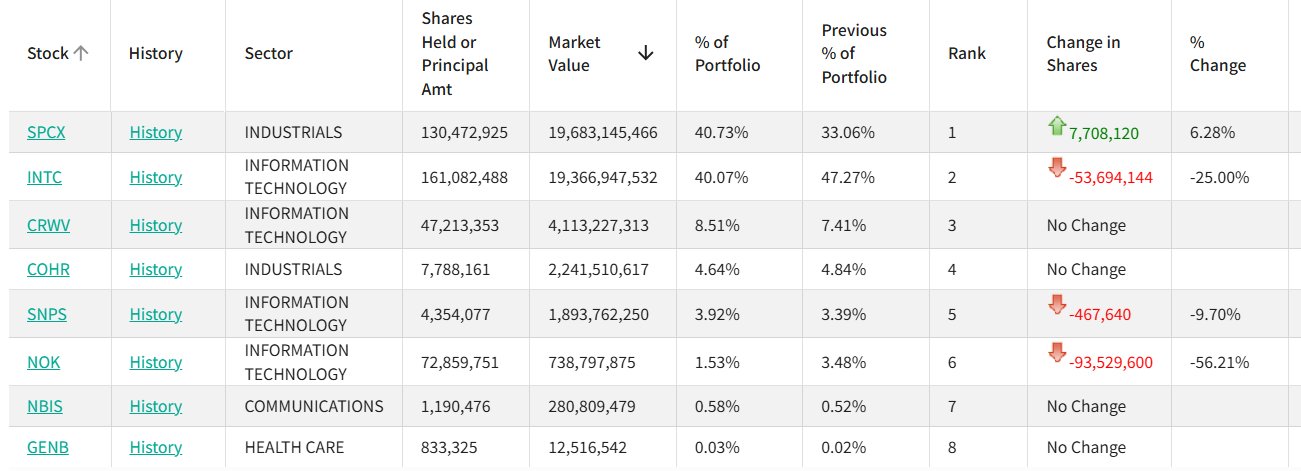
The sixth to eighth largest European communication network equipment company Nokia (NOK.US), AI cloud service provider Nebius (NBIS.US), and AI protein drug developer Generate Biomedicines (GENB.US), respectively. It held approximately 72.8598 million American Depositary Receipts, 1.1905 million shares, and 833,300 shares in that order, with market capitalization of about $739 million, $281 million, and US$13 million, accounting for 1.53%, 0.58%, and 0.03%, respectively. Among them, Nokia reduced its holdings by 56.21%, while the shares of the latter two companies remained unchanged.
Key differences in the third-quarter trading list: SpaceX increased its positions, while Synopsys reduced its holdings but increased its power
Judging from changes in position ratio, Nvidia's top buyers list in the third quarter was only SpaceX (SPCX.US), and the combined weight increased by about 7.66 percentage points. This figure measures the change in weight. The actual increase in shareholding was 6.28%; the increase in weight was also affected by the number of new shares and the decline in the total market value of the portfolio.
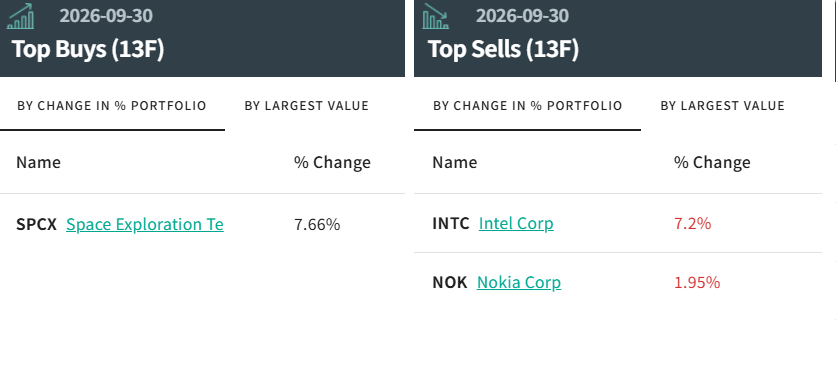
Intel (INTC.US) and Nokia (NOK.US) were the two targets on the Top Sell list, and their weights dropped by about 7.20 and 1.95 percentage points, respectively. The actual holdings reduction ratio of the two companies was 25.00% and 56.21%, respectively; Nokia's shareholding volume decreased by about 93.5296 million shares, the largest reduction of the three holdings this quarter.
Although Synopsys's holdings were reduced by 9.70%, the weight increased from 3.39% to 3.92%. The core reason behind this is that the market value of its holdings only fell by about 11.95%, far less than the 23.82% decline in the total market value of the portfolio. It was neither subject to an increase in holdings, nor did it lose weight, so it did not enter the two lists in the screenshot; the increase in CoreWeave's weight cannot be understood as an additional purchase.
It should be noted that Nvidia's equity adjustments are not yet equivalent to the withdrawal of technical cooperation. The public agreement between Intel and Nvidia involves customizing x86 processors via NVLink; Nokia still announced the progress of AI radio access network (AI-RAN) commercial testing in October after the end of the third quarter. Combined with the reserved new cloud, optical interconnection, and design software holdings, a more grounded interpretation is that some strategic equity exposure has shrunk while retaining the AI infrastructure cooperation chain.
Post-quarterly backtesting and testing: accurately escaping Intel's peak, ecological value still needs to be realized
From September 30 to November 16, when regular trading closed, Intel and Nokia fell by about 53.86% and 24.16% respectively; SpaceX fell by about 8.95%, while Synopsys rose by about 1.47%. Nvidia's holdings reduction operations particularly highlight that reducing Intel and Nokia's holdings reduced their exposure to subsequent declines, but the effects of the various adjustments were not consistent.
The number of reserved shares of CoreWeave and Nebius declined by about 42.75% and 54.58%, respectively, during the same period, indicating that the value of strategic cooperation and short-term stock returns may still diverge. After the 13F disclosure on November 16, Intel and Nokia fell by about 3% and 2% respectively after the market, and the market continued to reassess the signal significance of changes in Nvidia's shareholding. These are price performances for the corresponding period. Nvidia's actual transaction revenue cannot be restored based on this, and 13F did not disclose specific holding costs.
Nebius, the leader of AI New Cloud, also has equity differences that need to be penetrated — Nvidia's July 13g filing revealed pre-paid warrants (pre-paid warrants) that can be subscribed for approximately 1.195,900 shares in addition to approximately 1.195,900 common shares. Therefore, the 0.58% weight in 13F does not represent Nvidia's full economic exposure to Nebius, nor is it appropriate to judge its importance in the AI ecosystem based on this.
An investment clue worth paying more attention to in this round of position adjustments is how equity capital supports GPU demand acceptance, computing power operations, and key connectivity capabilities. SpaceX, CoreWeave, and Nebius need to turn computing power investment into sustainable revenue, while Coherent and Synopsys participate in solving the efficiency problems of interconnection and AI chip computing engineering; whether these commercial collaborations can generate cash returns is the key to realizing shareholding value.