


EN
Honeywell’s AI Breakthrough Could Turn 30,000 Buildings Into a Massive Growth Opportunity
Honeywell (HON) just gave its investors a fresh catalyst with its latest AI announcement, but the bigger opportunity may be hiding in its existing customer base.
At its Nov. 10 Accelerate 2026 conference, Honeywell unveiled EBI One, an AI-powered building management platform, alongside new fire safety and security tools.
The timing is notable here. Building operators are managing more complex facilities with fewer skilled workers, while data centers, hospitals, and industrial sites need reliable systems that can monitor energy use, spot problems, and respond faster.
Honeywell already has Enterprise Buildings Integrator technology in more than 30,000 buildings. That gives it a large installed base to sell upgrades, software, and services into.
The products could strengthen customer relationships and make Honeywell’s automation portfolio stickier. Yet, investors should not confuse a product launch with immediate revenue. Honeywell has not disclosed sales targets or pricing. Commercial adoption will determine whether this becomes a meaningful catalyst for HON.
Honeywell Refocuses on Automation and Emerging Markets
Honeywell International is a global technology and manufacturing company focused on industrial automation, building automation, and energy and sustainability solutions, operating primarily in the United States.
After recent divestitures, including a spin-off of its Aerospace division, the company is focused on automation-driven businesses and emerging markets like data centers, low-carbon energy, and hydrogen technologies. Honeywell retains a significant backlog, with a global presence and a broad installed base. Major initiatives also include product innovation and software-driven service offerings across key growth verticals.
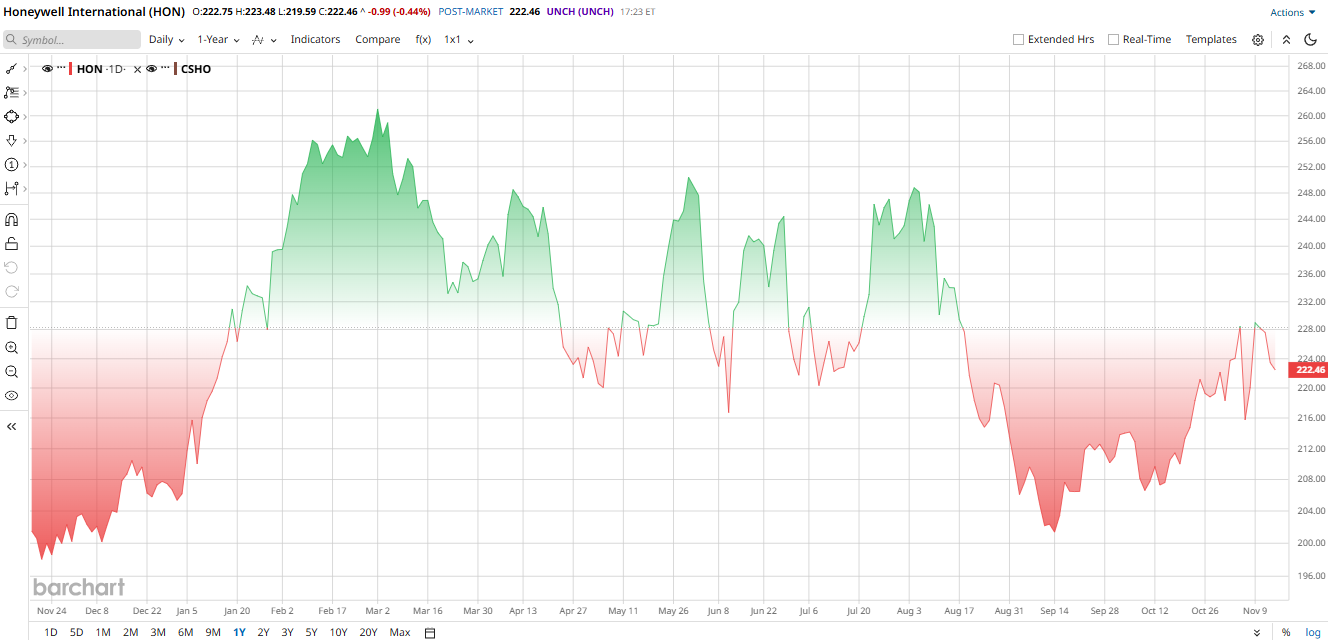
The market has responded to this refocused strategy so far this year. HON stock has gained more than 8% year-to-date (YTD), fueled by strong Q3 results, a nearly $19 billion backlog, and its shift to a standalone automation business. However, reported Industrial Automation sales fell 23%.
With the shares already up this year and Industrial Automation sales still down, the key question is how much of the good news is already reflected in the price. At 22.6 times forward earnings and 9.1 times EV-to-EBITDA, it suggests HON is not cheap. The valuation leaves room for upside, but assumes continued earnings recovery.
AI Could Make Honeywell’s Building Business More Valuable
EBI One integrates Honeywell’s Enterprise Buildings Integrator platform with the Honeywell Forge Cognition AI system. Conversational commands can be utilized, alarms can be prioritized, and operators can gain insight from building data. Carbon monoxide monitoring products, multi-function fire versus dust and steam detectors, and Incident Command software that brings all the emergency information together around a single table are all new safety products.
In early 2027, Honeywell will reveal its LenelS2 Adaptive Intelligence Suite and Niagara 5 framework. The security suite will check alarms and alert on unusual activity. Niagara 5 will integrate HVAC, fire, lighting, security, and energy systems to bridge inter-territorial connections between vendors.
This can pave the way for software upgrades and for services. Honeywell claims it was able to reduce unnecessary alarms by 90% and achieve energy savings of up to 10% in a deployment at NVIDIA (NVDA) headquarters. That's only one deployment.
Q3 Results Show Momentum Beyond Building Automation
On Oct. 22, Honeywell reported its Q3 earnings, which beat estimates on earnings but missed revenue estimates. Sales only rose 1% to $4.994 billion, or 7% organically.
Adjusted EPS rose 34% to $2.27. Net income attributable to Honeywell fell 64% to $664 million from $1.825 billion, partly reflecting discontinued-operations income in 2025. Free cash flow increased 15% to $688 million. Cash and equivalents were $5.694 billion. Backlog reached nearly $19 billion, up 7% excluding divestitures.
CEO Vimal Kapur said adjusted EPS rose “well ahead of our expectations.” Data-center orders increased more than 100% year to date, and he expects very high growth in 2027.
Honeywell also raised 2026 revenue guidance to $20.0 billion to $20.1 billion and adjusted EPS to $8.40 to $8.45. Free cash flow guidance is now about $2.1 billion.
Beyond buildings, LNG and refinery projects in the Middle East and Africa are adding demand. Honeywell has completed its aerospace separation and expects to eliminate remaining stranded costs by year-end, supporting margins. Industrial Automation still needs to sustain its recovery.
Wall Street Sees Modest Upside
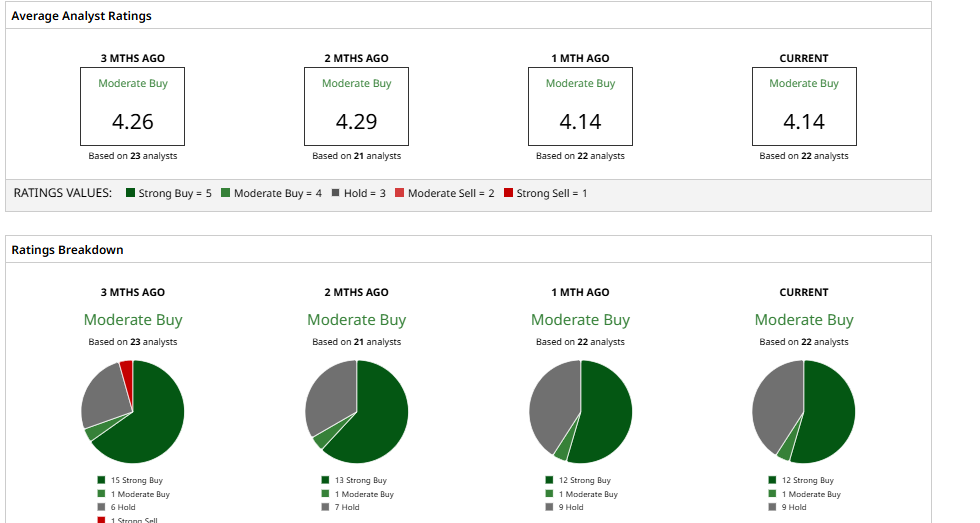
Overall, analysts have a consensus “Moderate Buy” rating and continue to praise Honeywell’s shift to a standalone automation business and its nearly $19 billion backlog, but many believe the valuation will remain the biggest issue surrounding HON stock in 2026.
Moreover, analysts set a mean price target of $257, suggesting a decent 15% upside run for HON from the current level.
Yet there is a consensus forming here: RBC kept its Buy rating but trimmed its target to $269 from $270 after Q3. It also praised management’s habit of “under-promising and over-delivering.”
On the bullish side, JPMorgan reiterated its Buy rating and raised its target to $241 from $240. Bernstein maintained its Hold call but lifted its target to $256 from $254. Analysts like Honeywell's backlog, margin gains, and cash generation. However, they want proof that industrial automation can recover, and AI launches can become meaningful sales
On the date of publication, Nauman Khan did not directly have a position in any of the securities mentioned in this article. All information and data in this article is solely for informational purposes. For more information please view the Barchart Disclosure Policy here.