


EN
Technology stocks have experienced the biggest reduction in allocations in 20 years! Bank of America investigation reveals the current state of “AI trading”: positions have cooled down drastically, and the panic required to bottom out is still insufficient
The Zhitong Finance App learned that Wall Street financial giant Bank of America's latest survey of the world's top fund managers shows that the current strong rebound in the core players of global technology stocks — AI computing power-themed stocks and the broad semiconductor sector — has not yet translated into an optimistic recovery in the risk appetite of global technology stocks that continue to expand. The Bank of America survey shows that institutional investors' optimism about the global AI investment boom in recent years has subsided drastically, and fund managers have cut their exposure to technology stocks to the greatest extent in nearly 20 years. There were 169 participants in the Bank of America survey, with total assets under management of US$461 billion.
Bank of America's latest fund manager survey shows that the stock market trading frenzy surrounding AI is experiencing a significant cooling in allocations, but the overall pessimism supporting reverse buying has yet to take hold. From November 6 to 12, the net ratio of fund managers who were overequipped with technology stocks fell from 37% to 12%, the biggest drop since June 2006; at the same time, they believe that the net ratio of corporate overinvestment reached a record 38%. 52% of respondents expect AI hyperscale cloud vendors to announce capital expenditure cuts in the next six months, indicating that the market is beginning to re-examine the matching relationship between computing power expansion and terminal revenue, financing capacity, and return on investment.
However, the Bank of America survey also showed that fund managers around the world are still in a state of net overallocation to technology stocks. Instead, the average share of funds in cash fell to 3.6%. Only about 3% of respondents expected a recession, which is enough to indicate that capital is more being reallocated between industries and regions, and that cash assets have not generally declined. This is an important basis for Bank of America's chief strategist Michael Hartnett, who has the title of “Wall Street's Most Accurate Strategist,” to maintain a defensive stance in the coming months — the decline in technology stock congestion does not automatically mean that the risk of declining profit expectations driven by the risk of delays in data center construction after the Democratic Party won the midterm elections and the pressure to collapse valuations have been fully calculated.
Compared with the judgment that Morgan Stanley and Goldman Sachs are optimistic about mid-term stock returns, Bank of America is more concerned about whether current positions can withstand new expected gaps; for the global AI industry chain, which is critical to the technology stock market, the next stage of investment differentiation will depend more on who can still turn orders into sustainable profits and cash flow in an environment where the growth rate of infrastructure hardware procurement related to AI data center construction is slowing down and financing constraints are strengthened.
AI frenzy is ebbing, and fund managers are redistributing risk exposure! Investors cut tech exposure the biggest since 2006
Overall, Bank of America's survey of global fund managers shows that institutional investors' optimism about the global artificial intelligence boom is fading, and fund managers have cut their exposure to technology stocks to the greatest extent in nearly 20 years. The survey, which was conducted from November 6 to 12, found that the net share of fund managers who overallocated technology stocks fell to 12% from 37% in October, the biggest drop since June 2006.
Michael Hartnett wrote in the report that investors are also sending a “strong” signal that companies should stop spending on artificial intelligence. The net percentage of respondents who believe that companies are overinvesting reached a record high of 38%, and 52% of respondents expect an AI hyperscale cloud vendor to announce capital expenditure cuts in the next six months.
Hartnett's latest review on the subject of AI trading wrote, “The frenzy surrounding economic prosperity and the frenzy surrounding AI seems to have come to an end.”
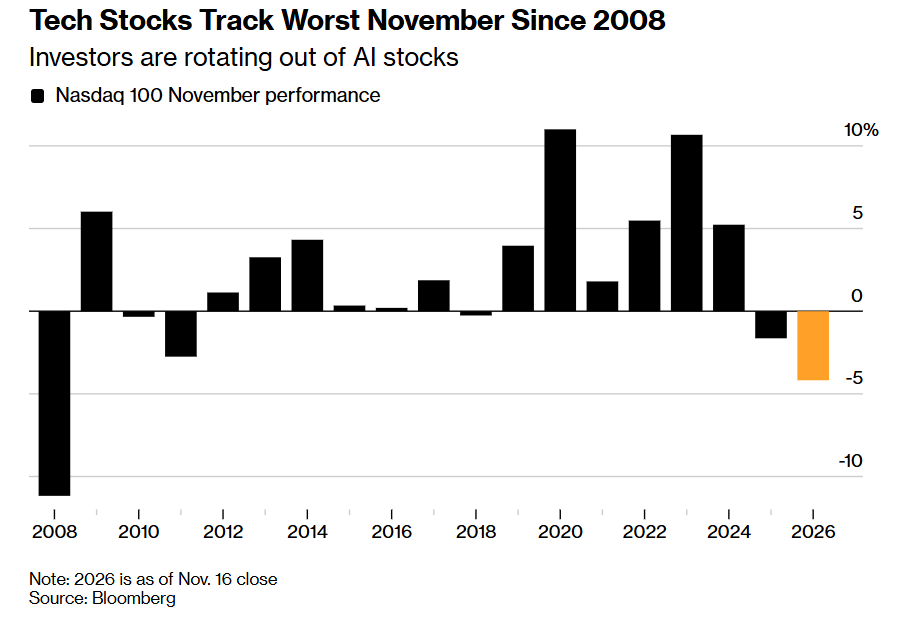
As shown in the chart above, tech stocks are heading for their worst performing November since 2008 — investors are withdrawing money from popular AI-linked stocks. Note: 2026 data closes on November 16.
A new round of market concerns about the return on huge AI spending has impacted global financial markets. The Nasdaq 100 Index, which is heavily weighted by technology stocks, has fallen by more than 4% this month. According to current trends, it may have recorded the worst November performance since 2008. A semiconductor-related stock index has fallen 27% since the beginning of October.
Bank of America's Hartnett suggests continuing to maintain a risk-averse stance in the coming months because the survey “has not yet shown sufficient investor 'fear' to support the purchase.” He said that judging from the historical experience of this survey, the best time to enter the market often comes after fund managers further cut their exposure to technology stocks and switch to low allocations.
Investors, however, are less concerned about the risk spreading to the wider economic sector. Only about 3% of survey participants expected a recession in the coming year, while cash holdings fell to 3.6% of total assets, the lowest since August.
Other market strategists are also bullish on stocks. This week, the Morgan Stanley team said that the AI spending boom will make 2027 a “year to embrace risk”; Goldman Sachs's forecasting team expects the S&P 500 index to rise 17% over the next 12 months to 8,700 points.
In the Bank of America survey, about 36% of fund managers expect international stocks to be the best performing assets in 2027, followed by US stocks and gold, with selection ratios of 24% and 17%, respectively. According to Bank of America's research notes, there were 169 participants in the survey, with total assets under management of US$461 billion.
The rebound was sold off again, and the market began to revise AI growth expectations and valuation premiums at the same time
The strong rebound in AI computing power stocks has yet to translate into a continued fix in risk appetite. From November 9 to 13, the Philadelphia Semiconductor Index and the Nasdaq 100 Index cumulatively rose by about 8.05% and 3.53% respectively; however, on November 16, the two fell again by 5.28% and 2.67%. The fee was halved at 9,610.65 points, a retracement of about 34.3% from the highest closing level of 14,634.72 points on June 22, and is still deep in the technical bear market.
These latest market data highlight that a phased counterattack can occur during a deep adjustment process, and the rebound itself is not enough to prove that long-term profit expectations have stabilized.
Nvidia announced the resignation of Hwang In-hoon on November 12, with Chief Financial Officer Colette Kress as interim CEO, further raising the market's focus on strategy execution and customer relationship continuity. In response to this round of uncertainty, Goldman Sachs lowered its target price from $300 to $220, Citi from $285 to $225, and UBS from $300 to $240, by about 26.7%, 21.1%, and 20%, respectively, but they all retained a “buy” rating.
Goldman Sachs believes that the backlog of orders will still support operating performance over the next 12-18 months, and uncertainty will have a greater impact on the valuation multiples; UBS lowered its 2028 revenue and earnings per share forecast by about 10% due to potential export restrictions and data center delays. However, it should be noted that this round of market repricing already involves both forward profits and valuations that investors are willing to pay, and cannot simply be understood as the complete disappearance of near-end orders.
The Asian market has further amplified this pressure. On November 16, the Taiwan Weighted Index, South Korea's KOSPI, and Nikkei 225 closed down 6.03%, 3.59%, and 2.42%, respectively; on the 17th, Taiwan and South Korea fell further by 2.31% and 2.59%, with cumulative declines of about 8.20% and 6.09%, respectively. At the industry chain level, changes in GPU procurement expectations will affect demand for advanced manufacturing processes, packaging, HBM, and high-speed connectivity. Therefore, holding stocks in different regions and industry segments may still be jointly exposed to the same AI capital expenditure cycle. The combination of leadership transitions, funding constraints, and project deployment expectations can cause a seemingly scattered mix to retreat simultaneously during periods of pressure.
Reducing technology has not retreated to cash. Bank of America warns that there is still a gap between “easing congestion” and “forming a point of purchase”
What is most noteworthy about the Bank of America survey is that investors have changed their attitude towards AI to be cautious, but the overall fund manager position index has yet to show a sufficient defensive investment stance.
From November 6 to 12, the net ratio of fund managers with excess technology stocks fell from 37% to 12%, down 25 percentage points, the biggest decline since June 2006; this is a change in respondents' allocation positions; it is not a 25 percentage point drop in the share of technology stocks in the portfolio.
At the same time, they believe that the net proportion of corporate overinvestment has reached a record 38%, and 52% of respondents expect AI hyperscale cloud vendors to announce capital expenditure cuts in the next six months; according to reports, the Financial Times further revealed that the latter ratio was only 30% last month, which means there has been a marked change in confidence that capital expenditure will continue to expand.
However, the average share of fund managers in cash fell to 3.6%. Only about 3% of respondents expected a recession in the next year, indicating that adjustments are closer to risk redistribution between industries and regions. Bank of America's “The Flow Show” on November 12 proposed that if the cash ratio falls below 3.7%, the market still lacks sufficient fear; the fund flow data tracked by the same report shows that the net inflow of global equity funds was still 98.3 billion US dollars during the week, and the net inflow of technology funds was 8.9 billion US dollars. Although fund flows and survey positions are different samples, the two together show that the market's cautious speech/tone has yet to be fully translated into divestment or underallocation.
Hartnett pointed out that if the fund manager survey report shows that institutional investors' expectations for next year's economic “boom” are still high, and the average cash allocation ratio of fund managers falls below 3.7%, this means that market panic is not enough, capital is still crowded in the market, and adjustments in US stocks and even global technology stocks are not over yet. What the team led by Bank of America strategist Hartnett is waiting for the market's willingness to take risks to shrink further until a major bottom-down opportunity arrives, rather than just confirming a buying window based on a sharp decline in technology stocks.
The latest calculation model adjustments by SemiAnalysis, a well-known semiconductor industry chain research agency, provided an industry-level explanation for capital expenditure concerns in the Bank of America survey: the growth of new annualized revenue from cutting-edge model companies is slowing down, compounding debt and equity financing tightening, weakening the ability of some projects to lock in land, electricity, and computer rooms in advance.
SemiAnalysis cut the global AI accelerator spending forecast by 28% to US$758 billion in 2028 and 40% to US$923 billion in 2030; however, the new model still expects spending to continue to grow from US$392 billion in 2026. It should be noted that what has been revised down here is the previously anticipated expansion path, and the caliber is focused on accelerators, and cannot be expanded to the full data center capital expenditure.
The agency also anticipates that 5.8 gigawatts of the US data center capacity originally scheduled to be put into operation from the second half of 2027 to the first half of 2028 will be extended, but it emphasizes revenue growth and the financing environment as the more important reasons for the adjustment. Analysts at the agency said that in line with the forecast model, investors are demanding that the scale of future purchases be re-matched with payment requirements, financing capacity, and actual delivery schedule.
In terms of hardware economics, the purchase amount is determined by both delivery volume and average sales price, while actual calculated output also depends on performance, software efficiency, utilization rate, and power supply conditions. SemiAnalysis lowered the five-year cumulative logic silicon wafer shipping area forecast by 17%, HBM demand in 2028 by about 30%, and reduced the HBM price and some GPU sales price assumptions, showing that the adjustments also involved demand scale and supplier pricing.
According to SemiAnalysis, Nvidia accounts for 66% of the industry's silicon wafer area forecast reduction, reflecting its greater exposure to high-priced GPUs and new cloud customers under financial pressure; in contrast, Broadcom's five-year cumulative revenue forecast for ASIC business was lowered by 11%, and Amazon Trainium's 2027-2028 shipping forecast remained unchanged. From this perspective, the competitive focus is expanding to the cost of effective computing power per unit, energy efficiency, customer capital strength, and computer room deliverability: a slowdown in capital expenditure growth will depress the revenue expectations of some hardware vendors, while falling computing costs may also improve the returns of cloud platforms and application companies. This is exactly the direction that the Bank of America investigation revealed in the financial allocation differentiation that needs to be further discerned.
In the Bank of America survey, 52% of respondents expected cloud giants to cut capital expenses; the downgraded SemiAnalysis forecast further revealed how this concern may be transmitted to the industry chain: slowing procurement expansion and falling hardware prices will lower the revenue expectations of some chip suppliers, while creating conditions for computing power users to reduce costs. The Bank of America strategist team said that investors' AI allocation strategies therefore need to be further distinguished, which suppliers can maintain their share and profit margins, and which cloud platforms and application companies can turn cost reductions into actual operating benefits.