


EN
Bet the US economy continues to be stronger than the world! T. Rowe Price fund manager went long on British bonds and shorted US bonds, outperforming 97% of similar funds this year
The Zhitong Finance App noticed that the strategy of going long on British treasury bonds and shorting US treasury bonds since the beginning of 2026 is trending towards T. Rowe Price's fund manager Scott Solomon brought rewards, and he wasn't in a hurry to close those positions.
According to the data, the $800 million Dynamic Global Bond fund managed by Solomon and others has risen by about 5% since this year, outperforming similar funds by 97%, and is expected to record the best annual performance since 2020.
What supports this return is a basic judgment that Solomon and his team have always maintained in the midst of geopolitical turmoil and sharp fluctuations in oil prices: the US economy will continue to outperform other economies, putting pressure on US debt. This view was confirmed again last week — heated US inflation data, compounded by hawkish statements from Federal Reserve officials, triggered the worst sell-off of US Treasury bonds since April 2025.
In an interview last week, Solomon said, “We adhere to the view that the US is growing strongly and that growth is relatively poor in the rest of the world.” “We have done a good job in these views, and we have not wavered over and over again.”
He held short positions on US Treasury bonds through futures and swaps, and increased his exposure to UK treasury bonds. This reflects his judgment: the market expects too many interest rate hikes from the Bank of England (BOE) and too little about the tightening of the Federal Reserve.
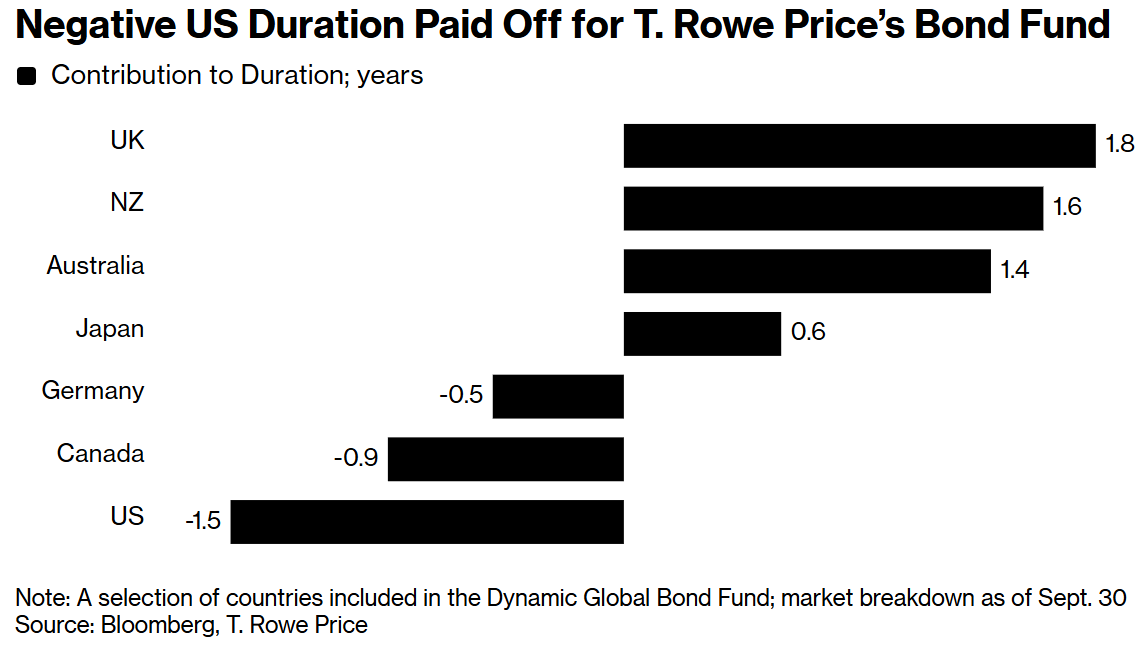
Negative America's long-term strategy is T. Rowe Price bond fund brings in revenue
The current pricing of swap rates shows that by the end of next year, the Bank of England will raise interest rates by 92 basis points, and the Federal Reserve will raise interest rates by about 80 basis points.
Both central banks are struggling to contain inflation — the Middle East war has boosted oil prices, and both economies remain resilient. The UK economy recorded its fastest growth rate in two and a half years in the second quarter. Consumer price data scheduled to be released on Wednesday is expected to show inflation of 3.6%, far higher than the Bank of England's target.
However, Solomon said that improvements in British fiscal policy and the “easing” of the labor market have made British treasury bonds a good bet. Data released on Tuesday showed that employers unexpectedly cut employment numbers in October.
Approximately 65% of the fund's assets are invested in global government bonds. Solomon had already underpaid US treasury bonds before the war broke out in late February and basically maintained this position. He said that the conflict “really only added fuel to some of our existing positions.”
The conflict disrupted interest rate assumptions: investors who bet on US and UK interest rate cuts at the beginning of the year reversed their positions after Iran blocked the Strait of Hormuz, oil prices soared, and bonds fell. When US yields rose above 5% in September, PIMCO reduced its low-allocation positions on US Treasury bonds.
Solomon did not follow this approach. He expects that as the economy continues to overheat, the extent of the Fed's interest rate hike will exceed market expectations. According to Solomon, this will push up short-term bond yields faster, and eventually cause the yield curve to invert for the first time since 2024.
“If profits have peaked to some extent, and overall inflation can perform well with some base effect, that is likely to point to a long but unaggressive cycle of interest rate hikes — 25 basis points per quarter, as we saw in 2017 and 2018,” he said.