


EN
From early pricing in the market to waiting for a new round of catalysis, when will Zhaoke Ophthalmology-B (06622), which has been approved as a new drug, undergo a revaluation?
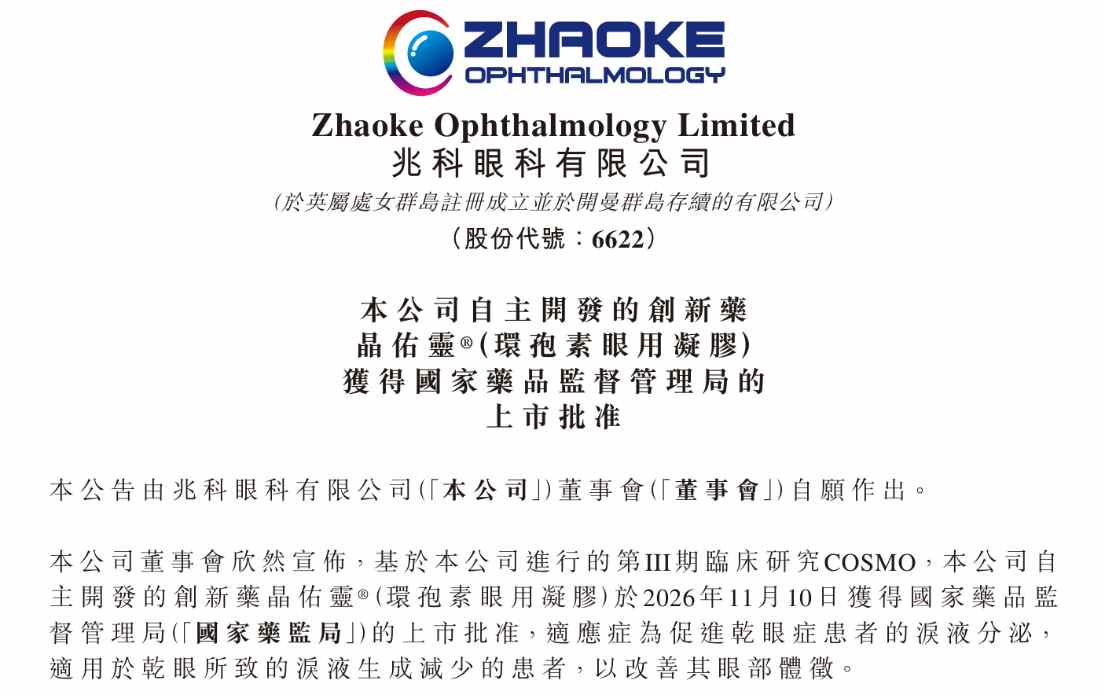
Since October 27 this year, the stock price of Zhaoke Ophthalmology-B (06622) has seen a relatively obvious rebound. The company's stock price rose from a phased low of HK$1.85 to a phased high of HK$2.20 on November 16, with a range increase of 18.92%. At this stage, the innovative drug Jingyouling® (cyclosporine ophthalmic gel) independently developed by the company was approved for marketing, which is an important catalytic factor.
The Zhitong Finance App learned that on November 13, Zhaoke Ophthalmology issued an announcement stating that the innovative drug Jingyouling® (ciclosporin eye gel) was approved for marketing by the China Drug Administration (China Drug Administration) on November 10, 2026. The indication is to promote tear secretion in patients with dry eyes, and is suitable for patients with reduced tear production due to dry eyes to improve their signs.
Looking back at the stock price trend of Zhaoke Ophthalmology since October 27, the company's stock price revolves around the catalyst for the listing of major products. Obviously, it has gone through a round to watch the bullish market.
From early market pricing to waiting for the next round of catalysis
After the stock price hit a phased low on October 26, Zhaoke Ophthalmology's stock price did not continue to decline; instead, it began a three-stage rebound starting the next day.
From October 27 to October 30, there was an obvious volume breakthrough in the field of Zhaoke Ophthalmology. Although the stock price increase in the range was only 6.61% based on the closing price, the average daily volume of the range was 195,000 shares, which confirmed the reverse trend at the bottom in line with the corresponding increase in stock prices.
However, in the mid-term market from November 2 to 9, Zhaoke Ophthalmology's stock price showed a period of contraction. With a 4.50% increase, the corresponding average daily transaction volume shrunk to about 99,000 shares, a decrease of about 49% compared to the previous phase; by the third stage, the phased increase in the company's stock price turned negative, while the corresponding daily average volume increased to around 157,000 shares.
In particular, on the day the company's ciclosporin ophthalmic gel was approved on November 10, Zhaoke Ophthalmology's stock price closed down while releasing 429,500 shares in the range.
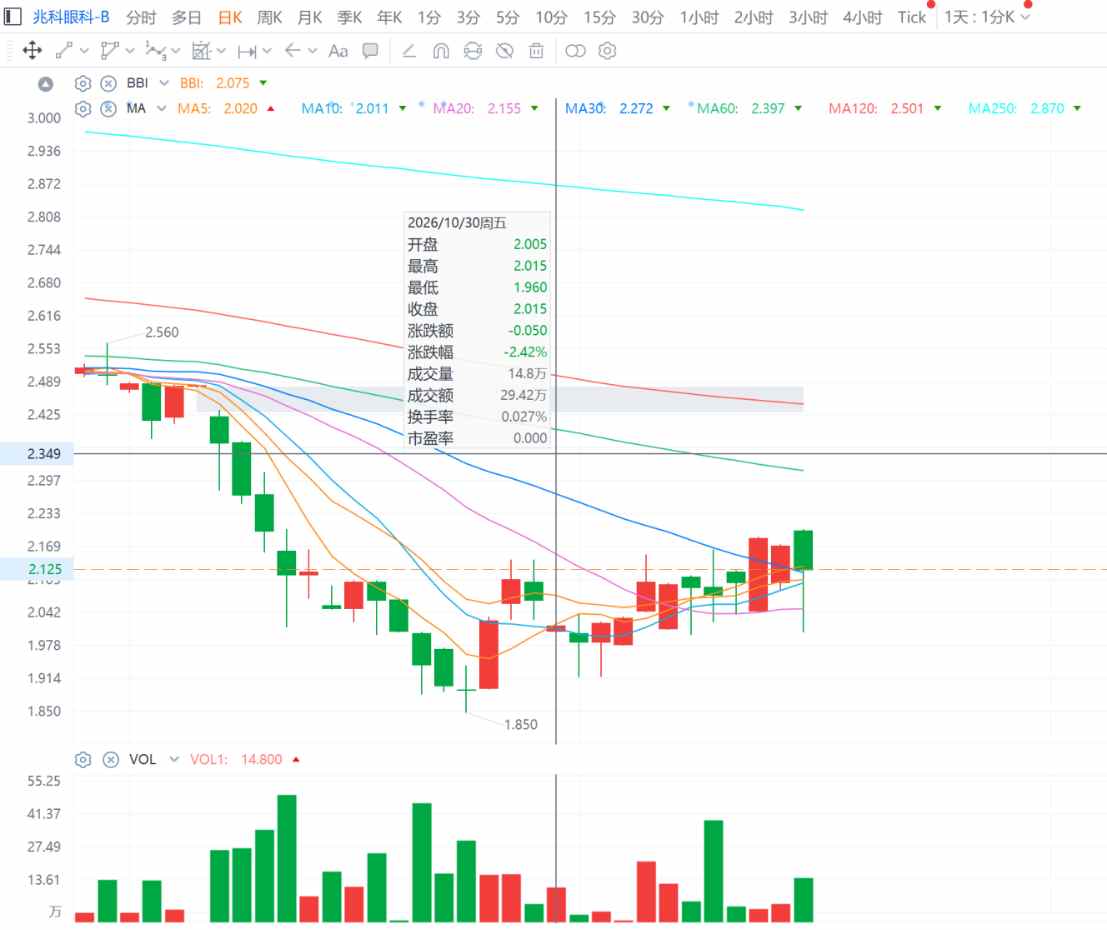
From a technical point of view, in terms of the MACD indicator, although its DIF was still negative on October 27, it gradually approached DEA and achieved a gold fork below the zero axis on October 30. Since then, its MACD column has expanded continuously for 3 days, showing a certain degree of marginal decline in bullish kinetic energy; in terms of RSI indicators, the RSI14 index fell below the 50-center axis to 45.8 from the previous 54.3 times, indicating that bears are dominant in the Zhaoke Ophthalmology market at this time, but it has not reached the oversold range yet; however, the indicator is still at 1.98 Below the company's stock price indicates At this point, the medium term trend in the market has not been disrupted.
Looking back at the stock price fluctuation performance of Zhaoke Ophthalmology throughout the range, investors can see that the stock price of Zhaoke Ophthalmology at this stage did not show a major upward trend from a rush to the top, but rather a stagnant rise from the bottom of the previous period to the contraction and upward trend in the middle segment to a high level in the third segment.
Furthermore, the increase in the company's stock price was mainly concentrated in the first two periods of rebound, but the corresponding daily increase of 119,500 shares was only 0.72 times the average daily decline of 165,900 shares in the range, showing a more typical pattern of “rise, contraction, and decline”.
In other words, before the company's major products were approved on November 10, the market had already set prices for them in advance. However, after the approval news came to fruition, the company's stock price did not continue to strengthen. Instead, it opened high to a range-high of HK$2.2 on November 16 and then fell back negative, awaiting the arrival of the next round of catalysts.
When will the stock price rise for the second round after the “repurchase backup+approval of the new drug”?
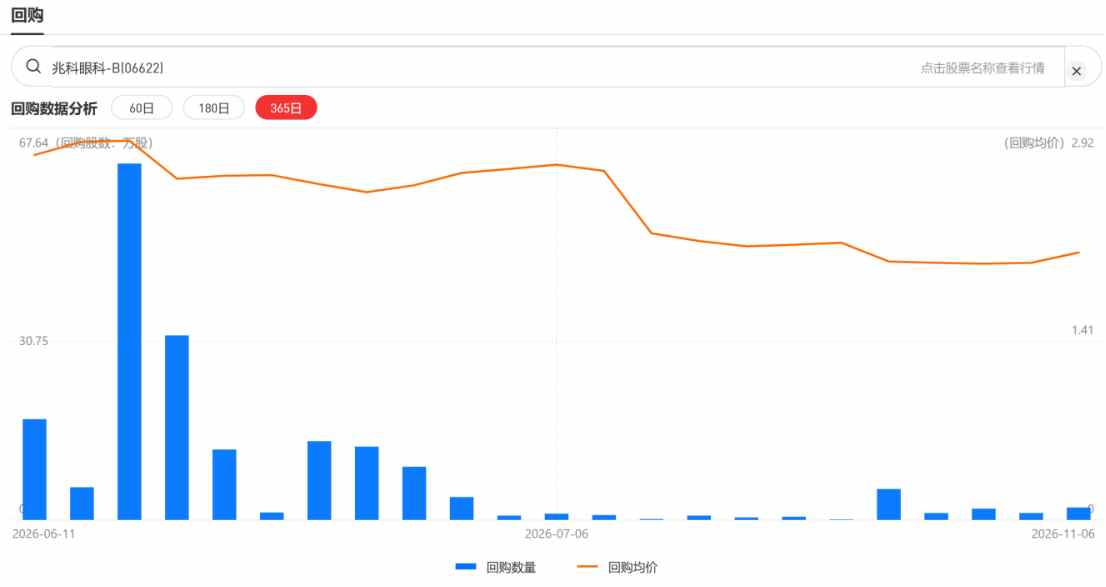
In fact, in addition to the approval of the new drug, Zhaoke Ophthalmology has continued to repurchase shares since June of this year.
According to the Zhitong Finance App, Zhaoke Ophthalmology has repurchased a total of 23 times since this year, spending HK$4.845,900 to repurchase 1,858 million shares.
From a financial perspective, Zhaoke Ophthalmology's balance ratio as of 26H1 was 20.13%, and the current ratio and acceleration ratio were 3.41 and 3.37, respectively. The overall debt situation was good, and the short-term solvency was good; in addition, the company's cash on hand was over 1 billion yuan, and the current net assets of HK$2.92 per share were significantly higher than the current price of the company, which is in a broken state. This indicates to a certain extent that the market's pricing for Zhaoke Ophthalmology is close to “pure cash+options”, and the approval of the core products has clearly not changed this valuation framework.
The reason for this is that the current approval of a new drug is only a milestone on the R&D side for the company, but what is anchored in market pricing is its ability to deliver on the commercial side.
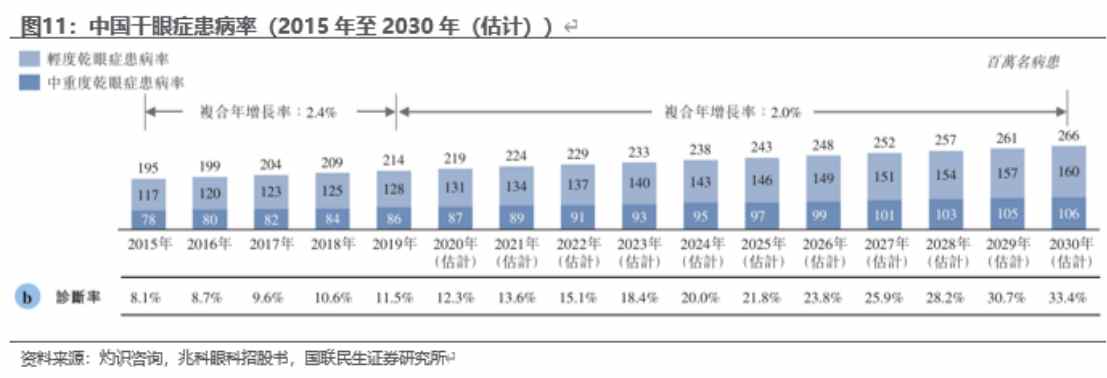
From a market perspective, the number of dry eye patients in China is estimated to be around 266 million in 2030, of which severe dry eye patients are expected to account for about 106 million. According to an estimate of 33.4%, the number of people treated for moderate to severe dry eye in 2030 is about 35.4 million. If the penetration rate is estimated at 10% in 2030, the domestic annual sales volume of low-concentration cyclosporine drugs is expected to reach 3.5 billion yuan.
Although the mainstream ciclosporin drugs currently on the market are mainly eye drops, according to Zhaoke Ophthalmology's announcement, 0.05% cyclosporine eye gel uses a patented hydrogel formula. Compared with Restasis®, it improves the metabolic efficacy and exposure of the drug on the eye surface, which can eliminate the need for daytime administration; it can also be effective quickly, and can be effective as early as two weeks, achieving drug adherence for patients with dry eye syndrome.
However, it often takes 6-12 months from approval of the drug to generating beneficial income through at least a series of processes such as channel establishment, hospital admission, and health insurance negotiations. Therefore, for Zhaoke Ophthalmology, this period became a commercialization vacuum period.
Furthermore, in addition to ciclosporin ophthalmic gel, another core product of Zhaoke Ophthalmology, atropine sulfate eye drops (NVK002) for myopia control are still being reviewed, and the company's management expects that Q2-Q3 will only be approved in 2027.
The Zhitong Finance App learned that as a patented formula, the drug successfully solved the instability of low concentrations of atropine, and that this technology is protected by intellectual property rights around the world. NVK002 contains no preservatives and is expected to last more than 24 months. According to reports, NVK002 is currently one of the most advanced atropine drug candidates for the treatment of deepening myopia in the world. It targets the broadest range of patients and can cover children and adolescents aged 3 to 17.
Looking at the market outlook, according to the World Health Organization and insights, there are currently about 700 million myopic patients in China, of which 163 million are children and adolescents who may benefit from NVK002. According to CICC estimates, the myopia prevention and control market is expected to reach 210 billion yuan in 2030, with a 10-year compound growth rate of about 13.7%.
In terms of competition in the domestic market, there is only one competitor for low-concentration atropine eye drops in the low-concentration atropine eye drops market. According to the current commercialization schedule, Zhaoke Ophthalmology's NVK002 is expected to become the second low-concentration atropine drug in China. Therefore, in the case where Xingqi Pharmaceutical has the first sales product for indications and 16 domestic related varieties are under development, SPDB International still predicts that the peak domestic market share of Zhaoke Ophthalmology NVK002 will reach 22% in the previous research report. Therefore, low-concentration Apintol is a key variety for Zhaoke Ophthalmology to expand its ability to commercialize.
Therefore, judging from the commercialization timeline, the past two years will be a critical period for the core products of Zhaoke Ophthalmology to reach R&D milestones. As the company's commercialization scale continues to expand in the first year of commercialization and subsequent commercialization, the certainty of switching from “expected pricing” to “performance pricing” in the secondary market is expected to continue to increase, becoming an important factor driving the continued rebound in its stock price.