


EN
Misplaced a bet again after the position was liquidated? Before the sharp fall in October, Situational Awareness sold back into AI stocks with full leverage
The Zhitong Finance App learned that according to the latest 13F position documents disclosed on Monday, the AI-themed hedge fund Situational Awareness, which was on the verge of bursting out in July, returned to the financial market at the end of the third quarter and took back AI stocks. However, counting from September 30, when the file was fixed, none of its holdings have been spared a sharp drop in the past month and a half.
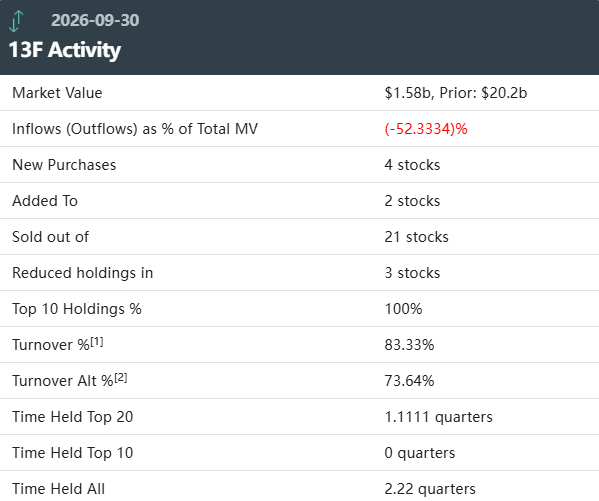
By the end of the third quarter, the total market value of the fund's declared positions was about US$1,577 billion, compared to about US$20.042 billion in the previous quarter, down 92.21% from the previous quarter. A total of 9 target positions were declared at the end of the period. According to data vendor statistics, the fund created 4 new positions, added 2 new positions, cleared 21 stocks, and reduced its holdings of 3 stocks during the quarter. According to the data, the turnover rate of the declared portfolio for this quarter was 83.33%, the concentration of the top ten positions was 100%, and the holding period was 2.22 quarters. The combination accounted for more than 55% of the top two targets at the end of last quarter, and the concentration was high.
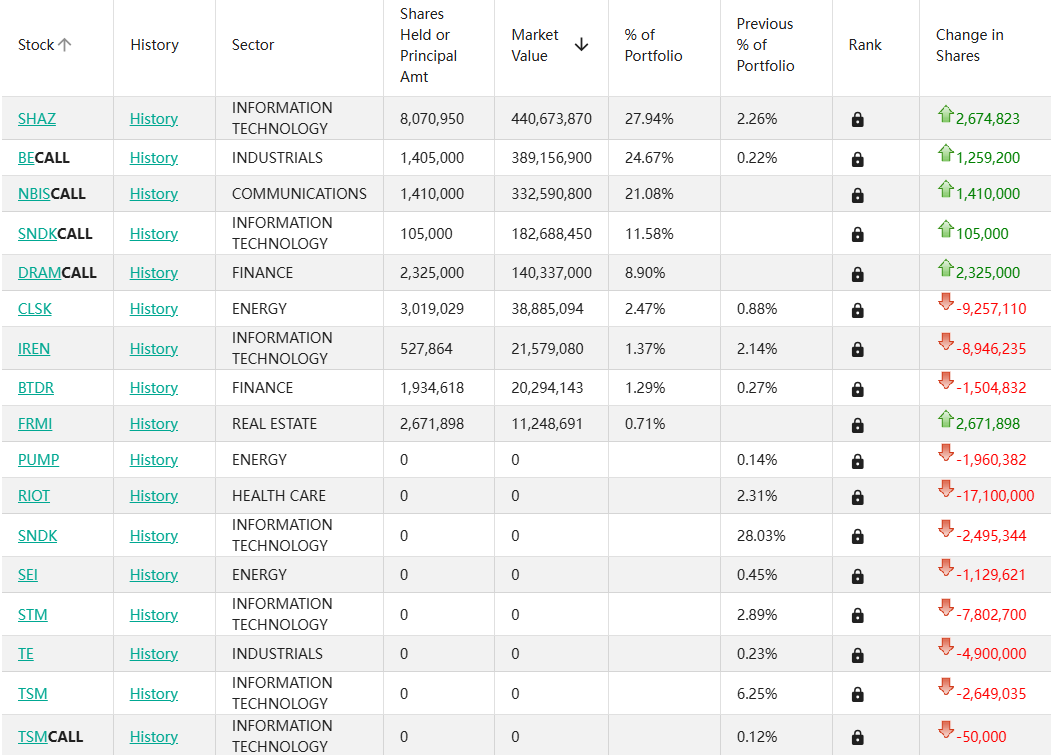
Australian AI cloud service provider Sharonai Holdings (SHAZ.US) has the largest position, holding about 807.1 million shares, with a declared value of about US$441 million, accounting for 27.94% of the portfolio. The number of holdings increased by 49.56% over the previous quarter. The declared value of this position declined slightly from about US$457 million in the previous quarter, and the portfolio weight increased from 2.26% to 27.94%, mainly affected by a sharp contraction in the total market value of the portfolio.
Fuel cell power generation equipment company Bloom Energy's bullish options (BE.US) ranked second, with a declared value of about US$389 million, accounting for 24.67% of the portfolio. The number of positions increased by 863.65% over the previous quarter.
AI infrastructure service provider Nebius Group's call options (NBIS.US) ranked third, with a declared value of about US$333 million, accounting for 21.08% of the portfolio, and built new positions for this quarter.
Flash memory manufacturer SanDisk Bullish Options (SNDK.US) ranked fourth, with a declared value of about US$183 million, accounting for 11.58% of the portfolio, creating new positions for this quarter.
Roundhill's memory-chip-themed ETF (DRAM.US) bullish options ranked fifth, with a declared value of about US$140 million, accounting for 8.90% of the portfolio. They also created new positions for this quarter.
Other holdings ranked 6th to 9th were: Bitcoin mining company CleanSpark (CLSK.US), AI computing power and Bitcoin mining company IREN Limited (IREN.US), computing power service provider BTDR.US (BTDR.US), and AI data center and private grid developer Fermi Inc (FRMI.US), accounting for 2.47%, 1.37%, 1.29%, and 0.71% of the portfolio, respectively. Among them, CleanSpark, IREN Limited, and Bitdeer's holdings decreased by 75.40%, 94.43%, and 43.75%, respectively, and Fermi Inc created new positions this quarter.
Big bet on AI cloud computing power
According to the documents, fund manager Leopold Aschenbrenner (Leopold Aschenbrenner) established a stock position worth more than US$4.4 billion in SharonAI while holding four AI concept stocks: Cleanspark, IREN, Bitdeer Technologies, and Fermi: Cleanspark positions are close to US$39 million, and IREN and Bitdeer respectively have more than 2100 With $10,000 and $20 million, Fermi is over $11 million. According to this calculation, SharonAI alone accounts for more than 80% of its public stock holdings.
Among these few stocks, there are three targets in the same category as the “AI computing power side” — switching from Bitcoin mining operations to AI computing power operators. Cleanspark and Bitdeer are both companies that started with mining and are transforming power and computer room resources into GPU clouds; IREN just announced results in earnings week, and AI cloud revenue increased by 182% month-on-month, but due to Microsoft's request to upgrade the network, the $4 billion ARR target was postponed from the end of the year to January and at the end of February at the latest; Fermi is another route — the “Matador Project”, a giant park to build a nuclear energy plus data center in Texas, did not have a penny when it went public in October 2025 Revenue.
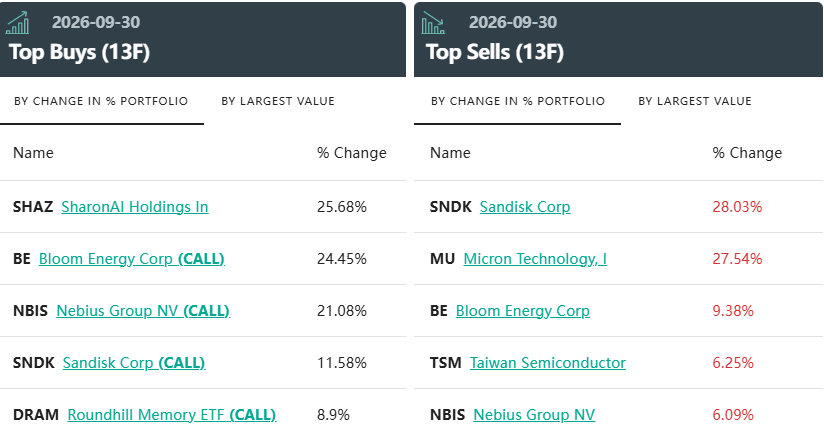
The fund also holds bullish options, targeting new cloud company Nebius, memory chip company SanDisk, Roundhill Memory ETF (DRAM), and data center power provider Bloom Energy (BE.US) — it was SanDisk and Nebius that almost blew up the fund's core holdings in the summer. The fact that call options are mixed with stocks on the same list means that positions in the third quarter were not only “bottom-up”, but also included leveraged bets on the two bottlenecks of storage and electricity.
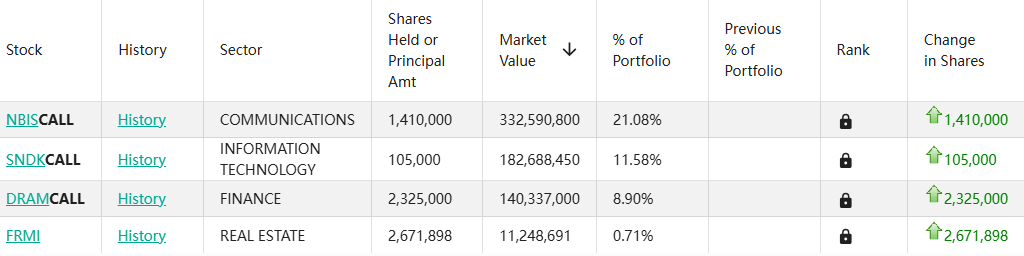
In the same period, the fund's top five sales targets were SanDisk, memory chip maker Micron Technology (MU.US), Bloom Energy, chip foundry TSM.US (TSM.US), and Nebius Group, which accounted for 28.03, 27.54, 9.38, 6.25, and 6.09 percentage points, respectively. None of the five target common stock positions appeared in this quarter's filing. 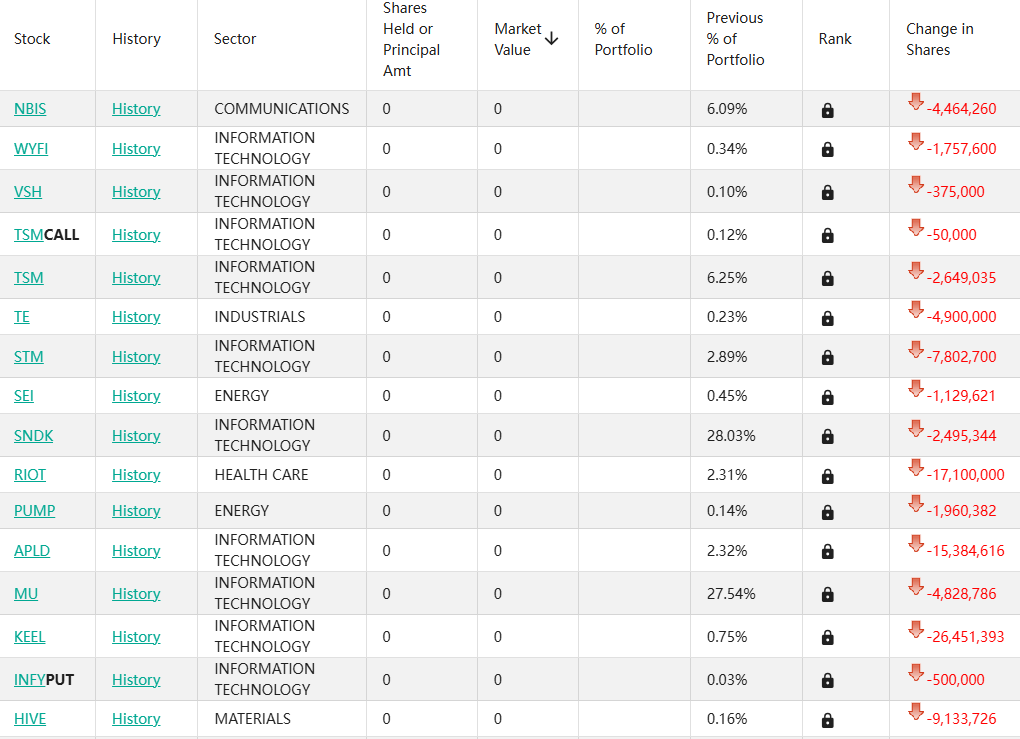
The lower-scale clearance targets include AI data center and energy infrastructure company Keel Infrastructure (KEEL.US), which declared about US$152 million last quarter; power infrastructure solution provider Solaris Energy Infrastructure (SEI.US), about US$91 million. AI data cloud service provider WhiteFiber (WYFI.US) reported about US$68 million last quarter, and solar module manufacturer T1 Energy (TE.US) reported about US$46 million. Bitcoin mining company HIVE Digital Technologies (HIVE.US) reported about US$33 million last quarter, oilfield service provider ProPetro Holding (PUMP.US) about US$28 million, discrete semiconductor manufacturer VSH.US (VSH.US) about US$20 million, and INFY.US (INFY.US) put options of about US$5.25 million.
In addition, the common stock of fuel cell power generation equipment company Bloom Energy reported about US$1,899 million last quarter, ranking third in the sales list for the current quarter, and no longer appears in this quarter's filing. A total of about US$1,441 million was declared last quarter for the remaining 4 clearance items.
Since September 30, there has been a sharp drop across the board
Since September 30, all of these positions have experienced a sharp drop. SharonAI is at the top of the decline list: down 58% in a single month in October and another 11% so far this month. IREN fell 41% in October and Nebius fell 35% — after Nebius issued weak full-year guidance last week, it once plummeted by more than 16% in a single day. What's even more remarkable is the comparison: According to foreign news reports, the fund's net return for the year was as high as 439% at the end of June, and now every ticket it has backed back is being repaid.
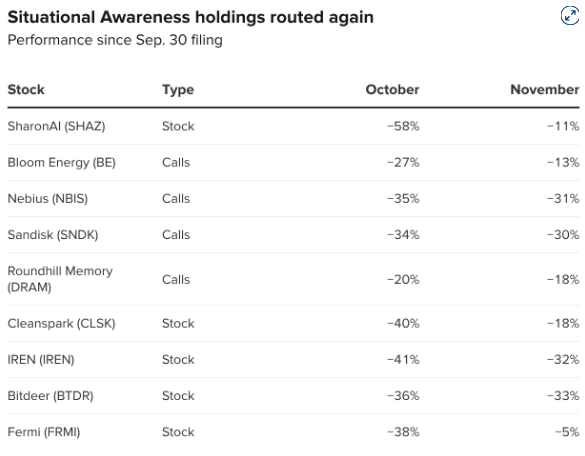
However, outsiders are unable to confirm whether the fund manager left the market during the AI sell-off in October: 13F is just a snapshot of his position at the end of the quarter, and the file itself does not record any subsequent operations.
From 45 billion to 10 billion to reopening
Ashenbrenner first became famous in 2024 with an AI manifesto of the same name, “Situational Awareness,” and then founded this fund. According to public information, he was born in Berlin in 2001, entered Columbia University at age 15, graduated with a degree in mathematics, statistics, and economics at age 19, and worked on the OpenAI Super Alignment Team. The core judgment of the declaration was that computing power, data centers, electricity, and storage will be the long-term bottlenecks of AI — this is the backbone of this inventory: new cloud, computing power, electricity, and storage. According to CNBC's previous report, he returned to the financial markets on a small scale in September; Monday's documents showed that he continued almost exactly where he left off — and bought back the same stocks.
This summer, the fund was on the verge of bursting out, forcing him to sell all of his open market stock holdings. The takeover was Ken Griffin's Citadel Fund (Citadel). The fund's asset management scale peaked at $45 billion, then plummeted to around $10 billion, and was dominated by private equity positions. The fund previously used about 4 times leverage to expand its AI long positions. Heavy stocks such as Bloom Energy, SanDisk, and IREN generally fell 45% to 55% during the July deleveraging wave, and banks paid back security deposits; Castle Fund took over a public stock portfolio of about 16 billion US dollars at a sharp discount in less than 24 hours, and related AI stocks immediately rebounded sharply after being cut — a fund that died before dawn opened a position on the same batch of stocks for the second time.
This batch of stocks he gambled back just plummeted collectively on Monday
There is a clear timeline for AI transactions over the past quarter: In September, Anthropic CEO Dario Amodi and OpenAI CEO Sam Altman ignited concerns. Altman bluntly stated that the company would be “unwise” to go public this year; since then, the pressure has only increased — three things investors are worried about recently are that the Democratic Party's victory in the midterm elections may slow down data center construction, some technology companies are burdened with too much debt for AI construction, and after Hwang In-hoon steps down as Nvidia CEO, Nvidia will also What role does the industry play in financing.
On Monday (November 16), the decline in Nvidia and other AI-related stocks dragged down the three major US stock indices as a group: NASDAQ fell 2.49%, the Philadelphia Semiconductor Index fell 5.28%, Nvidia closed down 4.12%; SanDisk fell 8.58%, Roundhill Memory ETF fell 7.38%, and Nebius fell 7.6% — almost coinciding with this fund's list of positions. The market next focuses on two tests: Nvidia reports earnings after the market on Tuesday, and Anthropic launches an IPO later this week.