


EN
Goldman Sachs Gold “roller coaster” forecast: This year may have the worst annual performance in more than ten years, returning to a record high of 5,600 US dollars by the end of 2028
The Zhitong Finance App learned that Goldman Sachs expects that as the Federal Reserve continues to tighten monetary policy, gold prices will still face downward pressure and sharp fluctuations in the short term. Although continued gold purchases by global central banks are expected to support gold prices, gold may not challenge the historical high again until the end of 2028.
A team of Goldman Sachs strategists led by Lina Thomas pointed out in a report released on Monday that the Fed's interest rate hike will continue to weaken the investment appeal of gold, which does not generate interest returns. However, once the Federal Reserve switches to cutting interest rates, Western investors' demand for gold exchange-traded funds (ETFs) is expected to pick up again, driving a stronger rebound in gold prices.
Goldman Sachs expects the price of gold to rise to 4,650 US dollars per ounce by the end of 2027, and further rise to 5,600 US dollars per ounce by the end of 2028. If investors re-increase their gold allocation to hedge against macroeconomic and policy risks, the price of gold may also gain additional upward momentum.
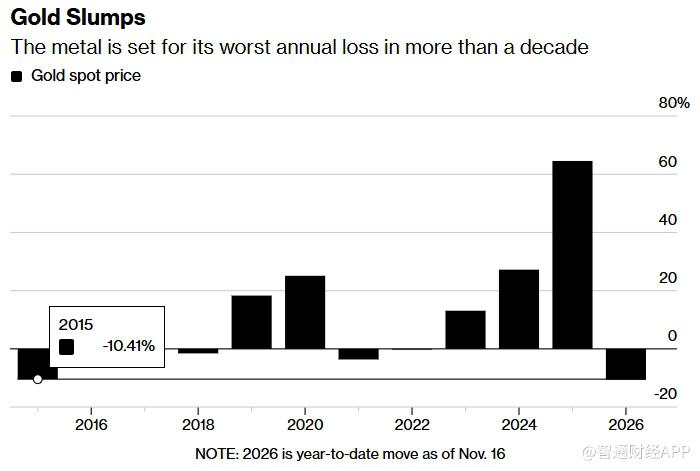
The gold market experienced sharp fluctuations this year. At the end of January this year, the price of gold soared more than 30% in just one month, to a record high of nearly 5,600 US dollars per ounce. However, since then, the price of gold has continued to be under pressure, especially against the backdrop of a boom in artificial intelligence (AI) investment, soaring US Treasury yields, and rising market expectations for further interest rate hikes by the Federal Reserve, investors' demand for gold has clearly weakened.
Up to now, the cumulative decline in the gold year is close to 11%, which is expected to be the worst annual performance in more than 10 years. Gold traded around $3,860 an ounce on Monday.
Gold has continued to decline since the end of August. At the time, Federal Reserve Chairman Walsh warned that the Federal Reserve still had work to do to curb inflation. Since then, market expectations for further tightening of monetary policy have continued to heat up.
The Federal Reserve initiated the first rate hike in three years in September this year, raising the federal funds rate target range to 3.75% to 4%. Currently, the market generally expects the Federal Reserve to raise interest rates again at the December policy meeting.
Strong inflation data released last week further prompted traders to bet that the Federal Reserve's monetary tightening cycle could continue until 2027. Goldman Sachs believes that continued interest rate hikes will be the main resistance facing the gold market for some time to come. Since gold itself does not generate interest income, when policy interest rates and bond yields rise, the opportunity cost of holding gold increases, thereby weakening private investors' willingness to allocate.
Goldman Sachs strategists pointed out that if historical experience has reference value, the 2027 gold market may be getting closer to the 2022 situation: the Federal Reserve continues to raise policy interest rates to curb private investors' demand for gold, but the global central bank's structured gold purchase demand will still provide solid support for gold prices.
This means that even if the inflow of gold ETF funds is weak, the central bank's purchase of gold may still become an important force supporting the price of gold and push the price back to 4,650 US dollars per ounce by the end of 2027.
Based on the price of around $3,860 per ounce on Monday, Goldman Sachs's forecast for the end of 2027 means that gold still has room to rise by about 20%, while the target price of 5,600 US dollars per ounce at the end of 2028 means a potential increase of about 45%.
However, Goldman Sachs believes that the key to a stronger rise in gold still lies in the Federal Reserve's monetary policy shift. The bank expects that when the Federal Reserve ends its interest rate hike cycle and begins to cut interest rates, demand for Western gold ETF investment will gradually recover, thus forming a synergy with global central banks continuing to buy gold and push gold prices back to historic highs.
Therefore, although gold may still be suppressed by a high interest rate environment and market fluctuations in the short term, Goldman Sachs remains optimistic about its long-term outlook, and expects the price of gold to reach around 5,600 US dollars per ounce again by the end of 2028.