


EN
QXO (QXO) Earnings And Buyback Put Its Valuation Story Back In Focus
QXO (QXO) drew fresh attention on November 12 after releasing third quarter results that paired higher sales with a narrower quarterly loss, unveiling a US$500 million buyback and announcing a finance leadership reshuffle.
QXO’s latest earnings, buyback plan and finance leadership moves landed against a mixed trading backdrop, with the share price up 16.02% over the past month but down 6.67% over 90 days. The year-to-date share price return is down 36.11%, while the 1-year total shareholder return has fallen 25.71%, pointing to short-term momentum building off a weak longer-term base as investors reassess the risk profile and the potential impact of these announcements.
Capitalize on the renewed focus on QXO by comparing it with other building products and capital goods players screened for balance sheet strength and fundamentals in our list of solid balance sheet and fundamentals (24 results).The share price swing after QXO’s earnings, buyback and finance reshuffle could be early recognition of business progress, or it could simply reflect a burst of optimism. The valuation work shows which explanation fits better.
Most Popular Narrative: 61% Undervalued
QXO closed at $12.60, while the most followed narrative on the stock pegs fair value at about $32.53, implying a wide valuation gap that hinges on execution. According to OOO97, an investor in the Simply Wall St Community who wrote the narrative, the long term case leans heavily on consolidation and margin uplift across building products distribution.
QXO represents a disciplined M&A consolidation play in the $800B building products distribution market, led by Brad Jacobs, the most proven serial acquirer in modern industrial history (300x cumulative returns across four prior platforms, ~500 acquisitions). The company has built a $2.13B EBITDA pro-forma platform in under 18 months by acquiring Beacon Roofing Supply ($11B), Kodiak Building Partners ($2.25B), and TopBuild ($17B, closed July 1), creating the largest publicly traded building products distributor in North America with #1 positions in insulation and waterproofing and #2 in roofing.
See why 25 investors see QXO as 61% undervalued.
That community view uses a discount rate of 10.6% and rests on QXO eventually reaching profit margins of 12.5%, helped by technology driven pricing, procurement and inventory systems. The same work points to revenue expansion supported by acquisitions and organic growth across North American roofing, siding and complementary building materials distribution.
Investors weighing that thesis against the current $13.10b market value need to balance the potential upside against clear execution risks. QXO is still loss making today, reported revenue of $12.07b and a net loss of $676.3m, carries only higher risk funding sources, and common shareholders have been heavily diluted over the past year.
The narrative also flags governance and capital structure as swing factors. The board and senior leadership team are relatively new, average tenures are short, and there are multiple layers of preferred equity above the common stock, all of which amplify both downside and upside for ordinary investors.
On the other side of the ledger, several data points line up with the constructive story. Earnings are forecast to grow strongly, QXO is expected to move into profitability within three years, and revenue is projected to expand by 21.1% per year, ahead of the broader US market according to analyst forecasts.
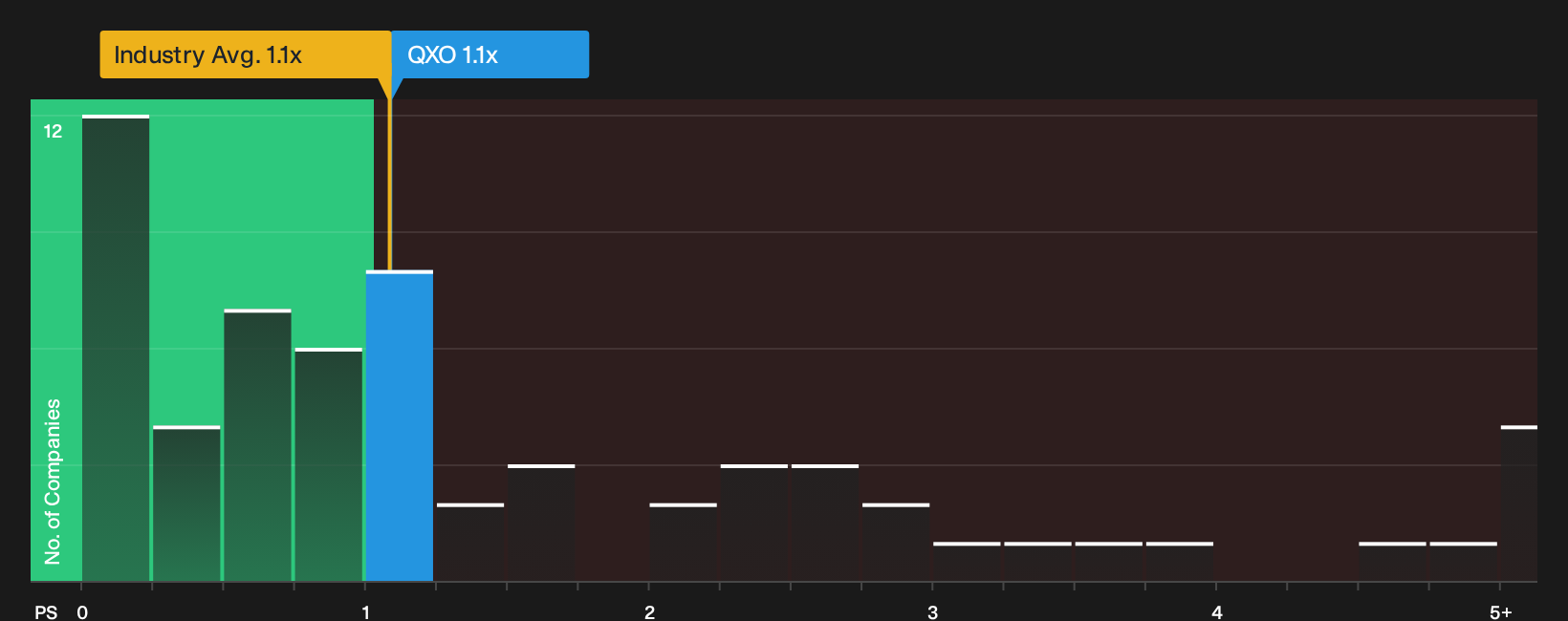
On price based measures, the stock trades on a P/S ratio of 1.1x, which is in line with the wider US trade distributors group but well below both peer averages and an estimated fair P/S of 3.7x. Simply Wall St's DCF work also suggests QXO, at $12.60, is trading at roughly a 70% discount to an estimated future cash flow value of $42, although that outcome assumes the business transitions from losses to sustained positive cash generation.
For readers trying to reconcile these signals, the key question is whether QXO can move from an unprofitable, acquisition heavy phase, with higher risk borrowing and preferred stock, to the higher margin, cash generative distributor described in the narrative. The gap between the current share price and the $32.53 community fair value reflects how differently investors might answer that question.
Result: Fair Value of $32.53 (UNDERVALUED)
Still, the community case around QXO can be hit hard if acquisitions disappoint or if the complex mix of debt and preferred stock limits flexibility.
Find out about the key risks to this QXO narrative.
Another View On QXO’s Valuation
While the community narrative leans on future cash flows and long term execution, the price tag on QXO today also lines up with a more down to earth sales multiple. The stock trades on a P/S of 1.1x, which is roughly the same as the broader US trade distributors group but well below both the 3.0x peer average and a fair ratio of 3.7x that our work suggests the market could move toward. That gap points to a wide range of possible outcomes, so the key question is whether you see that spread as compensation for risk or a sign the market is still unconvinced.
See what the numbers say about this price — find out in our valuation breakdown.
Next Steps
Conflicted by the mix of optimism and concern around QXO? Act while the data is fresh and weigh both sides through the 2 key rewards and 1 important warning sign.
Looking for more QXO-sized opportunities?
Do not stop your research with QXO alone. Broaden your watchlist with fresh ideas that match your risk comfort and return goals using targeted screeners.
- Target resilient balance sheets and steady fundamentals by scanning companies in the list of solid balance sheet and fundamentals (24 results).
- Hunt for quality at a discount by reviewing the 35 high quality undervalued stocks that line up strong business profiles with lower valuations.
- Spot potential future leaders before the crowd by checking the 19 high quality undiscovered gems that pair solid metrics with limited current attention.
Have feedback on this article? Concerned about the content? Get in touch with us directly. Alternatively, email editorial-team@simplywallst.com