


EN
Where Will Exelixis Be in 5 Years? 1 Experimental Drug Could Change Everything
Key Points
Cabometyx’s sales keep growing, but generic competition looms by the end of the decade.
Meanwhile, zanzalintinib could earn approval by March of 2027.
Exelixis’ shares currently appear reasonably valued.
Exelixis (NASDAQ:EXEL) has crushed the broader market over the past five years. It has done so mostly thanks to Cabometyx, a cancer medicine that has been its best-selling drug for years. However, things could change for the biotech by the next decade. Exelixis could start facing generic competition for Cabometyx by 2030. Can the company overcome this patent cliff? The answer largely depends on its leading pipeline candidate.

Image source: Getty Images.
Missed AI’s "Act 1"? Act 2 Could Be 15x Bigger. Most investors think they missed the AI boat because they didn't buy Nvidia in 2005. But according to our analysts, we’re only at the end of "Act 1"—the R&D phase. "Act 2" is the global rollout. Continue »
Targeting markets with high unmet needs
Exelixis's strategy in the past has been to develop cancer medicines that target areas of high unmet medical need. That's what it did with Cabometyx. This medicine became the first in renal cell carcinoma (RCC, a type of kidney cancer) to demonstrate statistically significant improvements in three efficacy endpoints: progression-free survival, objective response rate, and, most importantly, overall survival. Cabometyx became a leading medicine in RCC as a result.
It remains the top-prescribed drug of its type in first-line RCC. It has also earned several label expansions across other indications. The result: It has helped drive consistent revenue and earnings growth for Exelixis since it first earned U.S. approval in 2016.
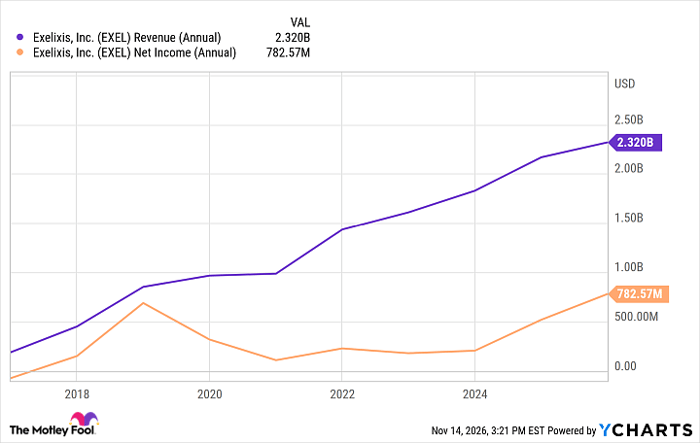
EXEL Revenue (Annual) data by YCharts
Exelixis is now looking to follow the same pipeline-in-a-drug approach with its most important candidate, zanzalintinib. The medicine's first target is colorectal cancer, which is the second-leading cause of cancer death, despite being highly treatable when caught early. According to some data, the 5-year survival rate for colorectal cancer is around 90% when it is caught early.
It drops significantly once the disease has metastasized. Exelixis is seeking approval for zanzalintinib in metastatic colorectal cancer. In a Phase 3 study in which it was combined with another cancer drug, Tecentriq, zanzalintinib improved overall survival in previously treated patients with metastatic colorectal cancer. However, it combined a fairly modest survival benefit with higher rates of adverse events compared with Stivarga, an approved drug in this niche against which the zanzalintinib and Tecentriq combo was pitted.
Further, the U.S. Food and Drug Administration extended the review period for zanzalintinib by three months. It now expects to decide whether to approve the medicine by March 3, 2027, rather than the previous target of early December. Still, given that we are dealing with an area where patients have few treatment options, there is a good chance that zanzalintinib will earn approval.
Further, the drug is being investigated for other potential indications, including RCC, lung cancer, and meningioma. It is being tested in combination with other medicines as well as as a monotherapy. Exelixis thinks zanzalintinib could generate about $5 billion in sales by 2033 if it earns approval in colorectal cancer and additional indications.
Note that Cabometyx still doesn't generate anywhere near that much revenue, and it might never get there, given that it faces a patent cliff by 2030. Exelixis' sales might decline as it navigates Cabometyx's loss of patent exclusivity, but the company could bounce back if zanzalintinib performs as well as expected.
Is Exelixis stock a buy?
Exelixis' financial results, driven primarily by Cabometyx, are strong and should remain so through the end of the decade. In the third quarter, the company's revenue increased 10% year over year to $658.7 million, while its earnings per share rose 23% year over year to $0.85.
The market is already expecting generic competition for Cabometyx by 2030. But Exelixis has several other pipeline candidates that could advance over the next few years -- and if they perform well enough in clinical studies, the results could jolt the stock. By 2031, Exelixis could generate significant sales from zanzalintinib while inching closer to earning approval for other cancer medicines.
Even with Cabometyx's looming patent cliff, the biotech company may have attractive prospects through 2030 and beyond. Of course, there is the risk that Exelixis will run into regulatory or clinical headwinds. Even with that, the biotech's shares look attractive at current levels. Exelixis is trading at 16.3x forward earnings, versus an average of 19.8x for healthcare stocks. So, where will Exelixis be in five years?
Its shares could be trading at much higher levels. So the company may deliver excellent returns over the medium term.
Prosper Junior Bakiny has positions in Exelixis. The Motley Fool has positions in and recommends Exelixis. The Motley Fool has a disclosure policy.