


EN
A $1.3 Billion Reason to Buy Firefly Aerospace Stock Here
Firefly Aerospace (FLY) has recently secured a potentially transformative catalyst that could strengthen its growth trajectory and provide substantial funding for its expanding launch business. The company announced a three-year agreement worth more than $1.3 billion with AST SpaceMobile (ASTS) to supply rocket engines and license its propulsion technology for AST’s planned Blacklift heavy-lift rocket.
Under the agreement, Firefly will deliver 36 engines, including 27 Miranda engines and nine Vira in-space engines for AST’s first three Blacklift rockets, while also providing engineering support and licensing the technology so AST can eventually manufacture the engines itself. The deal is particularly significant because Firefly will receive a combination of cash and AST shares, giving the company additional capital to accelerate production, expand testing infrastructure and increase its engineering workforce.
Moreover, Firefly says the additional funding will help it expand its Rocket Ranch facility in Texas, procure long-lead materials, and accelerate development across its launch portfolio, including its next-generation Eclipse rocket.
With the space industry facing increasing demand for launch capacity, the AST contract could give Firefly greater financial resources and commercial validation at a critical stage of its expansion. That makes the $1.3 billion AST SpaceMobile agreement a compelling reason for investors to take a closer look at Firefly Aerospace stock.
About Firefly Aerospace Stock
Firefly Aerospace is a Cedar Park, Texas-based space and defense technology company that develops launch vehicles, lunar landers, spacecraft and related propulsion technologies for government, national-security and commercial customers. The company was founded in 2017 and has built an integrated platform spanning launch, lunar, and in-space services. Firefly completed its IPO in August 2025 and currently has a market cap of $4.5 billion.
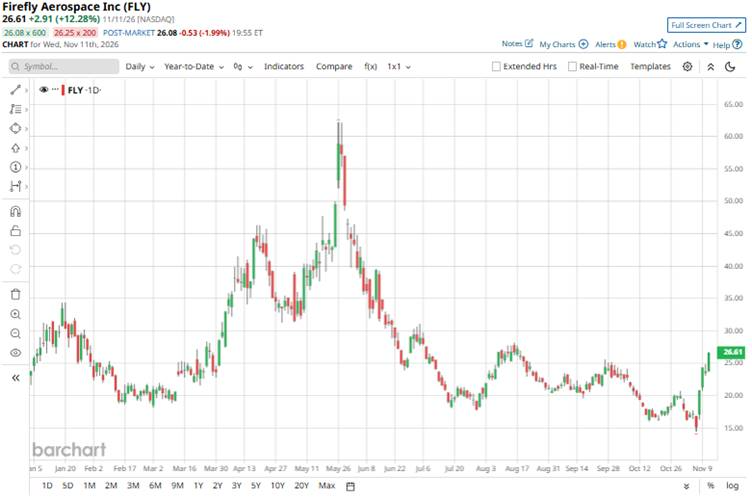
Firefly Aerospace has delivered a 39.1% gain over the past year and is up about 19% year-to-date (YTD), but the stock remains well below its 52-week peak, sitting 57.2% below its high of $62.17 reached on May 26. The wide gap reflects the sharp volatility that has characterized FLY shares as investors have weighed the company’s ambitious growth plans, execution risks, and relatively early-stage financial profile against its expanding commercial and government opportunities.
More recently, the stock has staged a powerful rebound. FLY has gained 55.1% over the past five trading days, driven primarily by the company’s announcement on Nov. 6 of a more than $1.3 billion, three-year agreement with AST SpaceMobile. Shares surged 36.8% on Nov. 6, as investors viewed the engine agreement as a major validation of Firefly’s propulsion technology and a significant source of capital to accelerate its own launch-vehicle production.
The momentum continued on Nov. 9, when FLY jumped another 17.1%, extending the post-deal rally as investors continued to digest the scale of the AST SpaceMobile transaction.
The rally paused on Nov. 10, with Firefly shares falling 2.5% to $23.70 despite the company announcing a new contract with Synspective for up to 10 Alpha launches through 2030. Shares then rebounded 12.3% again on Nov. 11, fueled by better-than-expected third-quarter financial results. Nevertheless, the recent price action highlights the high-risk, high-reward nature of Firefly stock.
The stock currently trades at 25.46 times sales, which is a premium to its industry peers.
Firefly Aerospace Delivers Strong Revenue Growth as Backlog Expands
Firefly Aerospace reported its third-quarter 2026 results on Nov. 10, delivering another quarter of exceptionally strong top-line growth as the company continued to scale its launch, lunar and national-security businesses. Revenue jumped 259% year-over-year (YOY) to $110.7 million. For the first nine months of 2026, revenue reached $309.2 million, up 202.6% from the same period of 2025.
The sharp revenue increase also translated into higher gross profit. Gross profit rose to $25.3 million from $8.5 million, while operating expenses also increased substantially, rising to $126.9 million from $70.7 million.
Firefly remained unprofitable, although the reported net loss narrowed on a year-over-year basis. Net loss was $94.2 million, or $0.56 per share, compared with a loss of $133.4 million, or $1.50 per share, in Q3 2025, exceeding expectations. However, adjusted EBITDA loss widened to $69.5 million from $46.3 million, highlighting the substantial investment Firefly continues to make in scaling its business.
Cash consumption also increased as Firefly invested aggressively for future growth. Operating cash flow was negative $69.7 million versus negative $53 million in Q3 2025, while free cash flow was negative $85.3 million compared with negative $62 million a year earlier. At the end of September, Firefly had $409.3 million in cash and cash equivalents, down from $996 million a year earlier.
One of the strongest indicators from the quarter was Firefly’s record backlog of $1.7 billion, up from $1.3 billion a year earlier and $1.5 billion at the end of Q2. The company also highlighted several important contract wins and milestones, including a $94 million U.S. Space Force contract, two European Alpha launch contracts, an extension of Lockheed Martin (LMT) multi-launch agreement for up to 25 Alpha launches through 2031.
Additionally, for 2026, management projects full-year revenue guidance of $440 million to $450 million. That outlook implies that Firefly expects a substantial acceleration in fourth-quarter revenue from the $309.2 million generated through the first nine months.
Also, the consensus loss per share estimate of $2.31 for fiscal 2026 reflects a deterioration of 66.2%, while the loss per share estimate of $2.07 for fiscal 2027 indicates a 10.4% improvement YOY.
What Do Analysts Expect for Firefly Aerospace Stock?
B. Riley Securities analyst Mike Crawford maintained a “Buy” rating on Firefly Aerospace and raised his price target to $54 from $40. The more bullish target followed Firefly’s stronger-than-expected third-quarter results and record $1.7 billion backlog, while the company’s recently announced more than $1.3 billion AST SpaceMobile engine agreement adds another significant growth catalyst.
On the other hand, Barclays analyst Anthony Valentini maintained an “Equal-Weight” rating on Firefly Aerospace and raised his price target to $35 from $34, following the earnings release.
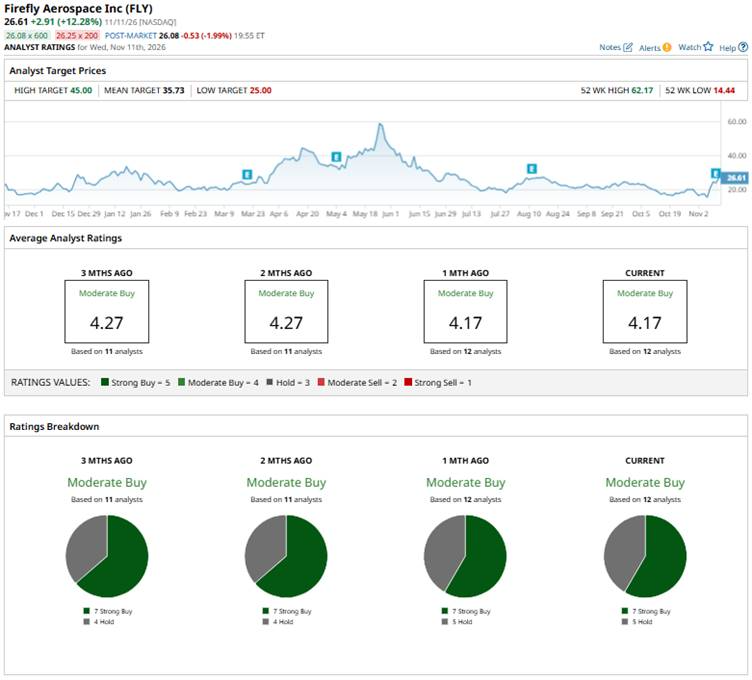
Overall, FLY has a consensus “Moderate Buy” rating. Of the 12 analysts covering the stock, seven advise a “Strong Buy,” and five analysts are on the sidelines, giving it a “Hold” rating.
While the average analyst price target of $35.73 suggests an upside of 34.3%, B. Riley’s Street-high target price of $54 suggests that the stock could rally as much as 102.9%.
On the date of publication, Subhasree Kar did not directly have a position in any of the securities mentioned in this article. All information and data in this article is solely for informational purposes. For more information please view the Barchart Disclosure Policy here.