


EN
Consumer discretionary - broadcasting stocks Q3 earnings review: FOX shines

Looking back on consumer discretionary - broadcasting stocks’ Q3 earnings, we examine this quarter’s best and worst performers, including FOX NASDAQ:FOXA and its peers.
The Consumer Discretionary sector, by definition, is made up of companies selling non-essential goods and services. When economic conditions deteriorate or tastes shift, consumers can easily cut back or eliminate these purchases. For long-term investors with five-year holding periods, this creates a structural challenge: the sector is inherently hit-driven, with low switching costs and fickle customers. As a result, only a handful of companies can reliably grow demand and compound earnings over long periods, which is why our bar is high and High Quality ratings are rare. Broadcasting companies produce and distribute television and radio content, generating revenue primarily through advertising and, in some cases, retransmission fees (payments cable and satellite operators make to carry local channels). Tailwinds include resilient demand for live sports and event programming, which commands premium ad rates, and political advertising during election cycles. Headwinds, however, are substantial: secular cord-cutting (consumers canceling traditional pay-TV subscriptions) is shrinking linear audiences, digital platforms are capturing an increasing share of advertising budgets, and content production costs continue to rise. Regulatory scrutiny over media consolidation and spectrum ownership further constrains strategic flexibility.
The 5 consumer discretionary - broadcasting stocks we track reported a mixed Q3. As a group, revenues beat analysts’ consensus estimates by 0.8% while next quarter’s revenue guidance was 5.2% above.
While some consumer discretionary - broadcasting stocks have fared somewhat better than others, they have collectively declined. On average, share prices are down 1.4% since the latest earnings results.
Best Q3: FOX NASDAQ:FOXA
Founded in 1915, Fox (NASDAQ:FOXA) is a diversified media company, operating prominent cable news, television broadcasting, and digital media platforms.
FOX reported revenues of $4.57 billion, up 22.3% year on year. This print exceeded analysts’ expectations by 6.5%. Overall, it was an impressive quarter for the company with a solid beat of analysts’ EBITDA estimates and a beat of analysts’ EPS estimates.
"FOX has had an outstanding start to fiscal 2027 with first-quarter records for revenue and Adjusted EBITDA underpinned by robust growth in both advertising and distribution revenue. We commenced the year with the stellar performance of the FIFA Men's World Cup, the kickoff of the college football and NFL seasons, and an active election cycle at the national and local levels. These events supported strong contributions from across the company, reflecting the focused strategy we are executing and the strength of our content and brands. These record results coupled with the strong momentum we are continuing to see across our business gives us confidence in delivering value for shareholders in a thoughtful and disciplined manner."
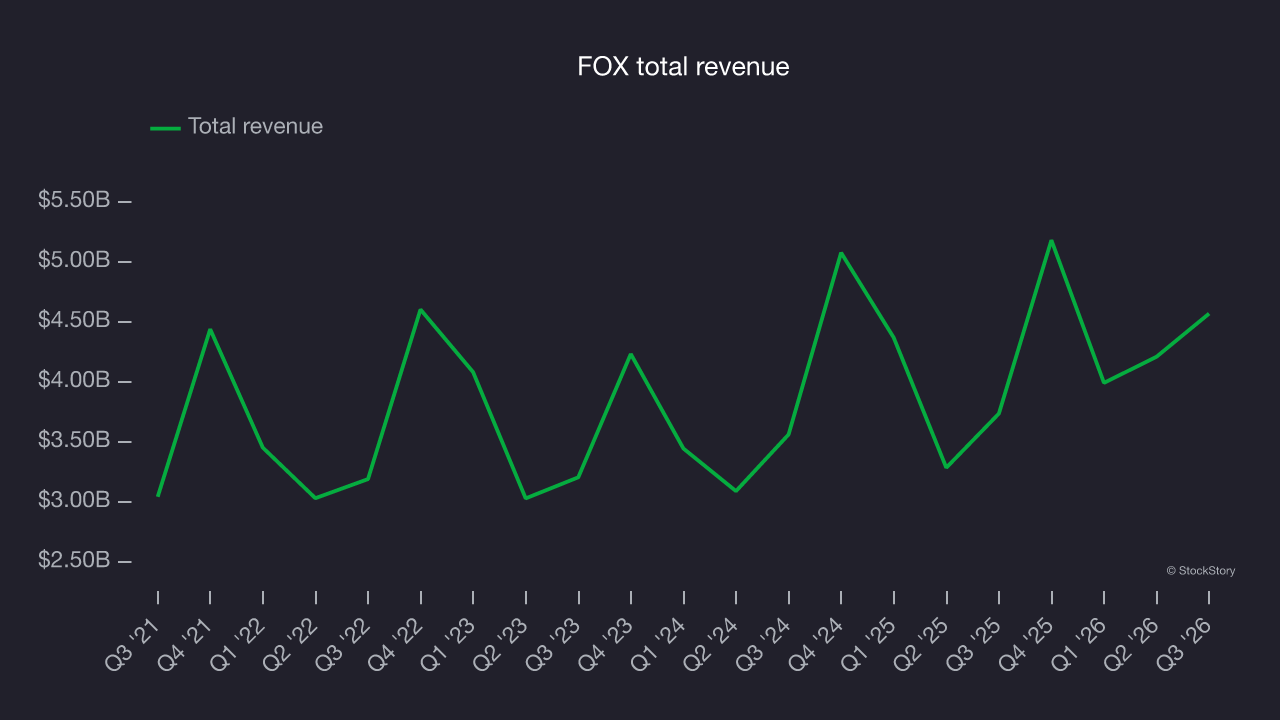
FOX achieved the biggest analyst estimate beat among its peers. Unsurprisingly, the stock is up 8.1% since reporting and currently trades at $68.35.
Is now the time to buy FOX? Access our full analysis of the earnings results here, it’s free.
Gray Television (NYSE:GTN)
Specializing in local media coverage, Gray Television (NYSE:GTN) is a broadcast company supplying digital media to various markets in the United States.
Gray Television reported revenues of $972 million, up 29.8% year on year, outperforming analysts’ expectations by 1.4%. The business had a favorable quarter with revenue guidance for next quarter exceeding analysts’ expectations and a decent beat of analysts’ EBITDA estimates.
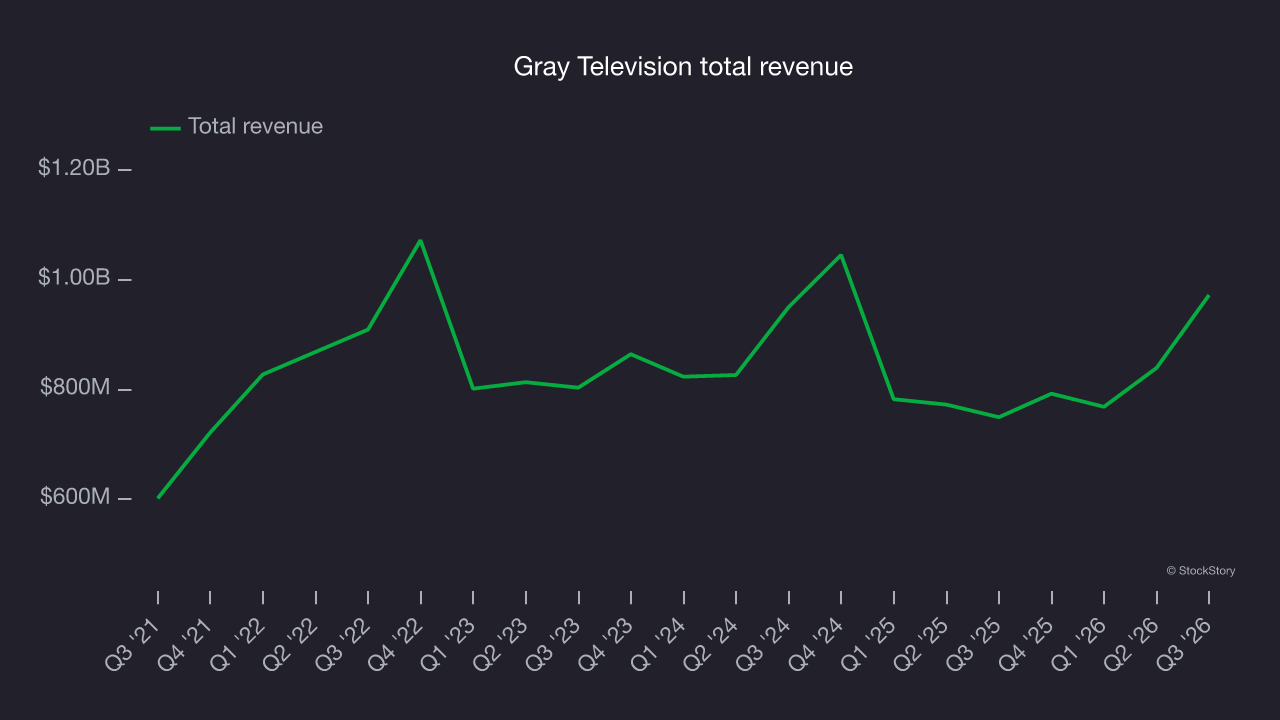
Gray Television delivered the fastest revenue growth in the group. The market seems happy with the results as the stock is up 21.8% since reporting. It currently trades at $5.95.
Is now the time to buy Gray Television? Access our full analysis of the earnings results here, it’s free.
Weakest Q3: iHeartMedia (NASDAQ:IHRT)
Occasionally featuring celebrity hosts like Ryan Seacrest on its shows, iHeartMedia (NASDAQ:IHRT) is a leading multimedia company renowned for its extensive network of radio stations, digital platforms, and live events across the globe.
iHeartMedia reported revenues of $1.03 billion, up 3.3% year on year, falling short of analysts’ expectations by 2.2%. It was an underwhelming quarter as it posted full-year EBITDA guidance missing analysts’ expectations significantly and EPS in line with analysts’ estimates.
iHeartMedia delivered the weakest performance against analyst estimates of the whole group. As expected, the stock is down 66.1% since the results and currently trades at $0.60.
Read our full analysis of iHeartMedia’s results here.
E.W. Scripps (NASDAQ:SSP)
Founded as a chain of daily newspapers, E.W. Scripps (NASDAQ:SSP) is a diversified media enterprise operating a range of local television stations, national networks, and digital media platforms.
E.W. Scripps reported revenues of $544.9 million, up 3.6% year on year. This print lagged analysts’ expectations by 0.5%. Zooming out, it was actually a solid quarter as it put up a beat of analysts’ EPS estimates and a decent beat of analysts’ EBITDA estimates.
The stock is up 22.4% since reporting and currently trades at $3.61.
Read our full, actionable report on E.W. Scripps here, it’s free.
AMC Networks (NASDAQ:AMCX)
Originally the joint-venture of four cable television companies, AMC Networks (NASDAQ:AMCX) is a broadcaster producing a diverse range of television shows and movies.
AMC Networks reported revenues of $566.1 million, flat year on year. This result missed analysts’ expectations by 0.9%. It was a sluggish quarter as it also logged a significant miss of analysts’ EPS estimates.
AMC Networks had the slowest revenue growth among its peers. The stock is up 6.7% since reporting and currently trades at $9.50.
Read our full, actionable report on AMC Networks here, it’s free.
Market update
Over the past year, investors have been forced to repeatedly answer the same question: What is the market’s biggest risk? The answer has changed several times, and each shift has reshaped market leadership.
Late in 2025 and early 2026, artificial intelligence became the market’s primary uncertainty. Investors questioned whether AI would erode software pricing power and weaken competitive moats as AI made it easier to replicate once-differentiated products.
By the spring, technology took a back seat to geopolitics. The U.S. conflict with Iran briefly became the market’s dominant narrative, raising concerns about oil prices, inflation, and global growth. But as energy markets remained orderly and fears of a prolonged supply disruption faded, investors quickly turned their focus back to fundamentals.
Want to invest in winners with rock-solid fundamentals? Check out our Hidden Gem Stocks and add them to your watchlist. These companies are poised for growth regardless of the political or macroeconomic climate.