


EN
Reflecting on testing & diagnostics services stocks’ Q3 earnings: Guardant Health
As the craze of earnings season draws to a close, here’s a look back at some of the most exciting (and some less so) results from Q3. Today, we are looking at testing & diagnostics services stocks, starting with Guardant Health NASDAQ:GH.
The testing and diagnostics services industry plays a crucial role in disease detection, monitoring, and prevention, serving hospitals, clinics, and individual consumers. This sector benefits from stable demand, driven by an aging population, increased prevalence of chronic diseases, and growing awareness of preventive healthcare. Recurring revenue streams come from routine screenings, lab tests, and diagnostic imaging, with reimbursement from Medicare, Medicaid, private insurance, and out-of-pocket payments. However, the industry faces challenges such as pricing pressures, regulatory compliance, and the need for continuous investment in new testing technologies. Looking ahead, industry tailwinds include the expansion of personalized medicine, increased adoption of at-home and rapid diagnostic tests, and advancements in AI-driven diagnostics that enhance accuracy and efficiency. However, headwinds such as reimbursement uncertainties, competition from decentralized testing solutions, and regulatory scrutiny over test validity and cost-effectiveness may impact profitability. Adapting to evolving healthcare models and integrating automation will be key for sustaining growth and maintaining operational efficiency.
The 5 testing & diagnostics services stocks we track reported a solid Q3. As a group, revenues beat analysts’ consensus estimates by 1.3%.
In light of this news, share prices of the companies have held steady as they are up 1.3% on average since the latest earnings results.
Guardant Health NASDAQ:GH
Pioneering the field of "liquid biopsy" with technology that can identify cancer-specific genetic mutations from a simple blood draw, Guardant Health (NASDAQ:GH) develops blood tests that detect and monitor cancer by analyzing tumor DNA in the bloodstream, helping doctors make treatment decisions without invasive biopsies.
Guardant Health reported revenues of $361 million, up 36.1% year on year. This print exceeded analysts’ expectations by 2.9%. Overall, it was a solid quarter for the company with a beat of analysts’ EPS estimates and full-year revenue guidance meeting analysts’ expectations.
“Revenue grew 36% year over year as we continued to execute across Oncology, Screening, and Biopharma,” said Helmy Eltoukhy, co-founder and co-CEO. “Oncology volume grew 58% with broad contributions across our portfolio. The FDA approval of Guardant360 CDx for longitudinal ESR1 testing is a major advance for breast cancer patients, ushering in a new paradigm of cancer treatment. It reinforces the role of Guardant360 in enabling earlier therapy decisions and strengthens our leadership across the cancer care continuum.”
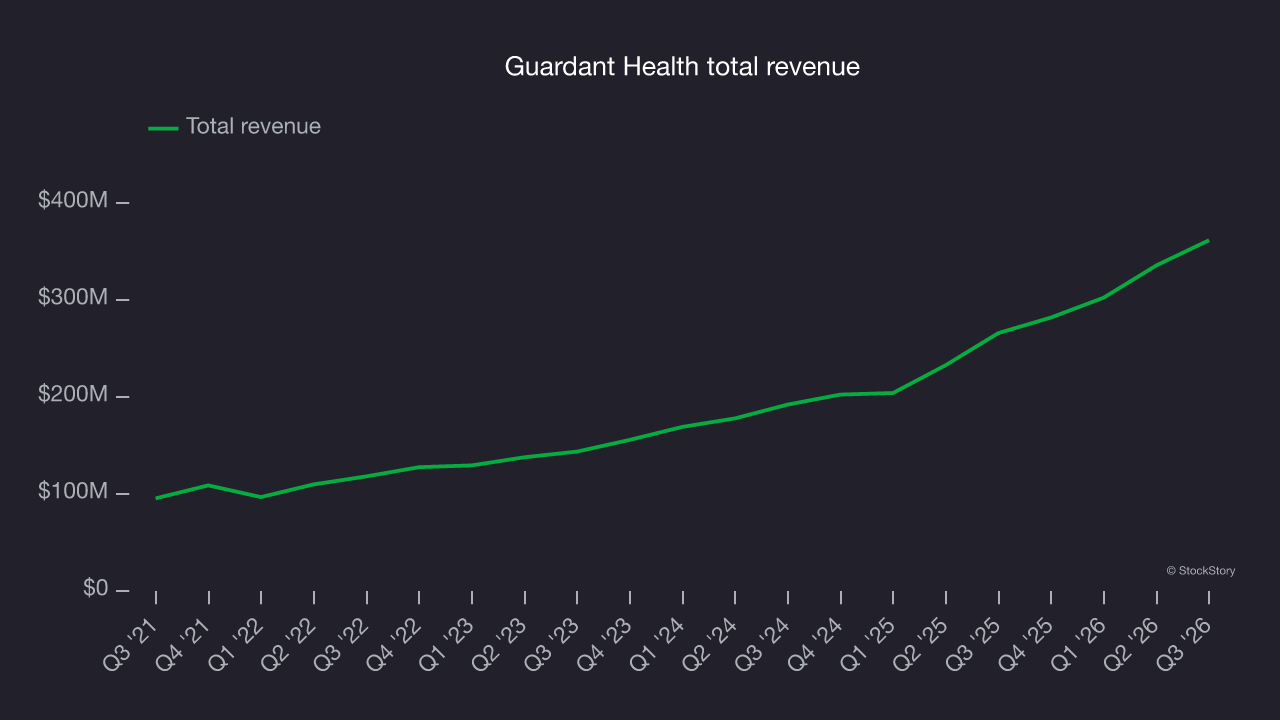
Guardant Health pulled off the biggest analyst estimate beat and fastest revenue growth of the whole group. Investor expectations, however, were likely higher than Wall Street’s published projections, leaving some wishing for even better results (analysts’ consensus estimates are those published by big banks and advisory firms, not the investors who make buy and sell decisions). The stock is down 1.1% since reporting and currently trades at $151.70.
Best Q3: NeoGenomics (NASDAQ:NEO)
Operating a network of CAP-accredited and CLIA-certified laboratories across the United States and United Kingdom, NeoGenomics (NASDAQ:NEO) provides specialized cancer diagnostic testing services, including genetic analysis, molecular testing, and pathology consultation for oncologists and healthcare providers.
NeoGenomics reported revenues of $209.3 million, up 11.4% year on year, outperforming analysts’ expectations by 1.1%. The business had a favorable quarter with a beat of analysts’ EPS estimates and a solid beat of analysts’ full-year EPS guidance estimates.
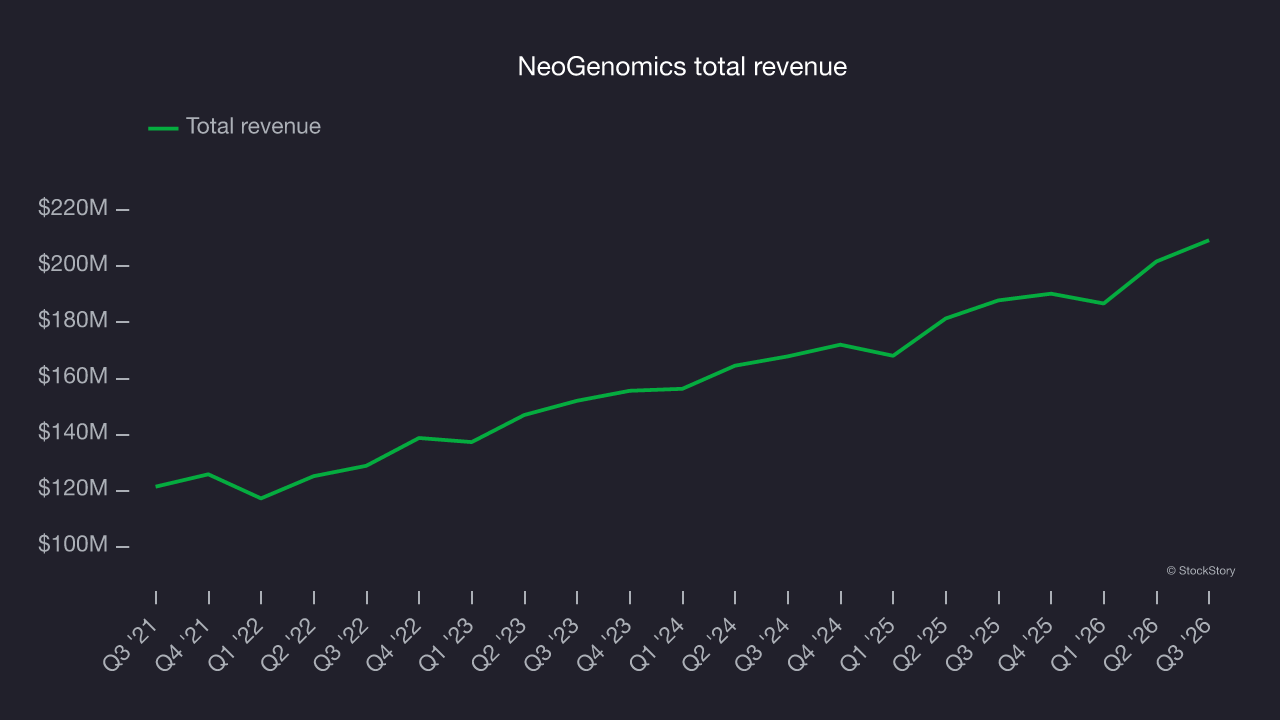
Although it had a fine quarter compared to its peers, the market seems unhappy with the results as the stock is down 11.5% since reporting. It currently trades at $15.92.
Is now the time to buy NeoGenomics? Access our full analysis of the earnings results here, it’s free.
Weakest Q3: Quest (NYSE:DGX)
Processing approximately one-third of the adult U.S. population's lab tests annually, Quest Diagnostics (NYSE:DGX) provides laboratory testing and diagnostic information services to patients, physicians, hospitals, and other healthcare providers across the United States.
Quest reported revenues of $3.10 billion, up 10% year on year, exceeding analysts’ expectations by 1%. It was a satisfactory quarter as it also posted full-year revenue guidance slightly topping analysts’ expectations.
Interestingly, the stock is up 6.7% since the results and currently trades at $255.
Read our full analysis of Quest’s results here.
Labcorp (NYSE:LH)
With over 600 million tests performed annually and involvement in 90% of FDA-approved drugs in 2023, Labcorp (NYSE:LH) provides laboratory testing services and drug development solutions to doctors, hospitals, pharmaceutical companies, and patients worldwide.
Labcorp reported revenues of $3.81 billion, up 6.9% year on year. This number surpassed analysts’ expectations by 1.2%. Overall, it was a solid quarter as it also put up a narrow beat of analysts’ organic revenue estimates and full-year revenue guidance slightly topping analysts’ expectations.
Labcorp had the slowest revenue growth in the group. The stock is up 11.9% since reporting and currently trades at $370.48.
Read our full, actionable report on Labcorp here, it’s free.
RadNet (NASDAQ:RDNT)
With over 350 imaging facilities across seven states and a growing artificial intelligence division, RadNet (NASDAQ:RDNT) operates a network of outpatient diagnostic imaging centers across the United States, offering services like MRI, CT scans, PET scans, mammography, and X-rays.
RadNet reported revenues of $638.3 million, up 22.1% year on year. This print was in line with analysts’ expectations. It was a favorable quarter as it also logged a beat of analysts’ EPS estimates.
RadNet had the weakest performance against analyst estimates among its peers. The stock is flat since reporting and currently trades at $76.50.
Read our full, actionable report on RadNet here, it’s free.
Market update
Over the past year, investors have been forced to repeatedly answer the same question: What is the market’s biggest risk? The answer has changed several times, and each shift has reshaped market leadership.
Late in 2025 and early 2026, artificial intelligence became the market’s primary uncertainty. Investors questioned whether AI would erode software pricing power and weaken competitive moats as AI made it easier to replicate once-differentiated products.
By the spring, technology took a back seat to geopolitics. The U.S. conflict with Iran briefly became the market’s dominant narrative, raising concerns about oil prices, inflation, and global growth. But as energy markets remained orderly and fears of a prolonged supply disruption faded, investors quickly turned their focus back to fundamentals.
Want to invest in winners with rock-solid fundamentals? Check out our Strong Momentum Stocks and add them to your watchlist. These companies are poised for growth regardless of the political or macroeconomic climate.