


EN
QumulusAI Just Scored a Major Deal to Expand AI Capacity. How to Play QMLS Stock Here.
Ahead of QumulusAI’s (QMLS) solid third-quarter results, the AI server company announced a five-year colocation agreement for 1.2 MW of IT capacity in Denver. The deal comes with automatic five-year renewal terms. As neoclouds need to deploy computing capacity online faster, this deal expands its Denver facility to accelerate revenue generation. The additional capacity is projected to be operational in the first quarter of 2027.
QumulusAI is trying to accelerate deployments. Last month, the company completed the final Nvidia (NVDA) B300 handoff under its $71.90 million, three-year Blackwell agreement. With high-value agreements in tow, QumulusAI’s cumulative signed customer contract value surpassed $500 million for the first time. Moreover, the agreements translate into about $209 million in annual recurring revenue on their initial terms.
Now, as major deals and AI capacity expand and Q3 results show a growing demand, it may be time to make a play on this stock.
About QumulusAI Stock
QumulusAI provides powerful computers, along with their essential GPUs, that companies use to build and run artificial intelligence. It owns and operates data centers and supplies the power, storage, networking, and cloud services AI work requires. Customers can rent dedicated GPU systems or use QumulusAI’s private AI cloud.
The company helps businesses, startups, and research groups run AI faster and at a larger scale. QumulusAI is headquartered in Atlanta, Georgia, and has a market capitalization of $95.83 million. QumulusAI went public on July 16 through a direct listing on the Nasdaq Global Market under the ticker “QMLS.” It did not raise new money in the listing.
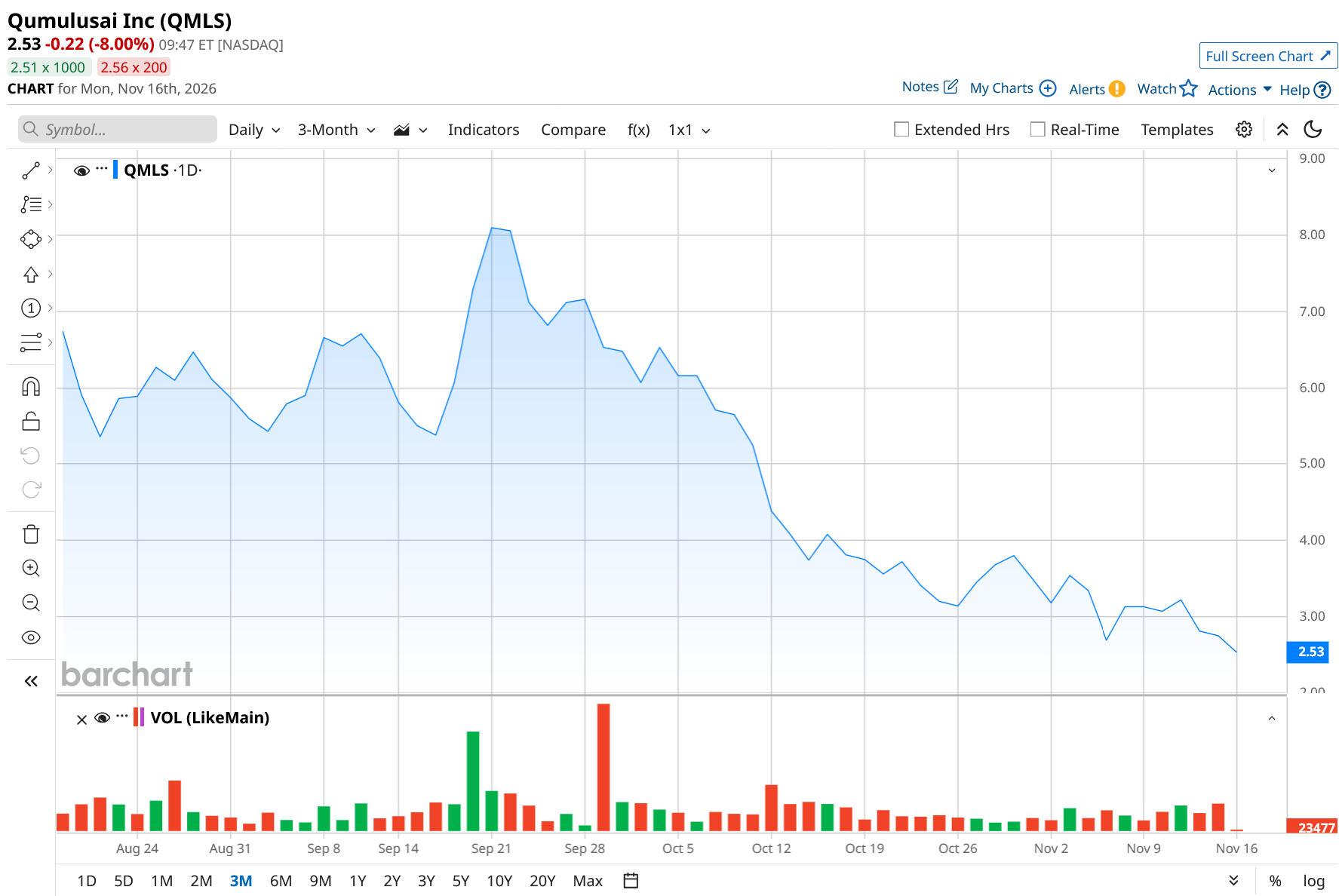
The market is focusing on financing needs because investors worry its rapid growth is not yet translating into steady profits. Over the past three months, the stock is down 61%, while it has been down 25% over the past month. It reached a three-month low of $2.35 on Nov. 13, but is up 21% from that level.
The stock had a sharp selloff, dropping 12.7% intraday on Nov. 12, despite strong results, as investors feared QumulusAI’s strong contracted backlog was not translating into billed revenue fast enough and a large GAAP-based loss.
On a forward-adjusted basis, QumulusAI’s stock trades at a price-to-sales ratio of 1.63x, below the industry average of 3.15x.
Strong Q3 Growth and Reached Profitability Milestone
QumulusAI’s third-quarter results showed significant top-line growth. Total revenue increased 375.9% year-over-year (YoY) to $14.76 million (also doubling sequentially for the second straight quarter). This was driven by compute power revenue (which accounts for 96% of QumulusAI’s top line) rising 878.7% YoY to $14.13 million.
The company also reported a positive adjusted EBITDA of $3.69 million driven by compute revenue, a major turnaround from the $602.93 thousand loss a year earlier. However, investors also noted that the GAAP-based net loss grew from $9.46 million to $14.44 million over the same period.
QumulusAI also saw demand surge, as its remaining performance obligations rose to $515 million at the end of Q3, up from $173.10 million at the end of Q2. Moreover, cumulative signed customer contract value surpassed $500 million, reaching $528.7 million.
Wall Street analysts are optimistic about QumulusAI’s future earnings. For fiscal 2026, its loss per share is expected to fall 35% YoY to $3.01, then improve another 71.8% to a $0.85 loss per share in fiscal 2027.
Here’s What Analysts Think About QMLS Stock
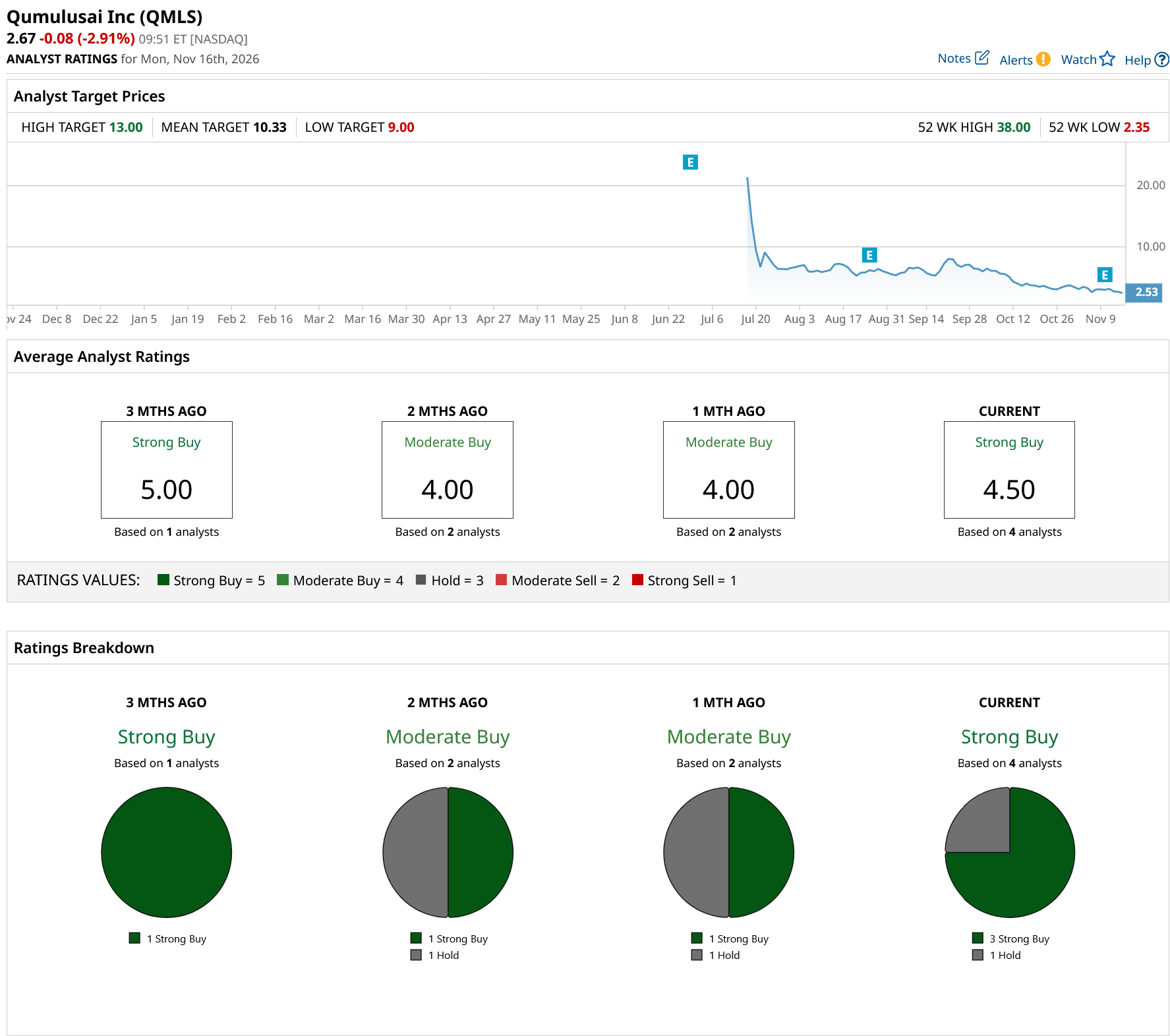
After the Q3 results, analysts at B. Riley Securities kept a bullish “Buy” rating on QMLS stock but lowered the price target from $11 to $9. Chardan Capital analysts also maintained a “Buy” rating but cut the price target significantly from $23 to $13. This suggests analysts see long-term potential in the stock but are grappling with the financial realities after its recent earnings release, particularly how fast it can generate earnings.
Wall Street analysts are taking a positive stance on this newly minted stock. Of the four analysts rating QMLS stock, three rate it a “Strong Buy,” while one takes a middle-of-the-road approach with a “Hold” rating. The consensus price target of $10.33 represents 287% upside from current levels. Moreover, the Street-high price target of $13 indicates a 387% upside.
On the date of publication, Anushka Dutta did not directly have a position in any of the securities mentioned in this article. All information and data in this article is solely for informational purposes. For more information please view the Barchart Disclosure Policy here.