


EN
The more amazing AI agents are, the more valuable cybersecurity is! Damo looks ahead to CrowdStrike (CRWD.US) adding new subscriptions, speeding up and calling for “increase in holdings” at a time of stock price pullback
The Zhitong Finance App learned that cybersecurity is moving further from corporate IT expenses to the core IT budget for business expansion continuity and AI application deployment. Wall Street financial giant Morgan Stanley (hereinafter referred to as “Damo”)'s latest performance outlook report shows that the agency is optimistic that CrowdStrike will benefit from the surge in cybersecurity budgets in the AI era. It is particularly optimistic that the next generation of SIEM, Cloud Security, and Falcon Flex will drive customer expansion. It is also expected that the quarter will exceed expectations and be transmitted to the full year's guidance. While the cybersecurity sector is recovering, Damo maintained CrowdStrike's “plus” rating and a target price of $254. Compared with the closing price of $226.61 on November 13, the target price implied room for an increase of about 12.1% over the next 12 months.
The core bullish basis for the Morgan Stanley analyst team is the accelerated expansion of the company's cybersecurity platform market share and cash flow. Guardian provides strong cybersecurity growth driven by subsequent AI technology, and the key to continuous revaluation is on the increase in full-year guidance, visibility of growth and cash flow in FY2028. As of November 13, the stock prices of the two major cybersecurity leaders, CrowdStrike and Palo Alto Networks, rose by about 93% and 75%, respectively, during the year, but have retreated about 21% and 25% from the historical high near the October 6 intraday high.
According to Dama, next-generation SIEM, Cloud Security and Falcon Flex are expected to enable CrowdStrike's net additional annual recurring revenue (NNARR) of the third fiscal quarter to reach US$400,000-405 million, an increase of 51% to 53% year-on-year, about 16% to 17% higher than the agreed expectations in the report table. In addition, Dama said that AI intelligence platforms go deep into corporate business and open up long-term space for identity, data and runtime protection, but recent performance increases are mainly due to the expansion of existing security products, and Guardian's contribution is still in progress.
Japan's IDC Frontier's IDCF Cloud was attacked by ransomware on October 7, affecting 495 enterprises and local government customers, and some virtual servers stopped operating; the Australian government announced the results of an investigation into the incident of unauthorized access to government websites by OpenAI agents on November 10, and accepted 18 recommendations, including mandatory incident reports. These two types of events can be described as exposing the risk of falling cloud infrastructure and unauthorized execution by AI agents, strengthening the global enterprise's need for identity, cloud workload, and runtime protection.
The market can be described as having given a significant premium to this trend, but it is currently in an adjustment phase after rising. As a result, the main trading line of the market for the cybersecurity sector is shifting to “cybersecurity demand supports long-term growth, but financial reports and performance guidelines need to prove that high growth can continue to advance.”
Falcon's growth relay: customers move from buying terminal protection to integrated security platforms
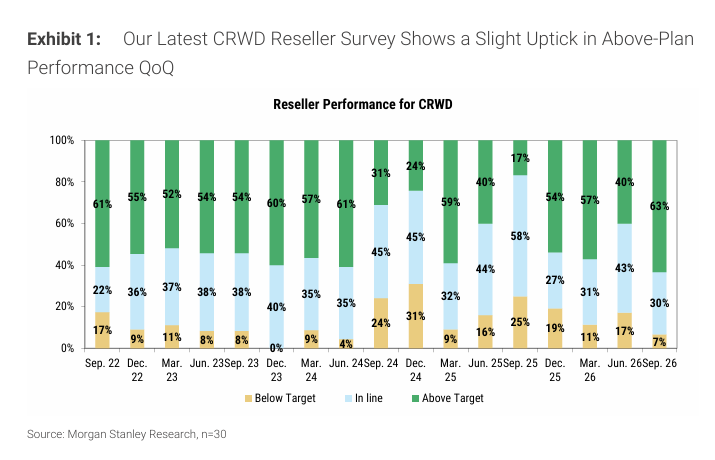
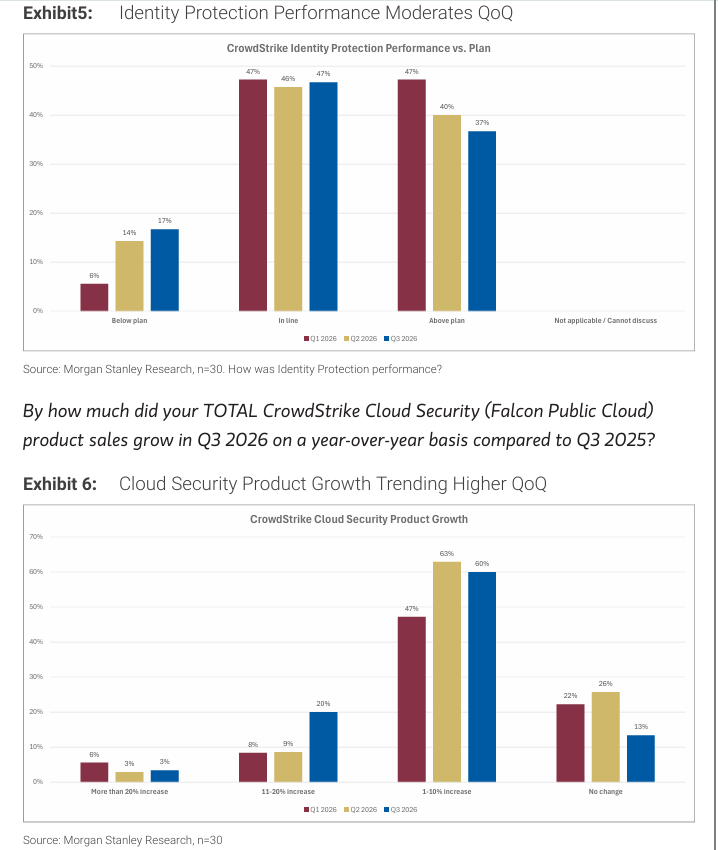
The clearest signal of the CrowdStrike cybersecurity platform channel improvement comes from customers continuing to expand the scope of procurement. According to Daimo's survey of 30 major dealers, CrowdStrike's overall business exceeded plans by 40% to 63% in the second quarter; Next-Gen SIEM (Next-Gen SIEM) exceeded plans by 20% to 37%, and exposure management increased from 26% to 33%. Cloud security sales increased 11% to 20% year over year, and the share of channels also increased from 9% to 20%.
Meanwhile, the percentage of terminal detection and response (EDR) overplanned remained 37%, while identity protection dropped from 40% to 37%. The core point of this latest set of research data is that SIEM and cloud security have become new impetus, and mature terminal businesses have remained stable.
This expansion already has a strong operating foundation: the company's revenue for the last fiscal quarter was approximately US$1,471 million, up 26% year on year, with a net increase of US$332.8 million in annual recurring revenue (NNARR) of US$332.8 million, up 51% year over year; the customer base using Falcon Flex contributed more than US$2.29 billion at the end of the period, an increase of 101% year over year. Flex reduces item-by-item approval and procurement friction by pre-committing platform purchase quotas and then configuring different modules; SIEM increases Falcon's share of the same customer's security budget by replacing old systems, integrating logs, and associated attacks.
Damo also pointed out that the strong performance of individual channels came from large contract renewals, while Guardian's revenue contribution only began to appear in late October, and some customers are still evaluating it. Therefore, the main pillars of the company's growth in the third calendar quarter are still SIEM, cloud security, and additional customer purchases, and the commercial contribution of the advanced protection business led by AI agents will be further tested in subsequent quarters.
Financial reports need to exceed both the unanimous expectations of the market and the implied expectations of the market
CrowdStrike will announce the results for the third quarter of the 2027 fiscal year ending October 31, 2026, after the market on December 1. Damo maintains the benchmark model in the table, while judging that actual results are expected to be achieved: NNARR was US$400-405 million, up 51% to 53% year on year, up about 20% to 22% month on month; revenue was US$1,560 billion to US$1,565 billion, up 26% to 27% year on year. Compared with the agreed expectations in the report table, it was about 15.8% — 17.2% and 2.0% — 2.3%, respectively.
The Dama analyst team expects most of the excess performance to enter full-year ARR and revenue guidance, and expects the company to reaffirm the framework of a free cash flow rate of more than 30% for FY2027 and an increase of at least 20% for NNAR in FY2028.
The difference that makes sense for investment is how much cash can be left behind as income increases. The official Tama model predicts revenue of FY2027 to be US$5.996 billion, up 24.6% year on year; ARR at the end of the period will be US$6.607 billion, free cash flow will be US$1.808 billion; revenue for fiscal year 2028 will increase to US$7.337 billion, up 22.4% year on year, free cash flow will increase by about 39.5% to US$2,523 billion, and the cash flow rate will increase from 30.2% to 34.4%. The latter was higher than market expectations of 32.8%, while the bank's revenue forecast was slightly lower than the agreed forecast, indicating that its strong judgment focused on customer expansion, operating leverage, and cash conversion.
The Dama analyst team said that the addition of ARR first reflected subscription size, and revenue and profit were gradually confirmed. It also explained why the report expected NNARR to significantly exceed expectations, but only determined that EPS expectations for the next 12 months would be moderately revised.
The target price of $254 is dependent on free cash flow of approximately US$5.4 billion in 2030, a 64-fold final valuation, and a 12% discount rate, reflecting Damo's willingness to pay a premium for platform share and long-term cash flow growth. The reported bull market and bear market scenarios were $308 and $103, respectively, up about 35.9% and down 54.5% from the close of November 13. This difference results from a combination of growth, profit margins, and valuation multiples. Over the past four quarters, the company's NNARR average has exceeded the agreed forecast by 10.7%, and reached 16.8% in the previous quarter, which means that “exceeding expectations” in a single quarter is not scarce; stronger full-year guidance and visibility of growth in the 2028 fiscal year have a better chance of driving continued revaluation after the pullback.
No matter what kind of AI big model wins, cybersecurity platforms must maintain the boundary of “real execution”
The underlying reason AI is expanding security requirements is that software is beginning to gain the ability to act continuously. AI agents that focus on advanced agent-based workflows can read databases, call interfaces, modify code, and manipulate cloud resources. Once prompted or credentials are leaked, they may spread along the tool call chain. The closed source AI model is hosted by the manufacturer and cannot manage its own licenses and data for the enterprise; the open weighting model is deployed locally, and it is still necessary to prevent software supply chain, permissions, and runtime risks.
The IT budget associated with global enterprise cybersecurity therefore depends on how many real businesses are connected and how many operating rights are open. CrowdStrike uses Falcon to link terminals, identity, and cloud behavior, while Palo Alto Networks covers proxy monitoring, access control, alert injection, and data breach prevention through products such as Prisma AIRS. Both are seeking continuous security expenses in enterprise AI deployments.
This demand has begun to connect to the computing power industry chain: CrowdStrike expanded its partnership with CoreWeave on November 2 to bring cloud workload, container and GPU cluster protection, and managed inspection responses to its production-level AI environment. Guardian, an exclusive AI-driven security platform, links reminders and network communication with actual execution actions to expand Falcon's protection targets.
As a result, the growth path at the level of commercial expansion is also more clear: AI application software led by AI agents increases protected assets, customers purchase additional security modules, platform integration increases budget share, and automated responses improve customer input-output ratios — this is the long-term logic that Damo is optimistic about CrowdStrike; however, the ultimate evidence that can support stock prices is still the renewal and expansion of contracts, additional ARR, and continuous cash flow.