EN
Omdia: Southeast Asia smartphone shipments fell 36% year over year to 16.5 million units in the third quarter
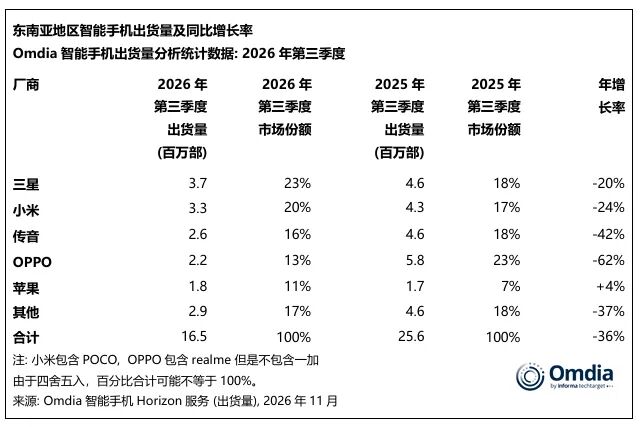
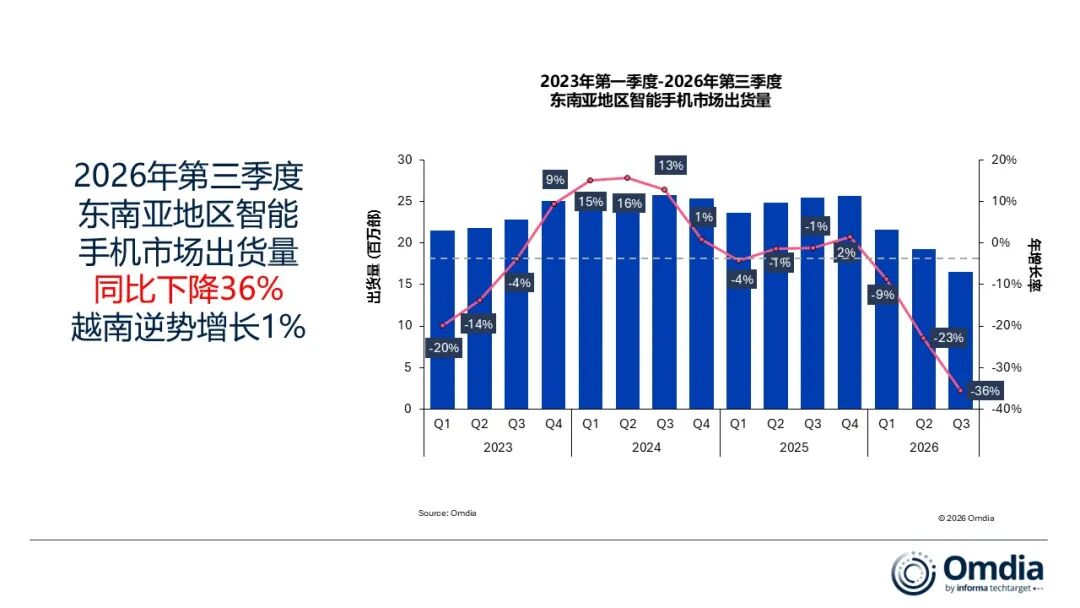
The Zhitong Finance App learned that according to Omdia's latest research, in the third quarter of 2026, the Southeast Asian smartphone market fell 36% year on year, and shipments fell to 16.5 million units. This market contraction continues the downward trend since the first half of 2026. Shortage of memory chip supply and rising component costs continue to limit the shipping performance of smartphone manufacturers.
Despite a sharp drop in shipment volume, market shipment value decreased by only 1% year over year, while average selling price (ASP) rose 53% year over year. This difference reflects that in a context where supply pressure continues to increase, smartphone manufacturers are coping with rising costs and supply restrictions by increasing product prices.
Highlights of the performance of major smartphone vendors in the third quarter of 2026
Despite a 20% year-on-year decline in shipments to 3.7 million units, Samsung maintained its leading position in the Southeast Asian market. The tight supply of memory chips and its consistent market strategy of focusing on high-end Galaxy Z Fold series products in the third quarter put pressure on overall shipments. The shipment volume of the Galaxy Z8 series was higher than that of the previous generation. Among them, with the release of the Galaxy Z Fold8 with a book-style design, shipments of book-style folding screen phones increased by more than 40%.
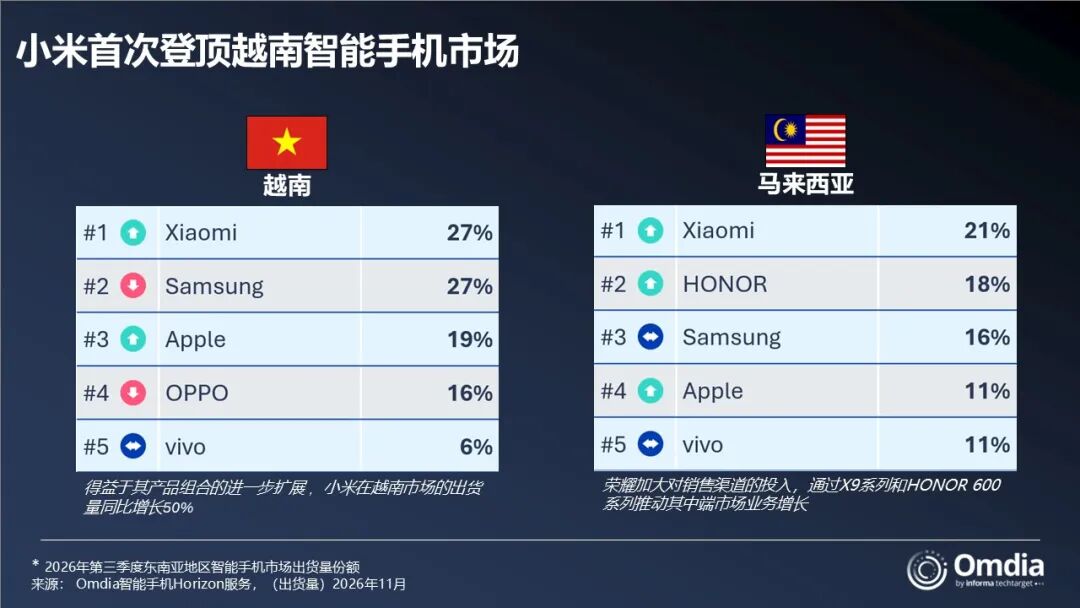
The average retail price (ASP) of Xiaomi (01810) rose 55%, offsetting the impact of the decline in shipments on market sales to a certain extent. Furthermore, Xiaomi reached the top of the Vietnamese smartphone market for the first time, and shipments increased 50% year over year, mainly due to its competitively priced models.
TRANSSION (TRANSSION) shipments fell 42% year over year, and the regional market share fell to 16%. Despite this, Voice has maintained a leading position in price-sensitive markets such as the Philippines and Indonesia. To cope with the tight supply of memory chips, Audio has streamlined its product portfolio and reduced the number of versions introduced for new models.
OPPO (including Realme) shipments fell 62% year over year to 2.2 million units, ranking fourth in the Southeast Asian market. The decline in shipments mainly reflects its strategic exit from the ultra-low end market (selling price below $100) to cope with rising memory chip costs. The entry-level model A6c 4G, launched in the third quarter of 2026, has reached a starting price of about $140 in most Southeast Asian markets. Meanwhile, shipments of models priced above $400 increased by more than 50%, mainly driven by the newly launched Reno 16 series.
Apple (AAPL.US) was the only manufacturer among the top five to achieve an increase in shipment volume. Shipments increased 4% year over year, mainly due to its strong performance in the Malaysian and Vietnamese markets. Since the product portfolio is dominated by high-end models, Apple is relatively less affected by the pressure on the supply of memory chips, and the impact of this pressure on manufacturers that rely on models priced below $200 is even more obvious. In addition, buy now pay later (BNPL) services, including SpayLater, are becoming increasingly popular, further increasing consumers' purchasing power.
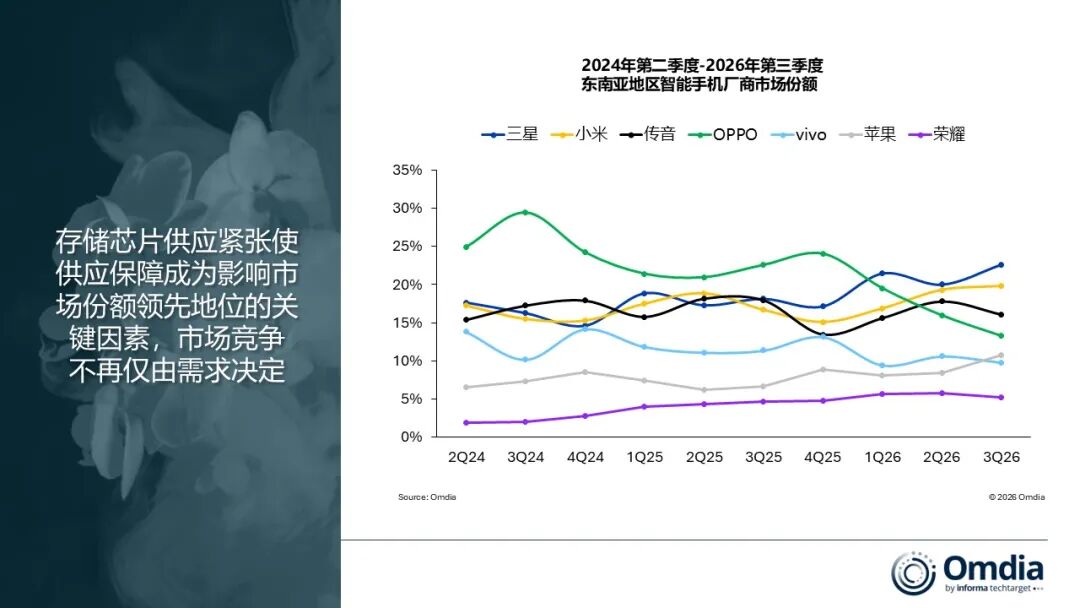
The decline in shipments reflects supply constraints rather than weak demand
Omdia senior analyst Sheng Win Chow (Sheng Win Chow) said, “The decline in smartphone shipments this quarter should not be directly interpreted as weakening market demand. Manufacturers are still able to supply devices that cost more than $100 and cover almost all price ranges, but they are no longer able to provide the same memory and storage configurations as in the past while maintaining the original price. The actual impact on consumer demand will depend on how consumers view these changes and whether they consider the resulting trade-offs acceptable. As a result, manufacturers are shifting their marketing focus to the actual use-value of new models without overemphasizing core hardware specifications such as RAM and storage capacity.”
Zhou Shengyong added, “As the supply of memory chips tightens and costs continue to rise, manufacturers are faced with a difficult choice between product positioning and profitability. For example, vivo has previously begun to raise the average selling price (ASP) and reduce its dependence on models priced under $100. Pressure on the supply of memory chips has further accelerated its exit from this market segment.
According to Omdia data, vivo's smartphone shipments from the beginning of 2026 to date (YTD) fell 33% year over year, while ASP rose 37%. The ultra-low end market usually has limited profit margins and is highly dependent on subsidies and discount promotions. Therefore, even if shipments decline, reducing reliance on this market segment will still help manufacturers increase their profitability.
Regional market performance
Omdia Research Manager Le Xuan Chiew (Le Xuan Chiew) said, “In the third quarter of 2026, Vietnam was the only smartphone market in Southeast Asia to achieve growth, with shipments increasing 1% year over year. All other markets in Southeast Asia experienced double-digit declines, with shipments from Indonesia, the Philippines, Malaysia, and Thailand all falling by more than 30%.”
“The performance of the Vietnamese market is relatively stable, thanks to its strong macroeconomic performance. Foreign direct investment (FDI), manufacturing activity, and export growth driven by global demand for AI hardware have supported Vietnam's economic growth. This economic growth momentum helps maintain domestic demand and makes the Vietnamese smartphone market more resilient.”
Zhou Lexuan added, “HONOR (HONOR) has also further consolidated its position in Southeast Asia's more mature markets. For the first time, it ranked second in the Malaysian smartphone market in terms of shipment volume, and ranked third in Singapore.”
Honor has long focused on mid-range and high-end products, rather than the price market under $200, which is most clearly affected by the tight supply of memory chips. This product strategy has reduced its impact on the decline in entry-level market shipments.
In addition, Honor has also expanded its presence in telecom operator channels. Carrier-led sales account for a significant proportion of smartphone purchases. Further enhancement of channel coverage has become an important factor driving the growth of Honor Market.