


EN
As market forces contend with each other, the yen fell into a long and short tug-of-war! Goldman Sachs is betting on a counterattack on Damao, but predicts a drop to 162
The Zhitong Finance App learned that at a time when the exchange rate of the US dollar against the yen is once again approaching the important mark of 160, Morgan Stanley and Goldman Sachs have given very different views on the trend of the yen. This highlights how difficult it is becoming to predict the yen exchange rate in a situation where multiple forces are dragging on each other.
Morgan Stanley strategists, including Serena Tang, believe that the yen will weaken to 162 against the US dollar by the fourth quarter of 2027. They believe that strong global risk appetite, Japan's terms of trade and arbitrage trading continue to be attractive, and will eventually outweigh the supporting effect of narrowing interest spreads on the yen.
However, Goldman Sachs strategists, including Kamakshya Trivedi, have the opposite view. They expect the yen to appreciate throughout 2027 as its “severe undervaluation begins to subside.” Goldman Sachs predicts that the USD/JPY exchange rate will reach 158, 155, and 150 in three months, six months, and one year, respectively. The bank's most popular measure of fair value shows that the yen is undervalued against the US dollar by about 30%.
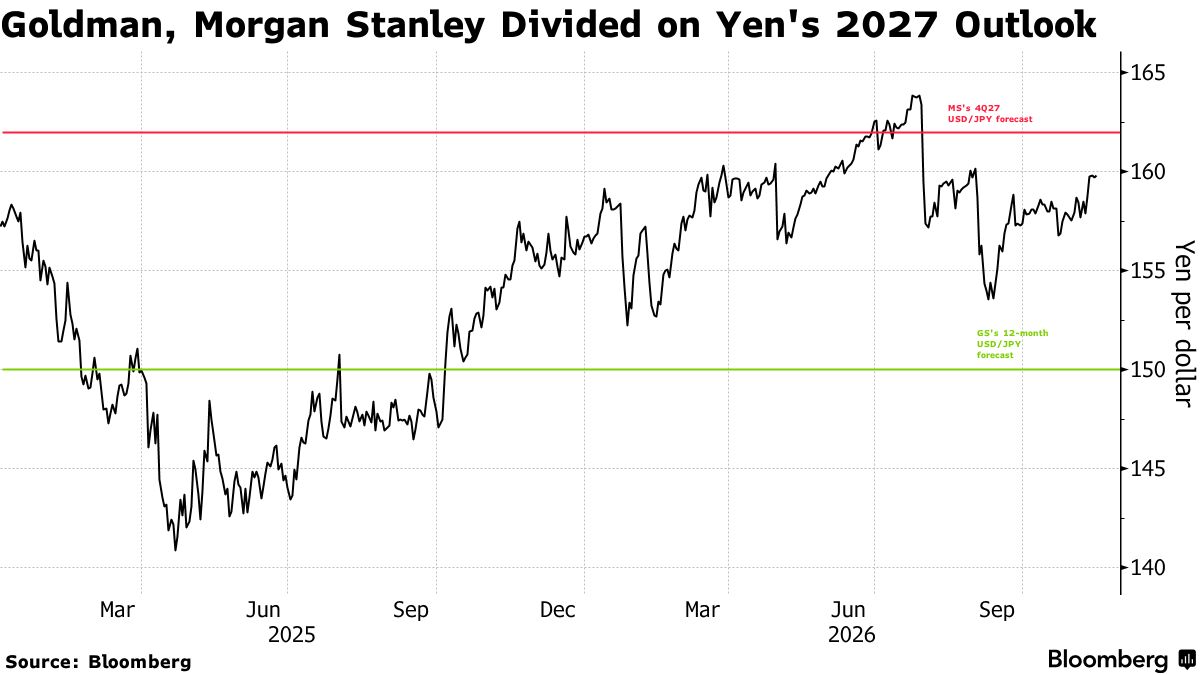
This very different view highlights the conflicting forces of many stocks, and has also made the yen extremely difficult to trade this year. The Bank of Japan is raising interest rates at the fastest rate in decades, yet interest rates in Japan are still lower than those in the US, and capital continues to flow overseas. At the same time, market concerns about intervention and speculation that Japanese institutions may eventually return more capital to the country have made the risk of shorting the yen higher and higher.
As of press release, the USD/JPY exchange rate was reported at 159.70. Last week, the exchange rate of the US dollar against the yen broke through this much-publicized barrier and broke the narrow fluctuation range that has continued for several months. As markets increasingly bet that the Federal Reserve will speed up monetary policy tightening to contain inflation, the dollar strengthened and put pressure on the yen.
Morgan Stanley ultimately anticipates that forces suppressing the yen will prevail. Although short-term interest rate convergence between the US and Japan should support the yen, the bank believes that global risk appetite, terms of trade, and arbitrage transactions will have a greater impact. The bank also pointed out that the market may continue to believe that the Bank of Japan is “behind the situation,” thereby limiting the boosting effect of rising interest rates in Japan on the yen.
Meanwhile, Goldman Sachs believes that the Bank of Japan has adjusted interest rate hikes to once every quarter, eliminating some of the inflation premiums that previously suppressed Japanese assets. The bank's economists expect that the Bank of Japan will also raise interest rates three times, 25 basis points each time, and raise the policy interest rate to 2% by June 2027. In contrast, the current market-priced interest rate level is around 1.75%.
The prospect that Japanese capital may flow back into the country also supports Goldman Sachs' bullish view of the yen, but the bank admits that this transformation is still “more of a possibility than a reality.” Goldman Sachs's most popular capital flow measurement measures track the flow of funds from investors with unhedged exposure to foreign assets. The indicator shows that since this year, investors' demand for overseas assets has generally increased, and there are no obvious signs of capital rotation as of October.
Despite this, Goldman Sachs believes that the prospect that the Japanese Government Pension Investment Fund (GPIF) may eventually adjust the investment allocation is significant, as this move may send a signal to other investors. Coupled with the possibility that the yen may face further exchange rate intervention, and that the Bank of Japan may adopt a more hawkish policy stance, these factors together reinforce Goldman Sachs's judgment that there is a downside risk in the exchange rate of the dollar against the yen.
The yen is becoming increasingly difficult to trade
After a year of intense fluctuations, the yen surprised traders that the exchange rate against the US dollar has gradually stabilized within a narrow range of 158 yen per dollar in recent months. However, the yen broke through this fluctuation range again last week, unexpectedly falling below the critical mark of 160, then rebounded after market speculation that Japanese officials would intervene to support the yen.
The sudden fluctuation in the yen highlights how difficult the Japanese currency has become to trade today. Traditional indicators such as interest spreads are no longer reliable guidelines, and the Bank of Japan's tightening of monetary policy, continued capital outflows, and unprecedented exchange rate intervention have led the yen to be drawn by forces in conflicting directions.
The impact of this problem extends far beyond Japan itself. The yen is one of the most traded currencies in the world, involving around $1.6 trillion in daily transactions. The trend of the yen may determine the success or failure of global investors' investments, and its long-term trend will affect a range of issues, from Japan's inflation to the flow of the country's huge savings capital to overseas markets.
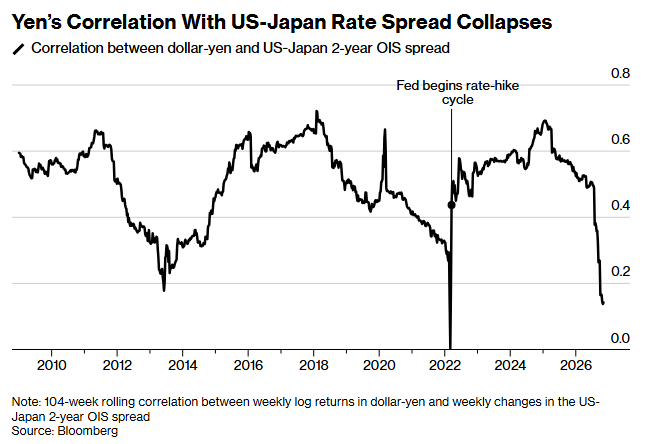
The correlation between the yen and the spread between the US and Japan collapses
Rajeev De Mello, global macro portfolio manager at Gama Asset Management SA, which manages assets of around 600 million Swiss francs, said: “The problem is that these competing forces make the timing and magnitude of the yen trend more difficult to predict. As a result, I've reduced my yen position to reflect greater uncertainty.”
There are good reasons to buy yen — the Bank of Japan raised interest rates the fastest since 1990, Japan's domestic yield is close to a decades-high, and officials in Tokyo and Washington have shown a willingness to intervene when the yen depreciates too fast.
But the reasons for selling yen are just as strong. Interest rates in Japan are still far lower than those of the US and other major economies. Some investors believe that the Bank of Japan is too slow to close this gap. This makes arbitrage trading attractive, while Japanese companies, institutions, and households continue to allocate large amounts of capital overseas.
There are clear differences in market views on the long-term trend of the yen. James Athey of Marlborough Investment Management expects the yen to appreciate sharply, while Fidelity International's Lei Zhu believes that further depreciation of the yen is a greater risk.
There are also investors who have chosen to leave the market altogether. David Clewell of T. Rowe Price Group Inc. has not held a position in yen for a long time, while Carol Lye of Brandywine Global Investment Management has avoided trading the dollar against the yen this year and chose to trade yen against the euro.
As it turns out, the yen is also difficult for policy makers to control. Japan's Finance Minister Katayama Satsuki led an exchange intervention in late July to set a bottom line for the yen exchange rate. US Treasury Secretary Bessent also provided support for this. He invested a small amount of capital, but he placed a significant portion of his personal credit in supporting the yen.
This year, Japan has spent a record 27.1 trillion yen (about 169.7 billion US dollars) to buy yen, which is almost three times the sum of the country's trade deficit and total outflows of direct investment capital. The intervention helped the yen rebound from a 40-year low of nearly 164 in July, but since then the yen has regained most of its gains.
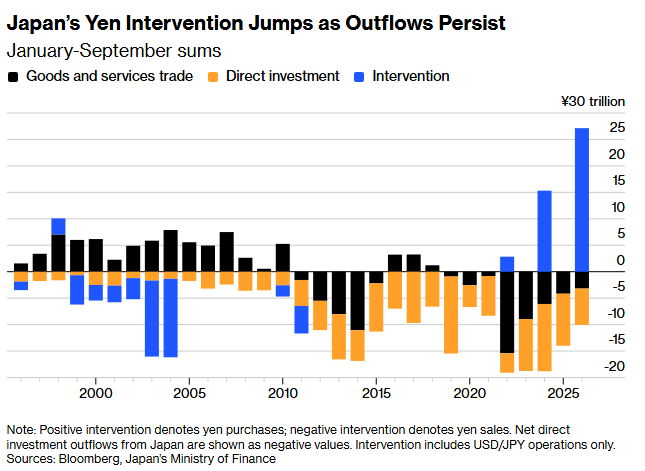
The scale of Japan's intervention in yen has soared, and capital outflows continue
Continued weakness in the yen will drive up import costs, squeeze household spending, and complicate Prime Minister Takaichi Sanae's efforts to promote economic recovery. This also helps explain why Tokyo has repeatedly supported the yen. Masahiko Loo, chief fixed income strategist at State Street Investment Management, said that the market should not underestimate the authorities' ability to strongly curb unilateral exchange rate trends, but exchange rate intervention is limited. He said, “Interventions can slow exchange rate changes, but few can change the fundamental direction of exchange rates on their own.”
Decades ago, the yen was closely tied to Japan, an export powerhouse. At the time, Japanese manufacturers earned foreign exchange by selling cars and electronics globally. Subsequently, Japan entered an era of zero interest rates. The country's huge savings capital went overseas in search of returns, and the yen became the preferred financing currency for global arbitrage transactions.
In theory, Japan's exit from the zero-interest rate policy should help strengthen the yen, as it would reduce the motivation to borrow yen at low cost and invest overseas. However, decades of cheap capital have enabled Japan to accumulate 811 trillion yen in overseas securities assets, and the long-established overseas investment model may be difficult to reverse.
Fidelity's Lei Zhu believes that Japan's transformation into a mature creditor economy has brought structural headwinds to the yen. She said that pension funds, insurance companies, and households are still investing heavily in overseas assets; unless Japanese yields become clearly attractive, it is unlikely to offset these outflows even if rising Japanese treasury bond yields cause capital to flow back into the country.
Even record inflows of capital have failed to help the yen strengthen. From January to October of this year, overseas investors bought a total of 34.5 trillion yen worth of Japanese bonds and stocks, a record high for the same period, but the yen remained weak. Citigroup strategists believe that one reason may be that foreign investors hedge their exposure to some Japanese stock investments by selling yen.
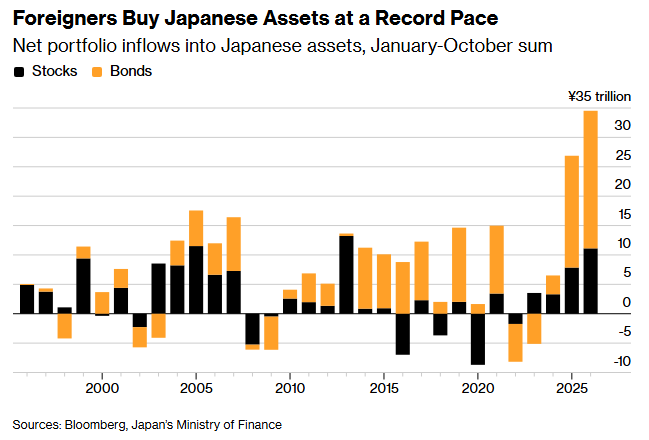
Foreign investors are buying Japanese assets at record speed
The biggest question facing the Japanese yen in the new era is whether Japanese capital will finally start to stay in the country.
At present, there are some initial signs of transformation. Since this year, Japanese investors have net sold 689 billion yen worth of foreign stocks and bonds, reversing the net purchase of 12.5 trillion yen last year. At the same time, Japan's domestic treasury bond yields are close to decades-old highs, the Japanese stock market is showing strong performance, and corporate reforms are improving shareholder return prospects.
However, these factors alone are not enough to trigger a large-scale return of capital to domestic assets. Masayuki Nakajima, senior strategist at Mizuho Bank in London, said, “The problem is not valuation, but uncertainty. Many institutions remain concerned that yields may rise further if inflation, market expectations of the Bank of Japan's tightening policy, or fiscal concerns intensify.”
Furthermore, the reversal in the flow of securities investment capital does not mean that Japan has stopped exporting capital overseas. This year, Japanese companies invested 11.9 trillion yen overseas through OFDI, not including reinvestment income, as they continue to expand their business layout outside the domestic market.
The Japanese Government Pension Investment Fund (GPIF) is a closely watched observation sample. Although the market speculates that the fund may transfer more capital to domestic assets, its investment allocation for the latest quarter has remained largely unchanged.
For the Tokyo side, the importance of the yen issue continues to rise. As Japan enters a new era of higher inflation and interest rates, the yen is becoming an increasingly important variable. The continued weakness of the yen may complicate the Bank of Japan's monetary policy normalization process and put additional pressure on the already volatile bond market.
James McAlevey, head of global integrated investment and absolute return business at BNP Paribas Asset Management, said, “If the yen strengthens, it will help control the overall inflation problem and help control long-term yields in the bond market.”
Washington also has its own considerations. Japan is the largest foreign holder of US government debt, and if Japan further interferes unilaterally in the foreign exchange market, Tokyo may need to sell some of its US treasury bond holdings. Earlier this year, the US and Japan jointly interfered in the foreign exchange market, thereby reducing Japan's demand to sell US Treasury bonds and limiting the risk of additional upward pressure on US Treasury yields.
Meanwhile, investors still don't see obvious trading opportunities. Maxence Visseau, chief investment officer at Dubai's Arkevium Capital, said that after Japan and the US jointly intervened in the foreign exchange market in July, the trend of the yen had become “almost impossible to predict.” He said, “I'm happy to keep watching for a while. I doubt I'm not the only one who thinks this way.”