


EN
Will Seven Year Capacity Sale Change Talen Energy (TLN) Narrative
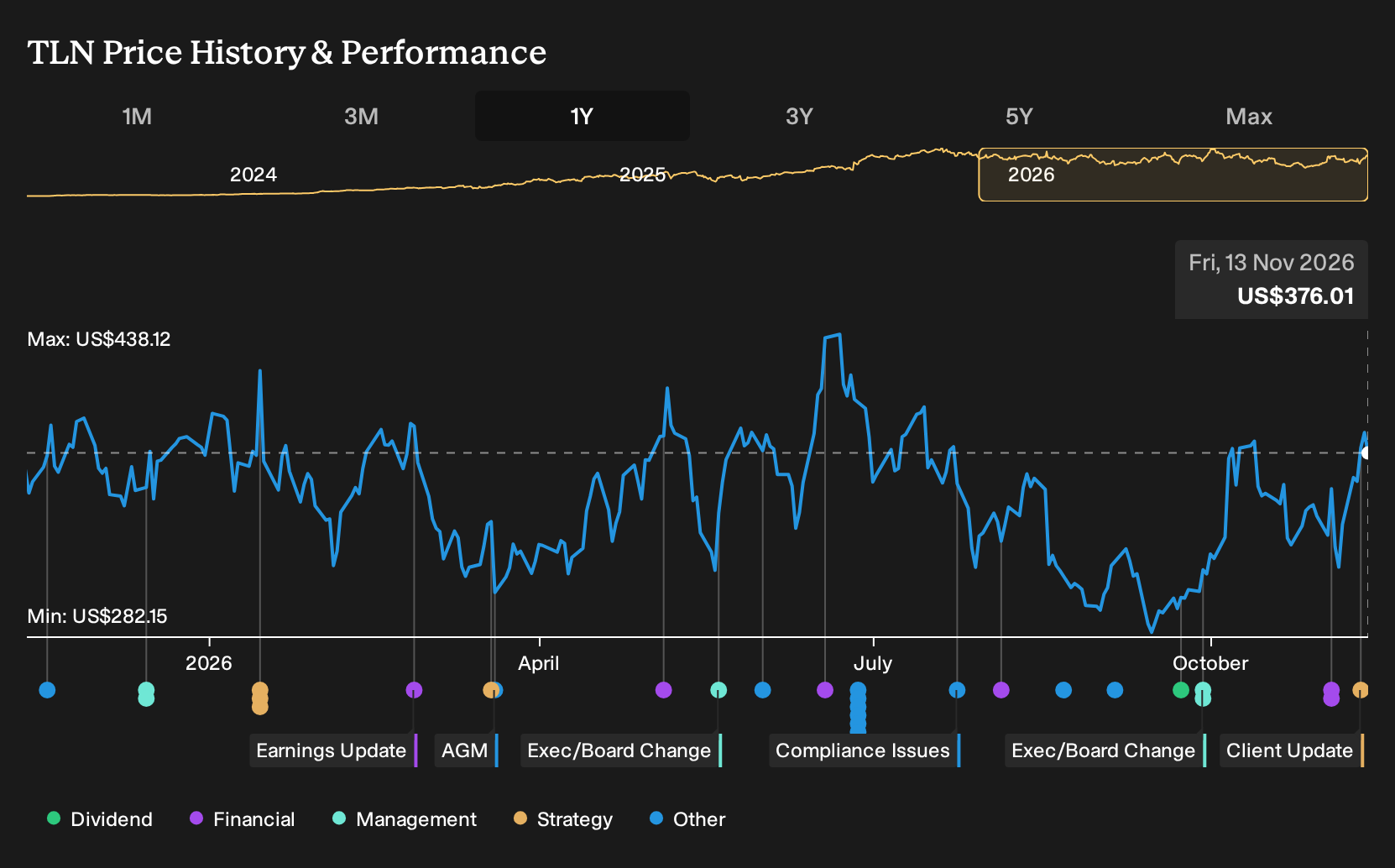
- Talen Energy Corporation announced in November 2026 a seven year sale of 750 megawatts of PJM capacity to an investment grade counterparty. This sale is expected to generate about US$100 million per year from 2029/2030 through 2035/2036 and to contribute to roughly US$1 billion of cumulative capacity revenue visibility.
- The long dated Guernsey and Waterford capacity contracts mean more than one third of Talen Energy’s ELCC accredited fleet is now under multi year agreements. This lifts the contracted share of gross margin to 40% through 2036 and tightens the link between physical assets and recurring cash flow.
- The next step is to consider how Talen Energy’s investment narrative of contracted cash generation is affected by this extended PJM capacity visibility.
Compare Talen Energy's long term contracted capacity story with other grid infrastructure plays by screening for 44 power grid technology and infrastructure stocks that could benefit from demand for reliable power.
Talen Energy Investment Narrative Recap
To own Talen Energy, you need to believe that contracted PJM capacity and long term offtake deals can turn a volatile generator into a more predictable cash producer. According to Andrei_Niculescu, an investor in the Simply Wall St Community, the appeal sits in cash generation rather than headline GAAP earnings. The new seven year PJM capacity sale fits that idea and adds revenue visibility, but it does not change the fact that operations remain exposed to power markets, hedge outcomes and plant reliability.
The key near term swing factor is still execution against management’s 2026 and 2027 adjusted EBITDA and free cash flow guidance. Interest costs and debt service stay front and center, since interest payments are not well covered by earnings on recent figures. The expanded contracted capacity may ease some earnings volatility, although leverage, derivative marks and any PJM market design shifts remain the biggest operational risks to watch.
The most relevant recent announcement is the reaffirmed 2026 guidance and new 2027 outlook released on 3 November 2026. Management guided 2026 net income to US$960m to US$1,080m and set 2027 net income expectations at US$1,105m to US$1,405m. Those targets frame how meaningful the new PJM contracts could be for smoothing the path to those earnings ranges and supporting planned capital allocation.
Andrei_Niculescu argues that investors should focus on adjusted EBITDA and free cash flow as the main scoreboards, with GAAP earnings acting more as a mark to market wrapper on hedges. The latest capacity deal, layered on top of existing contracts like the AWS agreement, feeds directly into that cash flow narrative. The main question now is execution: whether Talen Energy converts this contracted book into the guided cash outcomes while managing leverage and interest coverage.
In Andrei_Niculescu’s narrative, the fair value of US$395 for Talen Energy reflects an internal model that pairs 18.1% annual revenue growth with a future 13.1% profit margin, and then capitalizes the implied 2027 adjusted free cash flow using the author’s required return hurdle.
Uncover why Talen Energy's fair value indicates a 5% potential upside to its current price, which could narrow quickly.
Exploring Other Perspectives
Some of the most optimistic analysts focus on a different catalyst for Talen Energy. They lean into the pre news forecast that revenue could reach about US$6.3b and earnings US$2.7b by 2029, and see that as proof the cash engine can scale. You should treat this as one possible path, not a certainty, and compare it with more cautious views that may shift after this new capacity deal.
Explore 5 other Talen Energy fair value estimates, including one that suggests as much as 239% potential upside from the current price.
Form Your Own Verdict
Don't just follow the ticker; dig into the data and build a conviction that's truly your own.
- A great starting point for your Talen Energy research is our analysis highlighting 3 key rewards and 2 important warning signs that could impact your investment decision.
- See our latest analysis for Talen Energy. The report includes a comprehensive fundamental analysis summarized in a single visual, the Snowflake, making it easy to evaluate Talen Energy's overall financial health at a glance.
Looking for more Talen Energy style ideas?
If Talen Energy's contracted capacity story appeals to you, it can help to line it up against other businesses with clear financial profiles and different risk and return trade offs.
- For investors who want potential mispricing with quality in focus, scan through a curated 34 high quality undervalued stocks that pair robust fundamentals with pricing that may not fully reflect them.
- If income stability is a priority, compare Talen Energy with companies in a 6 dividend fortresses that concentrate on higher yield and more established payout histories.
- For a sturdier balance sheet focus, widen your research to a list of solid balance sheet and fundamentals (24 results) and see which other businesses combine financial resilience with consistent fundamentals.
Have feedback on this article? Concerned about the content? Get in touch with us directly. Alternatively, email editorial-team@simplywallst.com