


EN
AIG Stock And Other Insurers Positioned For Higher D And O Demand
Jensen Huang’s abrupt exit from Nvidia has thrown a spotlight on an under the radar corner of the market: the insurers and legal advisers that sit behind directors, boards and securities claims when governance questions hit the headlines. When leadership risk suddenly feels real, pricing and demand for D&O and related cover can shift fast. This piece walks through three stocks from that universe that could be affected in different ways by this shock, and why their exposure to governance risk might matter for your portfolio thinking.
The three stocks covered next are just a starter set. The full screen highlighted 15 more insurers and legal advisers with equally compelling governance and securities-claim angles that are not discussed in this article.
If you want to identify and analyze the wider field of potential beneficiaries and second order risks around leadership turmoil, head straight to the Corporate liability insurers and legal-advisory firms exposed to governance and securities-claim risk screener.
American International Group (AIG)
American International Group matters in this screener because it is a global insurer that helps absorb governance shocks through management liability cover, and the analyst consensus Narrative on Simply Wall St sees the current transformation as tightly linked to how effectively AIG runs that business.
"The acceleration of digitalization and artificial intelligence initiatives such as the Gen AI deployment across underwriting and claims remains central, with tools like Underwriting by AIG Assist and Claims by AIG Assist now allowing American International Group underwriters to process more submissions and quotes faster, which can support better risk selection, lower operating costs and stronger net margins over time."
What really matters now is how quickly that quieter shift in risk selection quality feeds through into pricing power and profitability.
American International Group is a global insurer with sizeable management liability exposure, earning about US$9.1b from North America Commercial, US$9.1b from International Commercial and US$6.5b from Global Personal, and carries a market value near US$43.0b.
When that underwriting shift matters for you, the full narrative for American International Group explains how AIG’s liability focus, technology spending and governance exposure could be separating from headline noise.

RenaissanceRe Holdings (RNR)
RenaissanceRe Holdings supports primary insurers across catastrophe, casualty and specialty risks. In this screener it matters because its reinsurance capacity indirectly backs corporate liability and D&O exposure at a time when governance questions are suddenly front of mind for boards.
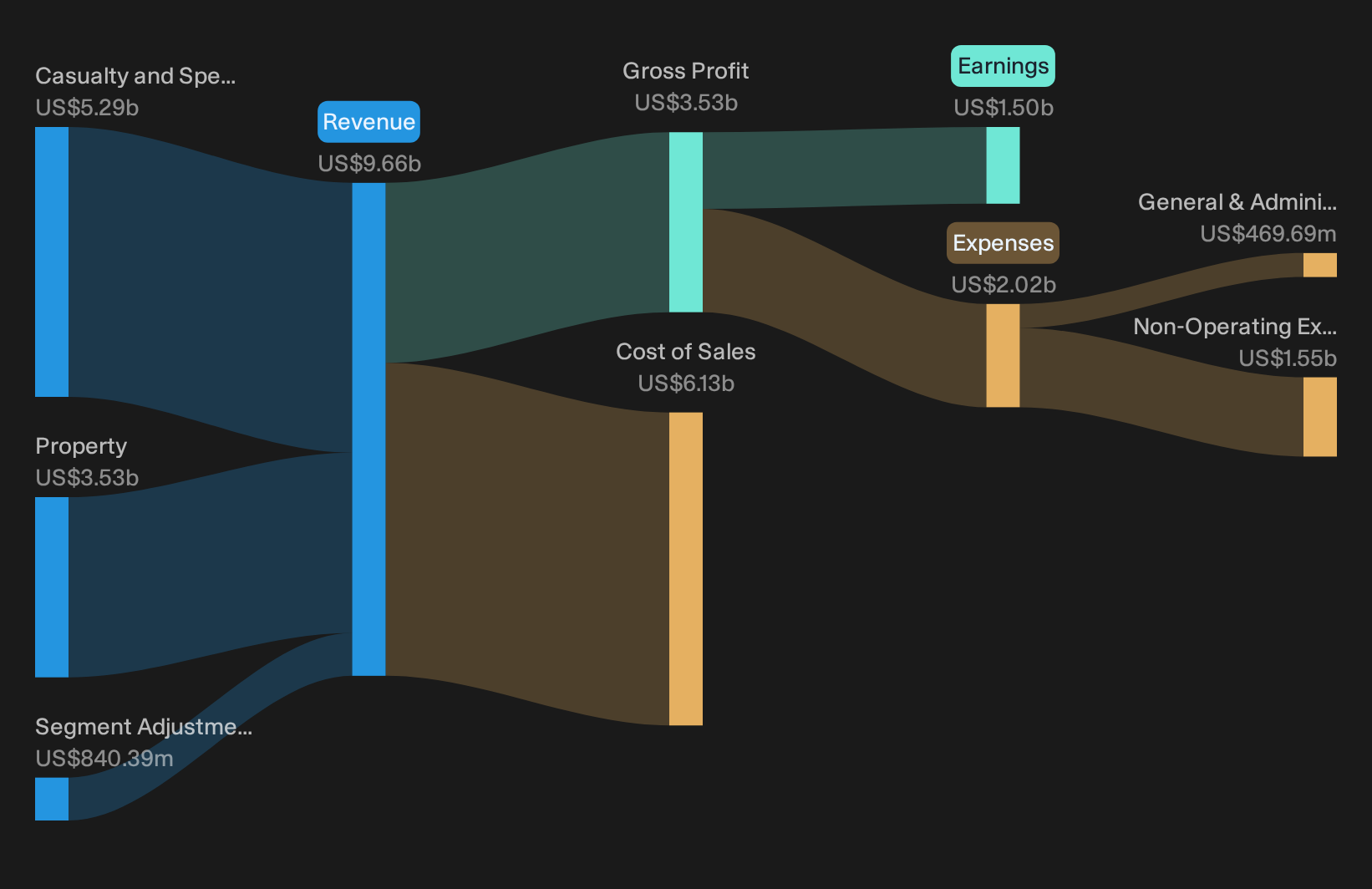
RenaissanceRe Holdings generates about US$3.5b of revenue from Property and roughly US$5.3b from Casualty and Specialty reinsurance, reflecting a broad mix of catastrophe and corporate liability exposure, and is valued at around US$14.3b in the equity market.
"The growing scale of RenaissanceRe Holdings' property catastrophe book, with increased absolute risk and percentage of equity exposure to U.S. perils such as Florida, keeps the company exposed to the possibility that a cluster of severe natural catastrophes could still hit underwriting earnings, raise loss ratios, and compress net margins."
The key factor shaping the potential upside from here is how one less visible pressure around corporate liability pricing interacts with that existing catastrophe risk load.
That pricing tension is exactly why the full narrative for RenaissanceRe Holdings explains how RenaissanceRe Holdings could turn catastrophe volatility and liability demand into a very different earnings and valuation story.
Fairfax Financial Holdings (TSX:FFH)
Fairfax Financial Holdings brings a mix of global property and casualty cover, reinsurance and corporate specialty lines that naturally intersect with management and governance risk. This is why the analyst consensus Narrative on Simply Wall St focuses on how its capital deployment into financial institutions could reshape that insurance and investment balance.
"The planned acquisition of approximately 61% of IDBI Bank for about US$5.6b, together with the intended combination with Digit and IIFL Capital, may already be baked into Fairfax Financial Holdings’ valuation, since investors can see IDBI’s current profitability of roughly US$1b over the 12 months to June 2026 and strong balance sheet metrics. If earnings from these equity accounted holdings prove more volatile than the insurance operations, the mix shift away from traditional underwriting profit could introduce wider swings in reported earnings and reduce confidence in the durability of margins."
What matters next is how one still unresolved pressure on Fairfax Financial Holdings' balance between insurance profit and investment income shapes future pricing power.
Fairfax Financial Holdings runs a broad insurance and reinsurance platform with corporate and specialty liability exposure that fits the governance and securities claim theme. It generates about US$9.3b from North American insurers, US$17.3b from global insurers and reinsurers, US$4.7b from international insurers and reinsurers, plus US$8.4b from non insurance businesses, and is valued around CA$61.8b.
If that balance between insurance earnings and investment swings is what you care about, the full narrative for Fairfax Financial Holdings explains in more detail how Fairfax Financial Holdings could turn volatility into momentum.

Seeking Alternatives Before The Crowd
Fresh ideas move first. Breakout stories gain momentum while others are still caught looking at yesterday’s headlines. Scan these under the radar for now opportunities and act now.
- Hunt for income machines that aim to keep paying while others wobble by screening for 6 dividend fortresses built for staying power when volatility picks up.
- Spot early-stage potential where growth stories are still flying under most radars by scanning 19 high quality undiscovered gems that combine quality fundamentals with quieter share registers.
- Track the picks and shovels behind AI momentum by using 53 AI infrastructure stocks to zero in on platforms powering data centers, chips, and network scale.
Have feedback on this article? Concerned about the content? Get in touch with us directly. Alternatively, email editorial-team@simplywallst.com