


EN
Here's Why We're Wary Of Buying Qualisys Holding's (STO:QSYS) For Its Upcoming Dividend
Qualisys Holding AB (publ) (STO:QSYS) is about to trade ex-dividend in the next four days. The ex-dividend date is commonly two business days before the record date, which is the cut-off date for shareholders to be present on the company's books to be eligible for a dividend payment. The ex-dividend date is important as the process of settlement involves at least two full business days. So if you miss that date, you would not show up on the company's books on the record date. Meaning, you will need to purchase Qualisys Holding's shares before the 20th of November to receive the dividend, which will be paid on the 26th of November.
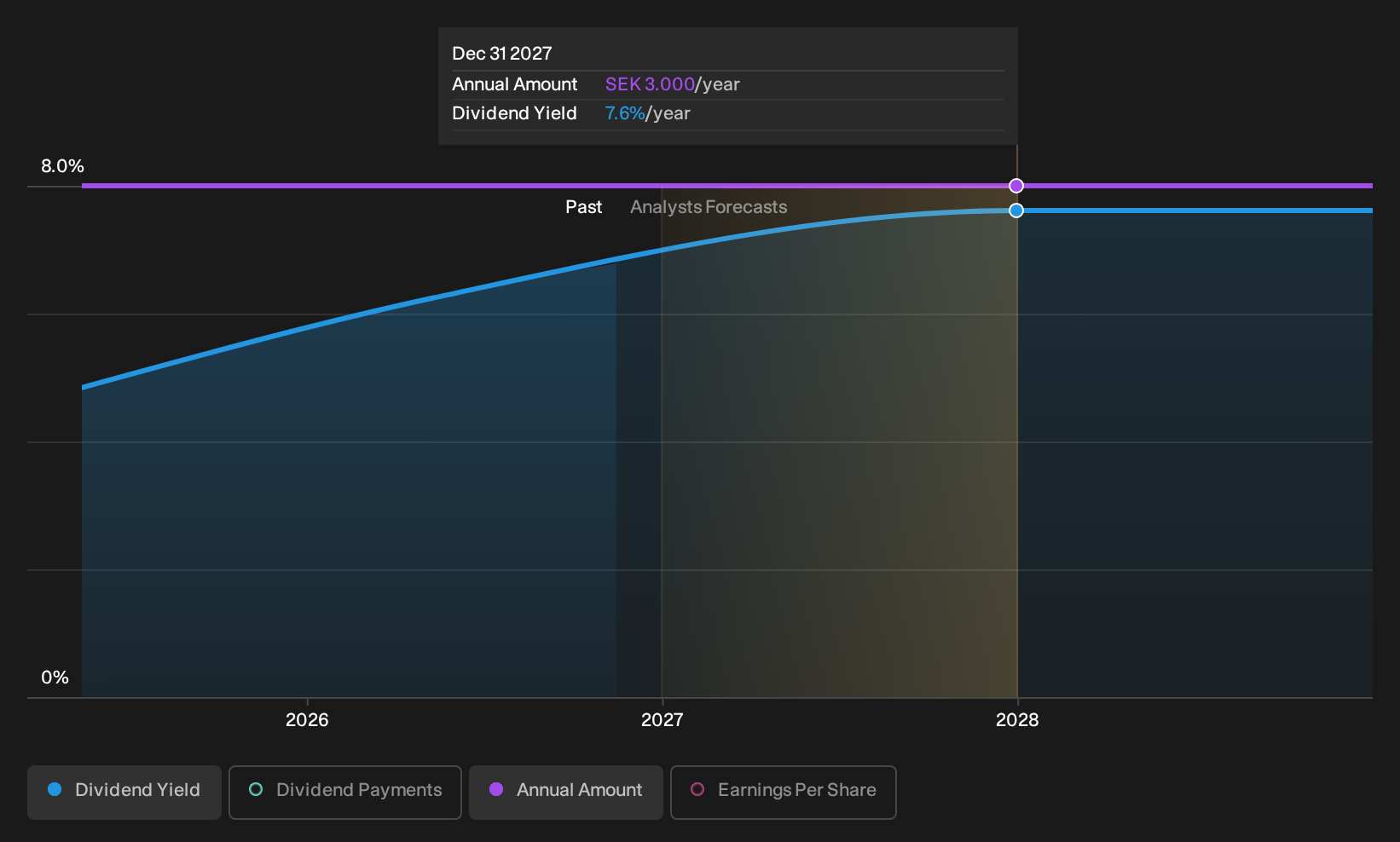
The company's next dividend payment will be kr01.50 per share, and in the last 12 months, the company paid a total of kr3.00 per share. Last year's total dividend payments show that Qualisys Holding has a trailing yield of 7.6% on the current share price of kr039.40. Dividends are a major contributor to investment returns for long term holders, but only if the dividend continues to be paid. So we need to check whether the dividend payments are covered, and if earnings are growing.
Dividends are typically paid from company earnings. If a company pays more in dividends than it earned in profit, then the dividend could be unsustainable. Last year, Qualisys Holding paid out 107% of its income as dividends, which is above a level that we're comfortable with, especially if the company needs to reinvest in its business. Yet cash flow is typically more important than profit for assessing dividend sustainability, so we should always check if the company generated enough cash to afford its dividend. Over the last year it paid out 62% of its free cash flow as dividends, within the usual range for most companies.
It's disappointing to see that the dividend was not covered by profits, but cash is more important from a dividend sustainability perspective, and Qualisys Holding fortunately did generate enough cash to fund its dividend. Still, if the company repeatedly paid a dividend greater than its profits, we'd be concerned. Very few companies are able to sustainably pay dividends larger than their reported earnings.
See our latest analysis for Qualisys Holding
Click here to see how much of its profit Qualisys Holding paid out over the last 12 months.
Have Earnings And Dividends Been Growing?
Companies with falling earnings are riskier for dividend shareholders. If earnings decline and the company is forced to cut its dividend, investors could watch the value of their investment go up in smoke. Qualisys Holding's earnings per share have fallen at approximately 15% a year over the previous five years. When earnings per share fall, the maximum amount of dividends that can be paid also falls.
Many investors will assess a company's dividend performance by evaluating how much the dividend payments have changed over time. It looks like the Qualisys Holding dividends are largely the same as they were two years ago. If a company's dividend stays flat while earnings are in decline, this is typically a sign that it is paying out a larger percentage of its earnings. This can become unsustainable if earnings fall far enough.
Final Takeaway
Is Qualisys Holding worth buying for its dividend? Earnings per share have been shrinking in recent times. Worse, Qualisys Holding's paying out a majority of its earnings and more than half its free cash flow. Positive cash flows are good news but it's not a good combination. Bottom line: Qualisys Holding has some unfortunate characteristics that we think could lead to sub-optimal outcomes for dividend investors.
Although, if you're still interested in Qualisys Holding and want to know more, you'll find it very useful to know what risks this stock faces. To help with this, we've discovered 3 warning signs for Qualisys Holding (1 doesn't sit too well with us!) that you ought to be aware of before buying the shares.
A common investing mistake is buying the first interesting stock you see. Here you can find a full list of high-yield dividend stocks.
Have feedback on this article? Concerned about the content? Get in touch with us directly. Alternatively, email editorial-team (at) simplywallst.com.