


EN
3 US Dividend Stocks That Could Hold Up Better As Producer Inflation Rises
Inflation is heating up again at the producer level, and that can quietly eat into profits long before consumers see higher prices. When PPI moves faster than CPI, some businesses get squeezed while others hold their ground or even gain an edge. This article walks through three dividend stocks exposed to this latest inflation shock, and explains how each one may contribute to a more resilient income portfolio.
The three dividend picks below are only a sample of what screens well when inflation pressure hits producers first. The broader filter actually surfaced 10 more large cap defensives with similar income stories that are not covered here.
If you want to go straight to the full list and focus on the ideas that best fit your goals, head into the US Defensive, Inflation-Resilient Dividend Stocks screener to identify, compare, and analyze the highest conviction opportunities.
Consolidated Water (CWCO)
Consolidated Water appears aligned with an inflation-focused income screen, with essential water and wastewater services that often feature contractual pricing and long-term customers. The analyst consensus Narrative on Simply Wall St outlines how that profile is evolving as the business expands in the U.S.
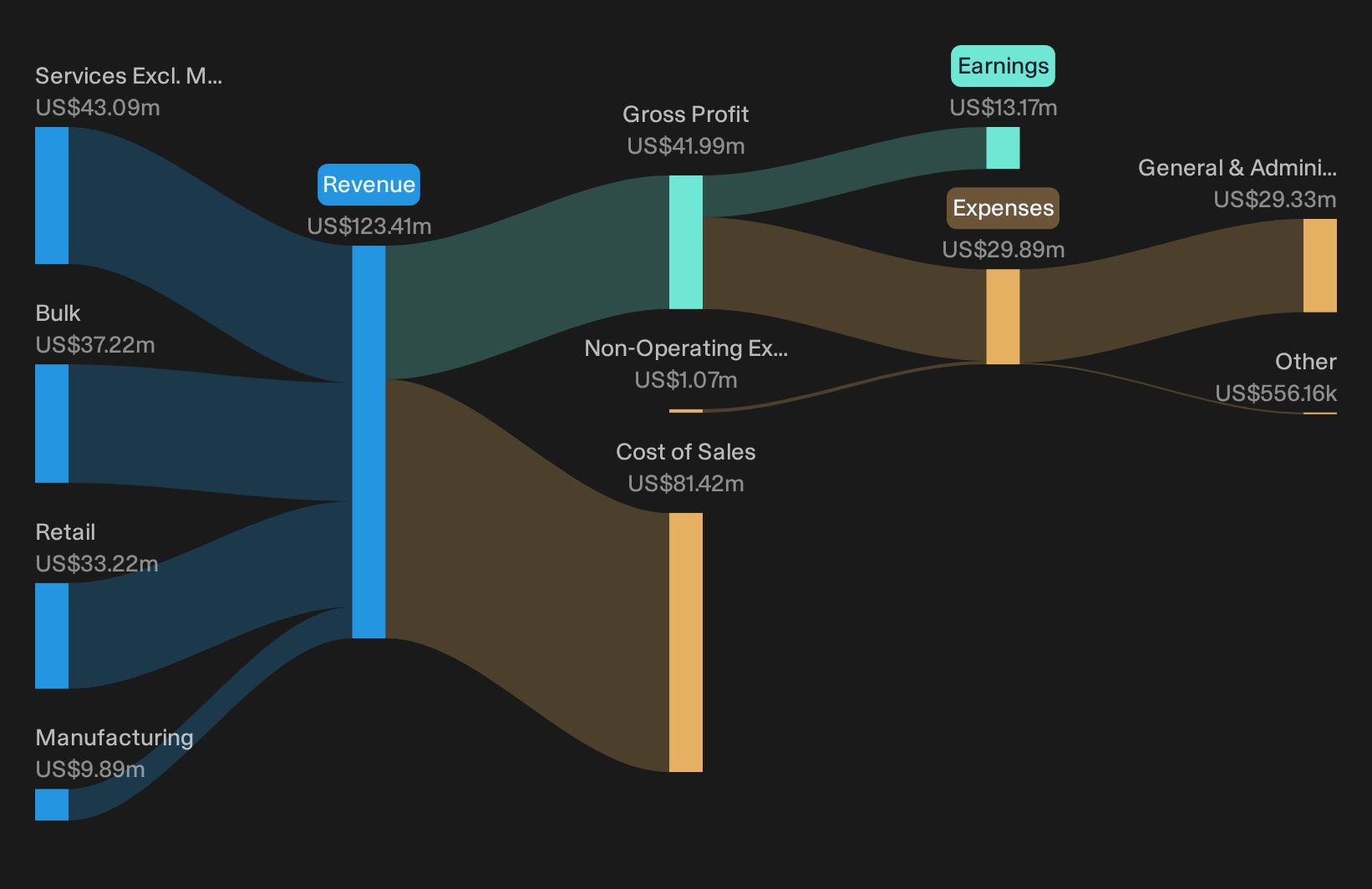
Consolidated Water operates a diversified water platform across retail, bulk, services and manufacturing, with about US$43 million from services, US$37 million from bulk, US$33 million from retail and US$10 million from manufacturing, and a market cap near US$399 million.
"Expansion of U.S. operations via new design-build contracts in Colorado and Arizona, combined with growth in recurring services/O&M contracts, diversifies geographic exposure and provides more stable and predictable cash flows, positively impacting earnings quality and reducing revenue volatility."
An important factor for Consolidated Water is how one unresolved pressure may affect future pricing power and the durability of those inflation-linked cash flows.
That pressure point sits at the heart of the full narrative for Consolidated Water, which lays out how Consolidated Water’s contracts, capital plans, and risks interact as producer inflation accelerates.
U.S. Physical Therapy (USPH)
U.S. Physical Therapy runs outpatient clinics and industrial injury prevention services that fit the screener’s defensive healthcare and dividend theme, generating about US$706 million from physical therapy operations and US$124 million from injury prevention services, with a market value around US$1.5b.
The appeal of U.S. Physical Therapy in this inflation-focused list comes from healthcare services that patients and employers often treat as essential. The analyst consensus Narrative on Simply Wall St links this to a potentially steadier backdrop for income-focused investors watching higher-for-longer rates.
"Operational technology rollouts such as semi virtual front desks, AI assisted documentation and remote therapeutic monitoring, which are already being deployed across the clinic base, are aimed at reducing front desk headcount, improving authorization capture and lifting clinician productivity, which directly targets net margin and earnings improvement."
What happens to that story will hinge on how one less visible cost pressure interacts with those efficiency gains over the next few years.
Those quieter cost pressures are exactly where the full narrative for U.S. Physical Therapy shows how U.S. Physical Therapy’s efficiency push could help separate its earnings power from producer inflation risk.

Stryker (SYK)
Stryker is a large medical technology group that fits the defensive, inflation resilient dividend theme by supplying essential equipment and implants to hospitals and surgeons. It generates about US$9.9b from Orthopaedics and US$16.4b from MedSurg and Neurotechnology, with a market value near US$118b.
Stryker’s role in critical procedures means its earnings profile often matters more to income focused investors when producer inflation jumps, and the analyst consensus Narrative on Simply Wall St highlights why robotics and higher acuity equipment have become central to that story.
"Expanding use of Stryker’s Mako platform, including record installations, broader procedure coverage such as shoulder and advanced hip or revision, and the rollout of Mako RPS for handheld knee robotics, supports a larger orthopedic addressable market and can lift revenue and associated service earnings over time."
What happens to that opportunity will depend heavily on how one pressure inside Stryker’s cost and capital spending plans feeds through to future margins.
That pressure on margins is exactly where the full narrative for Stryker shows how Stryker could keep earnings accelerating while producer costs and capital spending pull in different directions.

Seeking Alternatives Before Momentum Flies
Fresh ideas often move first, and the strongest themes can break out while many investors are still watching yesterday’s winners drop. Scan these curated lists, which may be under the radar for now, and consider them early.
- Look for underfollowed growth stories by running the 19 high quality undiscovered gems before attention increases and early entry points become less accessible.
- Monitor digital infrastructure trends with the 53 AI infrastructure stocks to stay informed about shifts in capital allocation within the next build out wave.
- Focus on income-oriented opportunities by using the 6 dividend fortresses while yields remain elevated and prices may not yet reflect the underlying cash flow profile.
Have feedback on this article? Concerned about the content? Get in touch with us directly. Alternatively, email editorial-team@simplywallst.com