


EN
Missed Viasat's 88% Gain? Here's What Investors Got Right
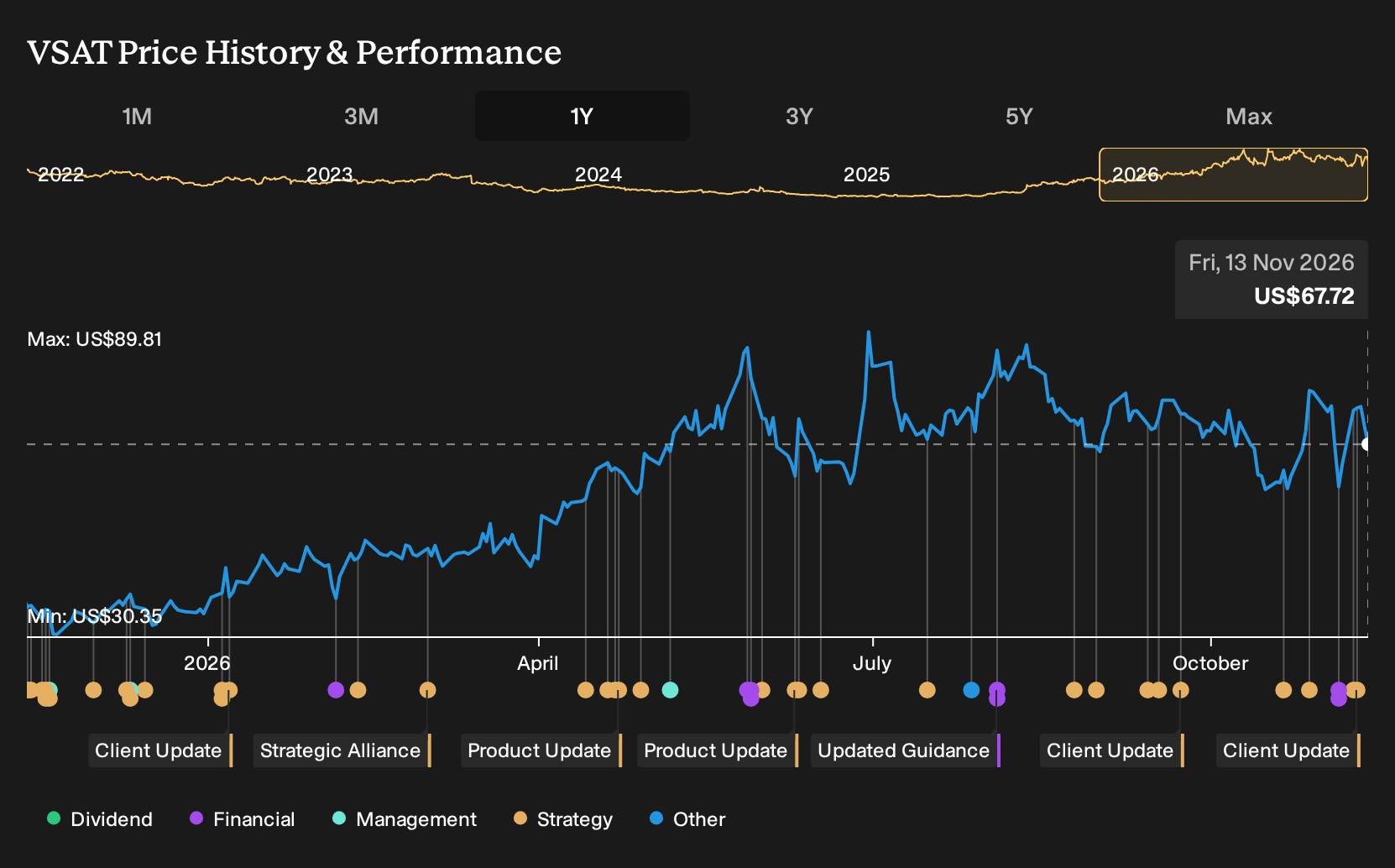
If Viasat sat on your watchlist instead of in your portfolio, the recent move probably caught your eye. For Viasat shareholders, the return over the past year was 87.8%, including dividends. That kind of gain invites a tougher question. Back on 13 November 2025, when analysts were split between a higher conviction US$50 case and a much lower US$24.29 view, what clues in Viasat’s expected satellite capacity and margin path could have helped you judge which story to lean toward?
Viasat has already moved. See which of 34 high quality undervalued stocks still trade below our estimates.
Two Competing Stories Around Viasat Back Then
The shares cost US$35.78 at the start of the period, and Viasat sat between two sharply different stories about what came next.
On the bullish side, one camp saw a Fair Value of US$50. This was a rough guide to what that upside scenario might justify, built on ViaSat-3 turning into a step change in satellite capacity and a pivot toward a shared infrastructure model.
The cautious camp worked off a Fair Value of US$24.29. This was again just the price implied by its own assumptions, focused on heavy capital needs, subscriber pressure, and the risk that low Earth orbit rivals would squeeze returns from existing spectrum and satellites.
What The Evidence Around Viasat Actually Tested
Viasat’s later US Space Force wins under the Protected Tactical SATCOM program and the creation of Equatys with a planned US$1b equity pool leaned toward the bullish story about shared infrastructure and high value government bandwidth. Reported numbers told a different side. Revenue reached US$1,179.996m in Q2 2027 while the firm still reported a loss of US$128.655m, and net margin moved to 10.9% below zero. The period cut both ways.
The hinge assumption was not headline contract size but whether capacity and partnerships turned into healthier profit. For any other stock built on a similar thesis, track the trend in net margin and absolute profit alongside contract announcements before treating capacity gains as evidence that the upbeat case is playing out.
What Viasat’s Run Already Prices In
Today Viasat trades at US$67.72 after an 87.8% gain over the past year. The bearish analyst Narrative on Simply Wall St sets its Fair Value below that quote, arguing the stock price already leans on a richer outlook than recent revenue and earnings trends.
That Narrative focuses on spectrum use, regulatory outcomes and capital intensity. Anyone buying at today’s level is effectively assuming new satellites, Equatys and spectrum disputes resolve in ways that keep cash generation and margins on a much stronger path than recent history.
"The current valuation implies the share price is reflecting stronger growth and earnings power than recent revenue expansion of 4.1% and a 3.2% yearly EPS decline over five years would support. This underpins a bearish view that Viasat may be overvalued."
The price and this Narrative do not agree. → Uncover what this Narrative says Viasat is actually worth
Looking Beyond Viasat’s Orbit
Viasat leans on satellites and bandwidth. Your phone and laptop lean on something different.
When people pay more for premium devices, they often expect richer services. That appetite for apps, media and payments keeps climbing across hardware cycles.
One giant ecosystem builder is trying to turn that demand into deeper services income. It ties subscriptions, payments, health tracking and entertainment directly into its hardware.
The interesting angle is how that approach spreads. As more daily life runs through those devices, the grip of that ecosystem on user spending can quietly change.
That argument has a Narrative and a number behind it. → See the company one Narrative values 19% above its price
Have feedback on this article? Concerned about the content? Get in touch with us directly. Alternatively, email editorial-team@simplywallst.com