


EN
What Weatherford International (WFRD)'s Subsurface Hydrogen Pilot Means For Shareholders
- Weatherford International reported two major moves: a successful Permian Basin field pilot with Eclipse Energy that produced subsurface hydrogen through biotechnology and captured it via existing gas infrastructure, and the completion of its redomestication from Ireland to Delaware, with an expectation of US$20 million to US$30 million in annual cash savings from 2027.
- The combination of commercial scale subsurface hydrogen proof of concept and long term corporate cost efficiencies positions Weatherford International to potentially align its technology led service mix and free cash flow focus with emerging low carbon demand and a leaner holding structure.
- We will now look at how Weatherford International's Delaware redomestication could influence the investment narrative built around cash generation.
Weatherford International Investment Narrative Recap
To be a shareholder in Weatherford International, you need to believe in a business that leans on higher margin, technology led services and consistent free cash flow, even when activity in some regions is choppy. The analyst consensus narrative on Simply Wall St focuses on that mix shift, plus balance sheet strength, as the core of the story. The recent subsurface hydrogen pilot adds an early stage option but does not change the main drivers.
The near term swing factor still appears tied to international and offshore spending translating into steady execution. Disruptions in the Middle East and the roll off of the Saudi LSTK contract remain key pressure points. Management’s history of cutting guidance heightens that risk, as confidence can move quickly if expectations reset again.
Among recent developments, the redomestication to Delaware is the one that most directly aligns with the current Weatherford International equity story. Management has guided to US$20 million to US$30 million of annual cash savings from 2027. This fits into a thesis that already leans heavily on free cash flow conversion and corporate efficiency.
Those savings sit alongside planned cost benefits from the NCS Multistage acquisition and portfolio pruning. For you as an investor, the question is whether execution on these levers can offset operational headwinds in the Middle East and the Saudi contract roll off, so that the higher margin mix and technology offerings still appear clearly in future earnings and cash generation.
Weatherford International Cash Generation Assumptions
Analysts are effectively tying Weatherford International's cash narrative to a fairly modest growth profile rather than a big volume surge. Consensus estimates point to revenue expanding by 3.8% a year over the next three years, while earnings today of US$366.0 million are projected to reach US$581.6 million by 2029. That implies an earnings increase of about US$215 million over the same timeframe, with the step up in profit margin from 7.7% to 10.9% doing a lot of the heavy lifting in that story.
Weatherford International's narrative projects US$5.3 billion revenue and US$581.6 million earnings by 2029. This rests on 3.8% yearly revenue growth and an earnings increase of about US$215 million from US$366.0 million today.
For an investor who cares about cash generation, the key question is not whether analysts land exactly on those 2029 numbers. The real issue is whether management can convert a higher margin mix, Delaware tax savings and NCS Multistage synergies into something close to that scale of earnings uplift without leaning on aggressive top line assumptions. Revenue growth in the low single digits, layered over a tighter cost base and a focus on higher quality work, frames a thesis where free cash flow resilience matters more than chasing every project.
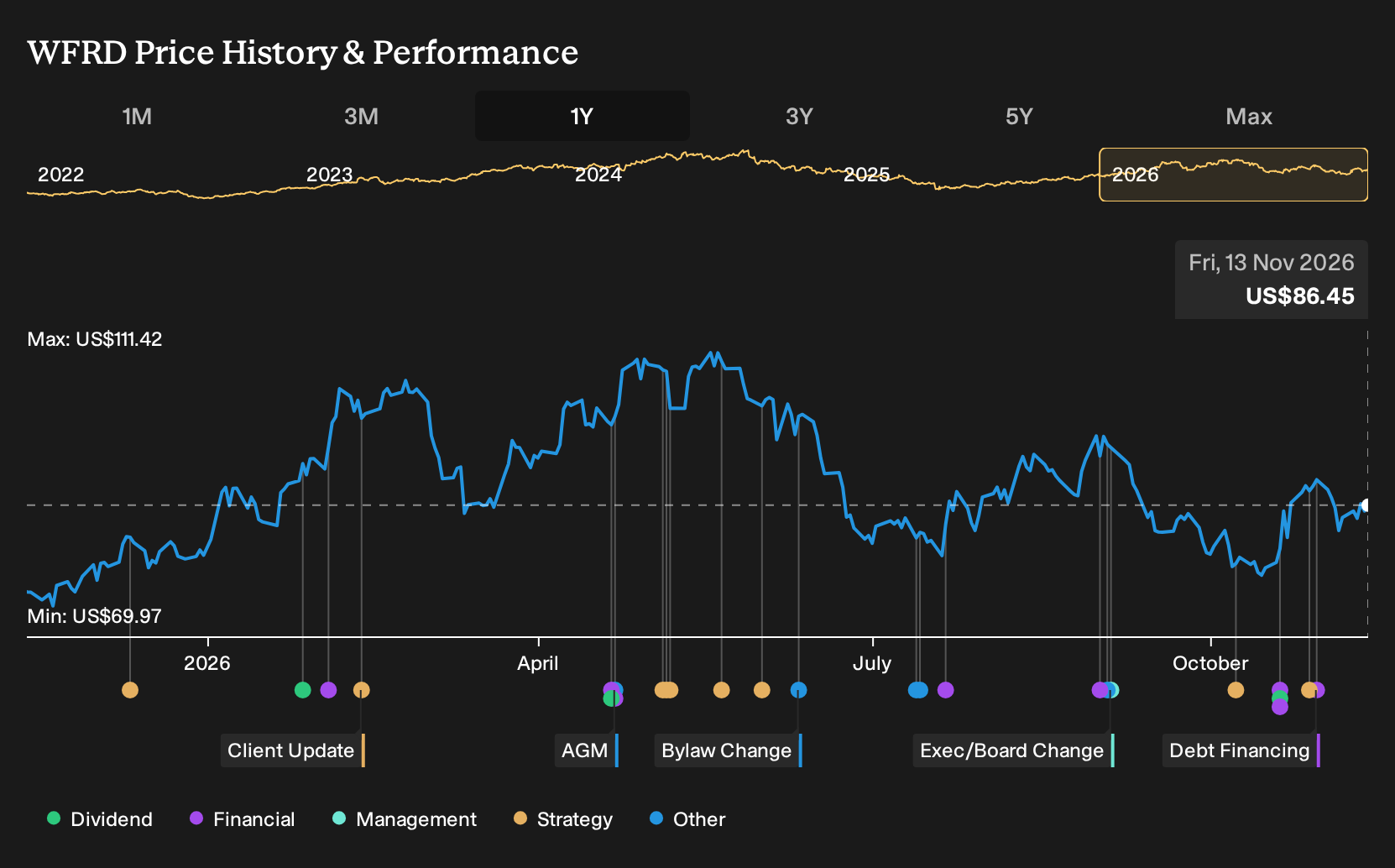
Uncover why Weatherford International's fair value indicates a 31% potential upside to its current price, before the discount to Weatherford International's story may shrink.
Exploring Other Perspectives
One alternate angle you might consider is the risk that Weatherford International’s move toward a more capital light, technology focused portfolio does less for long term revenue than bulls hope. The most cautious analysts were penciling in roughly US$5.3b of revenue and about US$607.8 million in earnings by 2029. Their story is more about lower P/E and slower re rating. Those estimates were all published before the subsurface hydrogen pilot and Delaware redomestication news, which leaves room for opinions to shift. Use that gap to compare several viewpoints and decide which future you find more convincing.
Explore 5 other Weatherford International fair value estimates, including one that suggests it could be worth just $93.00.
The Verdict Is Yours
Don't just follow the ticker. Dig into the data and build a conviction that's truly your own.
- A great starting point for your Weatherford International research is our analysis highlighting 4 key rewards that could impact your investment decision.
- See our latest analysis for Weatherford International. The report includes a comprehensive fundamental analysis summarized in a single visual, the Snowflake, making it easy to evaluate Weatherford International's overall financial health at a glance.
Looking for more investment ideas beyond Weatherford International?
If the Weatherford International story has sharpened your focus on cash generation, balance sheets and future optionality, you can use that same lens across a wider universe of companies with the Simply Wall St Screener.
- For investors hunting for value with quality to back it up, filter for resilient businesses through the 34 high quality undervalued stocks and see which tickers fit those criteria.
- If capital protection and steady compounding matter most to you, narrow the field to companies with stronger financial foundations using the 30 resilient stocks with low risk scores as a starting point.
- When you want to broaden your watchlist beyond the usual large caps, you can scan for less followed opportunities with solid fundamentals through the 19 high quality undiscovered gems and see what else deserves a closer look.
Have feedback on this article? Concerned about the content? Get in touch with us directly. Alternatively, email editorial-team@simplywallst.com