


EN
Vicor (VICR) AI Power Story Faces A Valuation Test Following A Sharp Pullback
Vicor (VICR) fell 6.4% in the latest session as part of a wider pullback in electronic component makers, putting fresh attention on how sector-wide sentiment is shaping the stock’s current valuation.
The recent slide comes after a sharp reset in Vicor’s share price over the past month, which fell 35.17% on a 30 day share price return basis. This is occurring even though the year to date share price return of 36.10% and the 1 year total shareholder return of 78.71% still point to longer term momentum that investors are now reassessing in light of sector wide volatility.
Scan how Vicor’s pullback compares to peers facing the same sector pressure by checking our hand picked list of 53 AI infrastructure stocks for context on other power and chip infrastructure plays.
Vicor’s slide can be interpreted in two ways. Either the market is re-pricing real questions about the power business, or sentiment has swung faster than the fundamentals. The valuation numbers now need to do the talking.
Most Popular Narrative: 60% Undervalued
Against Vicor’s last close at $159.05, the analyst consensus Narrative on Simply Wall St anchors fair value at $393.75, which frames the recent sell off as a move that widens the gap between price and that long term estimate.
The accelerated adoption of high power, high density AI computing in data centers is still a live driver, and Vicor’s second generation vertical power delivery reaching 3 amps per mm² for a lead customer with a target of over 5 amps per mm² by late 2026 or early 2027 supports the view that higher performance products can support future revenue and gross margin.
See why 39 investors see Vicor as 60% undervalued.
Result: Fair Value of $393.75 (UNDERVALUED)
Still, insider selling in 2026 and higher operating expenses tied to legal and licensing activity could pressure confidence in the Vicor narrative if these trends persist.
Find out about the key risks to this Vicor narrative.
Another View: Fair Value Tracker Puts Vicor Slightly Ahead Of Itself
There is a different read on Vicor when looking at the SWS DCF model. On this approach, the current share price of $159.05 sits just above the modelled future cash flow value of $157.32. This frames the stock as slightly overvalued rather than heavily discounted. That raises a simple question for investors: Which set of assumptions feels closer to reality?
For readers who want to see how the cash flow view is built line by line, Look into how the SWS DCF model arrives at its fair value..
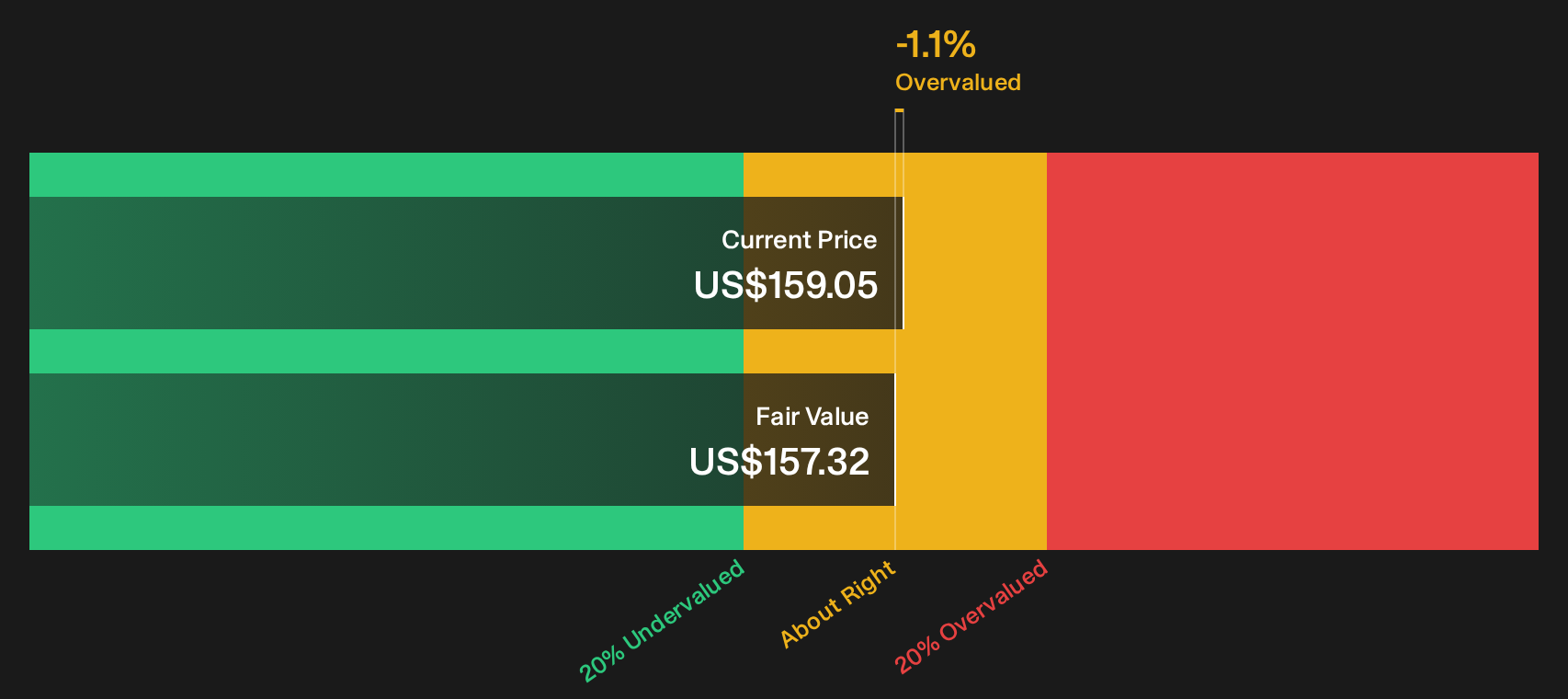
Simply Wall St performs a discounted cash flow (DCF) on every stock in the world every day (check out Vicor for example). We show the entire calculation in full. You can track the result in your watchlist or portfolio and be alerted when this changes, or use our stock screener to discover 32 high quality undervalued stocks. If you save a screener we even alert you when new companies match - so you never miss a potential opportunity.
Next Steps
Uncertain whether Vicor’s recent swing reflects temporary emotion or something deeper in the story? Move fast, get close to the numbers yourself, and then weigh both the potential upside and the downside starting with 3 key rewards and 3 important warning signs.
Looking for more investment ideas beyond Vicor?
If Vicor has sharpened your focus on valuation, do not stop here. Broaden your watchlist with other targeted ideas before the next move passes you by.
- Target potential mispricing by scanning a curated 32 high quality undervalued stocks that filters for companies with quality fundamentals at prices that may not fully reflect them yet.
- Build a steadier income stream by reviewing a focused 6 dividend fortresses that highlights businesses offering yields above 5% with an eye on resilience.
- Sleep easier through volatility by working through a 31 resilient stocks with low risk scores designed to spotlight companies with more durable balance sheets and lower risk profiles.
Have feedback on this article? Concerned about the content? Get in touch with us directly. Alternatively, email editorial-team@simplywallst.com