


EN
Unilever (LSE:ULVR) Has Investors Asking A Bigger Question
Unilever (LSE:ULVR) just raised its 2026 outlook after reporting firm sales and volume growth, and is coupling that guidance shift with a deeper portfolio refresh and operating restructure.
Investors have been leaning into this new Unilever playbook, with the share price up 3.3% over the past month and 8.7% over 90 days. The stock’s 5 year total shareholder return of 44.3% points to momentum that has been building rather than fading.
Scan for other consumer staples that could be lining up similar transformation stories by reviewing our hand picked 15 high quality undervalued stocks alongside Unilever.
The question now is whether Unilever’s re-rating mainly mirrors sturdier cash generation, or if enthusiasm around the 2026 plan and portfolio shake up is pulling the share price ahead of fundamentals.
Most Popular Narrative: 18% Overvalued
Unilever last closed at £49.88, while the leading narrative on Simply Wall St places fair value nearer £42.28, implying the share price is running ahead of that estimate based on an 8.35% discount rate.
According to Robbo, an investor in the Simply Wall St Community who wrote the narrative, the current restructuring and portfolio focus change how shareholders should think about the business and what they might be paying for.
Unilever (LSE:ULVR) is changing. It has plans to no longer simply be the mature consumer staples business it has been for decades. The plan is to demerge its food businesses, the creation of the Magnum Ice Cream Company already occurred. As such It is worth exploring what this means for the company and its case as an investment going forward.
See why 14 investors see Unilever as 18% overvalued.
That view sits alongside Simply Wall St’s own DCF output, which currently points to Unilever trading at around a 3% discount to an estimated future cash flow value of £51.40. The narrative fair value and the SWS DCF result therefore bracket the live price, with one framing the shares as meaningfully expensive and the other as only modestly cheap.
Both approaches rely on projected cash flows being discounted back to today. The narrative uses an explicit 8.35% discount rate along with assumptions about margins and growth durability, while the in house DCF model applies its own set of forecasts to reach the £51.40 figure.
For investors weighing Unilever’s 44.3% five year total shareholder return, 11.1% net margin and 3.29% dividend yield against its planned demerger and portfolio concentration, the spread between £42.28 and £51.40 is the valuation tension to focus on rather than any single point target.
Result: Fair Value of £42.28 (OVERVALUED)
Still, the demerger plan and heavier tilt toward Beauty & Wellbeing and Personal Care leave Unilever more exposed if execution slips or acquisitions misfire.
Find out about the key risks to this Unilever narrative.
Another View: Unilever Through The P/E Lens
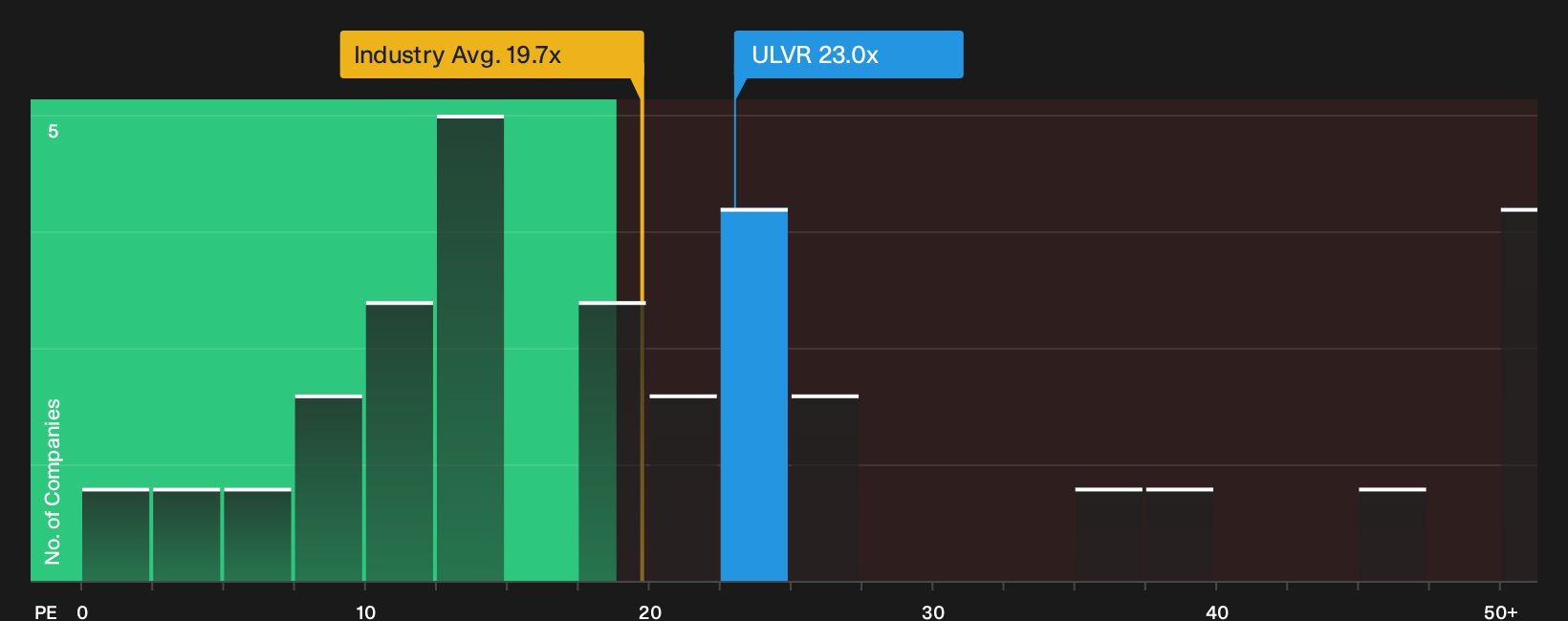
On a simple earnings multiple, Unilever looks punchy. The P/E sits around 23x, which is higher than both the European Personal Products group on 19.7x and the peer average on 18.6x. That gap means you are paying a clear premium compared with similar businesses.
The fair ratio for Unilever is estimated at 25.3x. That is above today’s 23x. This hints at some room for the market to move without the shares looking stretched against that benchmark. The open question is whether you view that gap as breathing space or as extra risk if sentiment cools.
For a closer look at how this earnings multiple fits into the wider picture, including peers and that fair ratio, See what the numbers say about this price — find out in our valuation breakdown.
Simply Wall St performs a discounted cash flow (DCF) on every stock in the world every day (check out Unilever for example). We show the entire calculation in full. You can track the result in your watchlist or portfolio and be alerted when this changes, or use our stock screener to discover 15 high quality undervalued stocks. If you save a screener we even alert you when new companies match - so you never miss a potential opportunity.
Next Steps
Mixed signals on Unilever’s valuation and outlook only get you so far, so move quickly from reading to checking the underlying numbers yourself, and weigh both sides of the story before relying on 4 key rewards and 2 important warning signs
Looking for more investment ideas beyond Unilever?
If Unilever has sharpened your focus on quality, do not stop here. Use the Simply Wall St screener to explore other opportunities that fit your style.
- Consider companies with resilient balance sheets and steady fundamentals by reviewing our list of solid balance sheet and fundamentals (9 results) that might suit a more cautious approach.
- Look for potentially mispriced quality by scanning the 15 high quality undervalued stocks that pair fundamentals with the possibility of upside.
- Identify income opportunities by checking out our 4 dividend fortresses that combine yield with underlying business strength.
Have feedback on this article? Concerned about the content? Get in touch with us directly. Alternatively, email editorial-team@simplywallst.com