


EN
3 UK Dividend Stocks For Reliable Income When Inflation Stays Sticky
Interest rate hikes, sticky inflation near 5% and pressure on household budgets are reshaping where reliable income might come from in the UK market. This mix creates both risk and potential opportunity, especially if you care about steady dividends rather than fast growth stories. This article walks through three UK defensive dividend stocks exposed to these macro shifts and explains how each could either help or hurt your portfolio income stream.
The stocks covered next are just a starter set, and the full screen pulled out 9 more UK defensive, non cyclical dividend companies with income stories that are not covered below but deserve a closer look alongside them.
If you want to identify, compare and analyze the highest conviction options before building your own shortlist, head straight to the UK Defensive, Non-Cyclical Dividend Stocks screener.
Living REIT (LSE:LIVE)
Overview: Living REIT is a UK real estate trust that owns residential supported housing, senior living and care homes, targeting stable, inflation-linked rental income.
Operations: Living REIT generates £40.6 million of revenue from UK residential REIT activities, with all of it coming from properties located in the United Kingdom.
Market Cap: £328.3 million
For an income-focused investor looking at defensive sectors, Living REIT links the screener’s steady dividend theme directly to essential UK housing, and the analyst consensus Narrative on Simply Wall St explains how this inflation-aware model might translate into tangible cash flows.
"Inflation-linked leases across the portfolio, which contributed to £20.2m of net rental income and a 2.2% rise in adjusted EPRA earnings per share to 3.4p in the period to 30 June 2026, create a pipeline for future rental uplifts that can feed through to revenue and earnings as rent reviews come through."
The key issue is how one unseen cost and funding pressure ultimately shapes the headroom between those rental uplifts and dividend cover.
That pressure on dividend headroom is exactly what the full narrative for Living REIT unpacks in detail, separating sustainable income potential from risks that might be masking underneath.

Telecom Plus (LSE:TEP)
Overview: Telecom Plus is a UK-based multi-utility group that bundles energy, telecoms and insurance services into recurring household bills for Utility Warehouse customers, giving it a direct fit with the screener’s focus on defensive, non cyclical dividend payers.
Operations: Telecom Plus generates about £1.9b of revenue from non regulated utility activities, with all of it coming from UK customers.
Market Cap: £697.4 million
Telecom Plus matters for this defensive dividend screen because household bills tend to be paid even when budgets are tight, and the analyst consensus Narrative on Simply Wall St states that management is actively trying to turn that resilient billing base into higher quality, multi service earnings.
"The plan to roughly double the partner network to around 150,000, and increase annually active partners from 20,000 to over 40,000, is designed to scale a relatively low cost, word of mouth acquisition channel that can support multiservice customer growth and potentially help margins."
What happens to Telecom Plus margins if one key assumption about how those new multi service customers behave under rising rates proves too optimistic?
If that assumption is wrong or right in a bigger way than expected, the full narrative for Telecom Plus shows how Telecom Plus economics could accelerate or stall surprisingly fast.

BT Group (LSE:BT.A)
Overview: BT Group is a UK telecoms operator that provides essential broadband, mobile, and fixed-line connectivity plus related services for households, businesses, and the public sector.
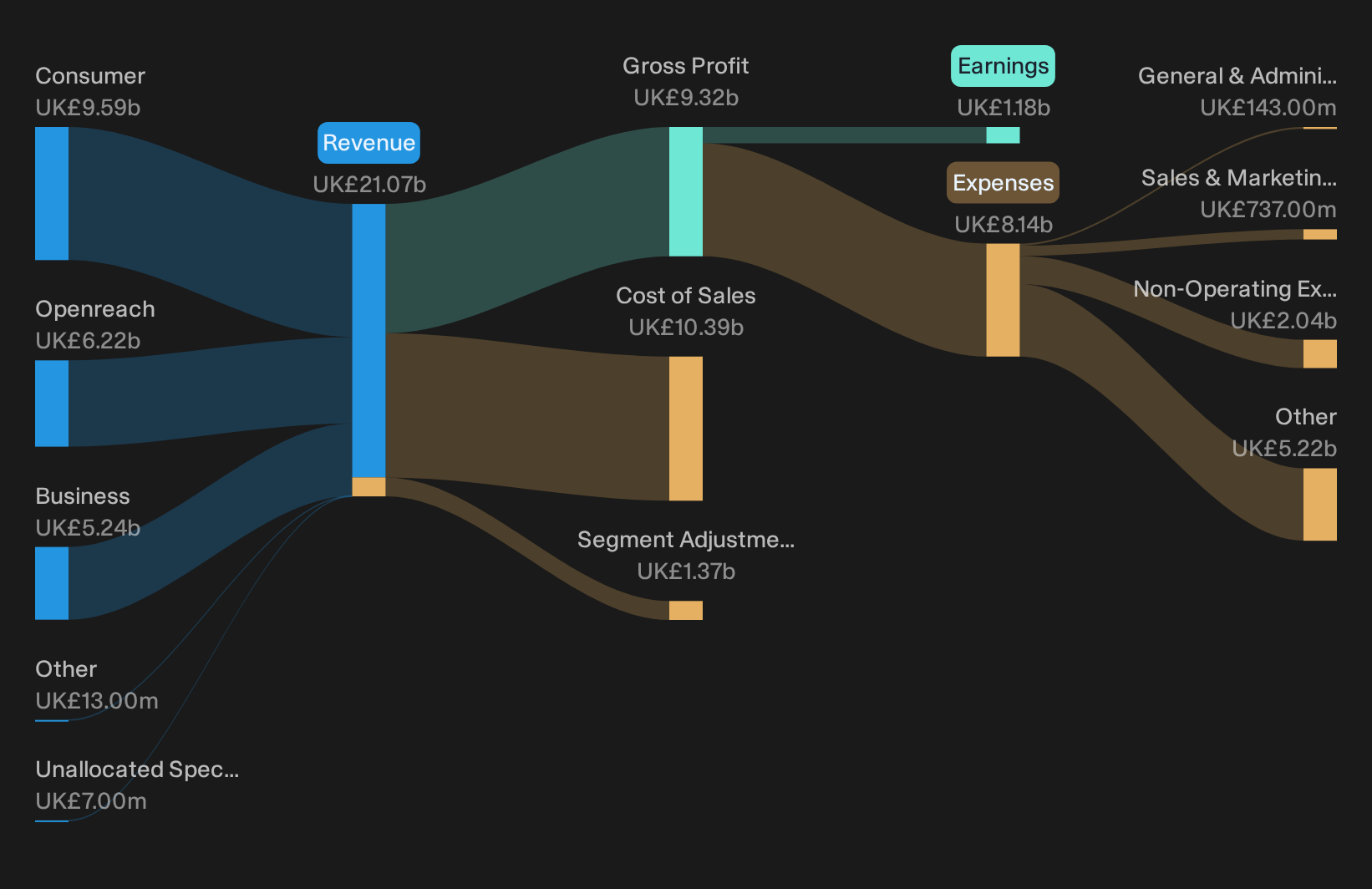
Operations: BT Group generates about £9.6b from Consumer, £6.2b from Openreach and £5.2b from Business activities, with smaller other adjustments.
Market Cap: £21.3b
BT Group plugs directly into this defensive dividend theme because most households and employers treat connectivity as a must-pay utility. The bullish analyst Narrative on Simply Wall St argues that this essential role could be the backbone for more flexible income than many investors currently assume.
"Carving out BT Group International from July 2025 and completing five disposals by the FY26 year end creates room for the remaining secure connectivity business to shift from a drag to a contributor to group EBITDA and free cash flow, as lower complexity supports higher margin contracts with multinationals."
What happens to BT Group’s income appeal if one quiet shift in how that future cash flow gets shared between debt holders and shareholders goes differently than expected?
If that trade off between BT Group’s debt and dividends is what you care about, the full narrative for BT Group lays out how the income story could be quietly accelerating.
Seeking Fresh Alternatives Beyond Dividends?
Markets move fast and the best breakout ideas rarely stay under the radar for long. Scan fresh momentum, before the crowd, while it matters, and get in early.
- Chase high cash returns with disciplined risk management by scanning a curated 15 high quality undervalued stocks that filters for quality balance sheets and meaningful free cash generation.
- Spot tomorrow’s automation leaders before enthusiasm goes flying through valuations by reviewing a focused group of 86 robotics and automation stocks built around real commercial traction.
- Target resilient compounding potential while others stay caught on headlines by running through a hand-picked 5 resilient stocks with low risk scores designed to prioritise financial strength and consistency.
Have feedback on this article? Concerned about the content? Get in touch with us directly. Alternatively, email editorial-team@simplywallst.com